Chapter 7: Thermochemistry
No description yet. This curated deck is ready for daily study.
Card preview (24)
What is the first law of thermodynamics?
∆U = Q - W U = change in internal energy Q = heat added W = work done
____________ processes occur when the system’s temperature is constant.
isothermal
When U is constant, change in U is 0 and the first law simplifies to what?
Q = W heat added equals work done by system
____________ processes occur when no heat is exchanged between the system and the environment. The thermal energy of the system is constant.
adiabatic
In adiabatic processes, Q = 0 and the first law simplifies to what?
∆U = -W change in internal energy of system = work done on the system
____________ processes occur when the pressure of the system is constant. Does not alter first law.
isobaric
________________ processes experience no change in volume. No work is performed, so first law is:
isovolumetric; ∆U = Q
What is a common method for supplying energy for nonspontaneous reactions?
Coupling nonspontaneous reactions to spontaneous ones
What are the state functions? When I’m under pressure and feeling dense, all I want to do is w When I’m under pressure and feeling dense, all I want to do is watch TVand get HUGS
Pressure, density, temperature, volume, enthalpy, internal energy, Gibbs free energy, entropy
State functions describe what?
The system in equilibrium state
Standard conditions have been defined for measuring enthalpy, entropy, and Gibbs free energy. What are they?
25°C 1 atm pressure 1 M concentrations used for kinetics, eq, and thermodynamics
Liquid to gase phase is known as ________________
evaporation, or vaporization
When liquid loses a high-energy particle, the temperature of the remaining liquid ____________.
decreases
Boiling can only occur ________ the boiling point of a liquid and involves vaporization through the entire volume of the liquid.
above
Gas back to liquid is ____________
condensation
The temperature at which the vapor pressure of the liquid equals the ambient pressure is called the ____________ point.
boiling
Transition from solid to liquid is ________
fusion, or melting
Liquid to slid is ____________
solidification, crystallization, or freezing
Solid to gas is ____________
sublimation
Gas to solid is ____________
deposition
The ____________ point is the temperature and pressure above which there is no distinction between the phases. This is where the phase boundary between gas and liquid terminate.
critical
Something above the critical point is called a ________________ fluid.
supercritical
Draw a phase diagram and label
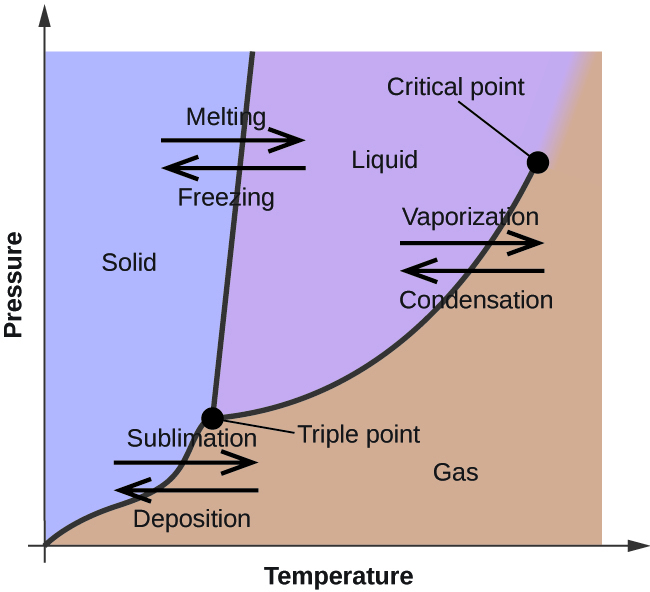
The heat of vaporization at the critical point and for all temps and pressures above this point is ________.
zero