Luting Agents
No description yet. This curated deck is ready for daily study.
Card preview (21)
What are some typical properties desirable of a luting agent?
Low viscosity to allow seating of restoration Easy to mix, long working time, short setting time Marginal seal with ideally chemical bond to tooth Good aesthetics - tooth coloured, and no staining Low solubility Cariostatic and fluoride releasing to prevent secondary caries at crown margins Biocompatible so it is non toxic and wont damage the pulp Low thermal conductivity High mechanical properties e.g. CS, TS, Hardness
What are some examples of luting agents?
Dental cement - zinc phosphate GIC - conventional or RMGI Composite resin luting agents - etch and DBA
How do zinc phosphate cements work?
Acid base reaction of powder + liquid Powder - zinc oxide - magnesium dioxide - to give white colour - alumina and silica - mechanical properties Liquid - aqueous phosphoric acid - aluminium and zinc oxides - even setting and slows setting
Good things about zinc phosphate cements?
Cheap Easy to mix and use Strong Low porosity and solubility
Problems with zinc phosphate?
Low initial pH of 2 - pulpal irritation Exothermic setting Not adhesive to tooth or restoration, works like tile grout Not cariostatic Opaque and brittle
What is and Pros of zinc polycarboxylate cement?
Similar to zinc phosphate except polyacrylic acid instead of phosphoric Bonds to tooth similar to gic Less exothermic Returns to neutral pH faster Cheap
How does GIC bond to the tooth surface? What about restoration?
Ion exchange with calcium in enamel and dentine Hydrogen bonding with the collagen in dentine Surface of restoration should be sandblasted to allow mechanical adhesion
Pros of GIC’s?
Low shrinkage Long term stability Relatively insoluble once set Better aesthetics than ZnPhos Adhesive to tooth surface And metal Fluoride release Cheap
Cons of zinc polycarboxylate cement
Hard to mix Hard to manipulate Soluble at lower pH Low compressive strength and modulus
How does incorporating resin into GIC improve material properties?
It decreases setting time Longer working time Higher compressive and tensile strengths due to filler Higher bond strength to tooth Decreased solubility
Issues with RMGI for luting?
HEMA hydrophilic molecule is cytotoxic HEMA swells in a wet environ meant No bond to direct restoration • basically good moisture control is needed, and all monomer needs to be set
What is a typical composite luting agent? Any pros??
Variant of composite filling material with smaller filler particles and lower viscosity Light or dual cure Better physical properties, lower solubility and better aesthetics
How do resin luting agents bond?
Composite bonds to composite Bond is micro mechanical to rough internal surface of inlay Also bond is chemical to remaining C=C bonds on the fitting surface of inlay Use a dual cure for inlay as light penetration will be poor
How does one bond to porcelain?
Through a wetting agent as the surface is not compatible with resin luting agents It needs to chemically bond as porcelain is brittle and will fracture if not
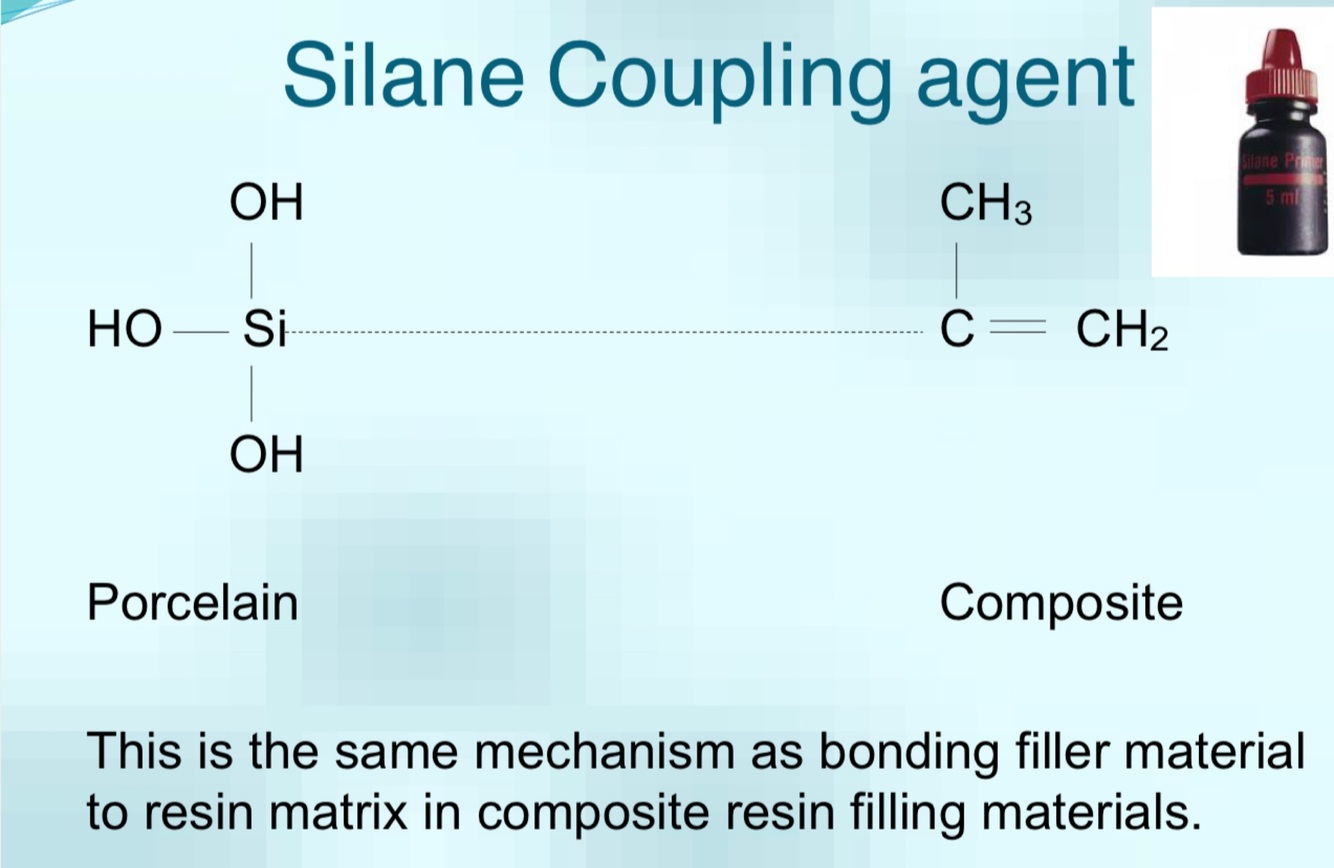
What is a silane coupling agent? How used? When?
Used when bonding to porcelain Applied to etched porcelain surface Forms strong bond between oxide groups on the porcelain and the silane Other end has C=C bond which reacts with composite resin
How can metal be bonded to composite?
Metal needs to be roughened either by etching or sandblasting Not used much now Material like MDP with acid end and C=C end. Acid end reacts with metals oxide and renders surface hydrophobic Must use dual cure resin as light can’t penetrate metal
How might you bond to precious metal?
Change to an alloy that produces an oxide layer
What is a self adhesive composite resin? Give example
Panavia Metal coupling agent incorporated into the resin to simplify bonding
What material use for MCC?
GIC or RMGIC
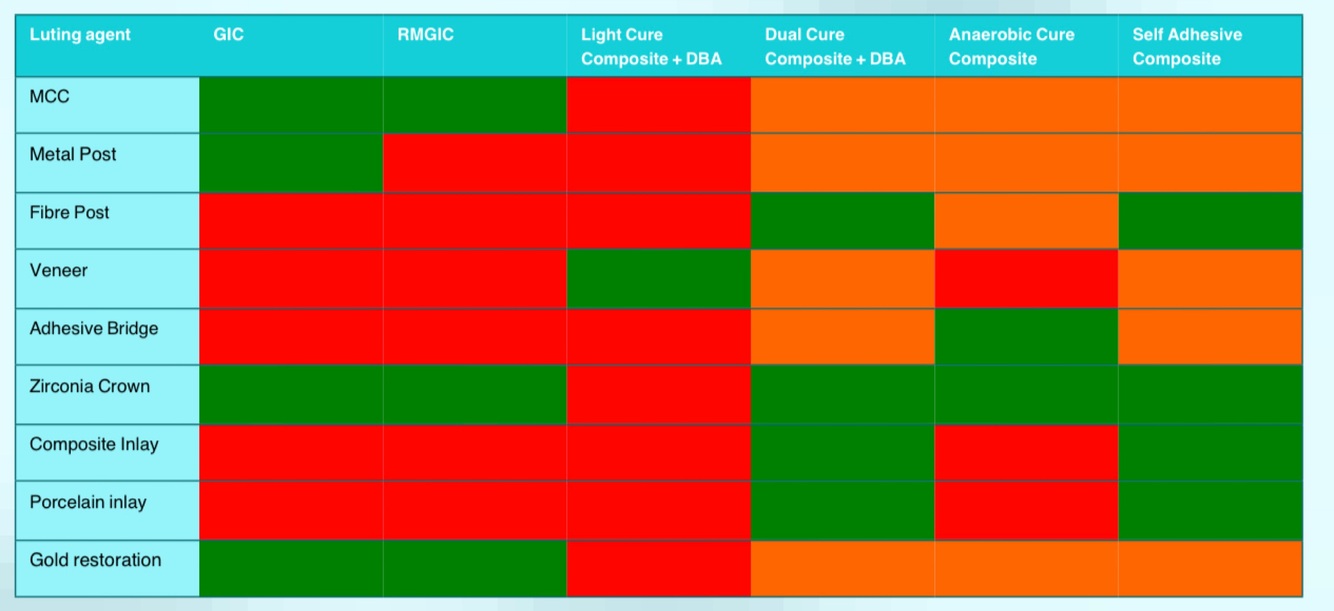
What to use for metal post?
GIC
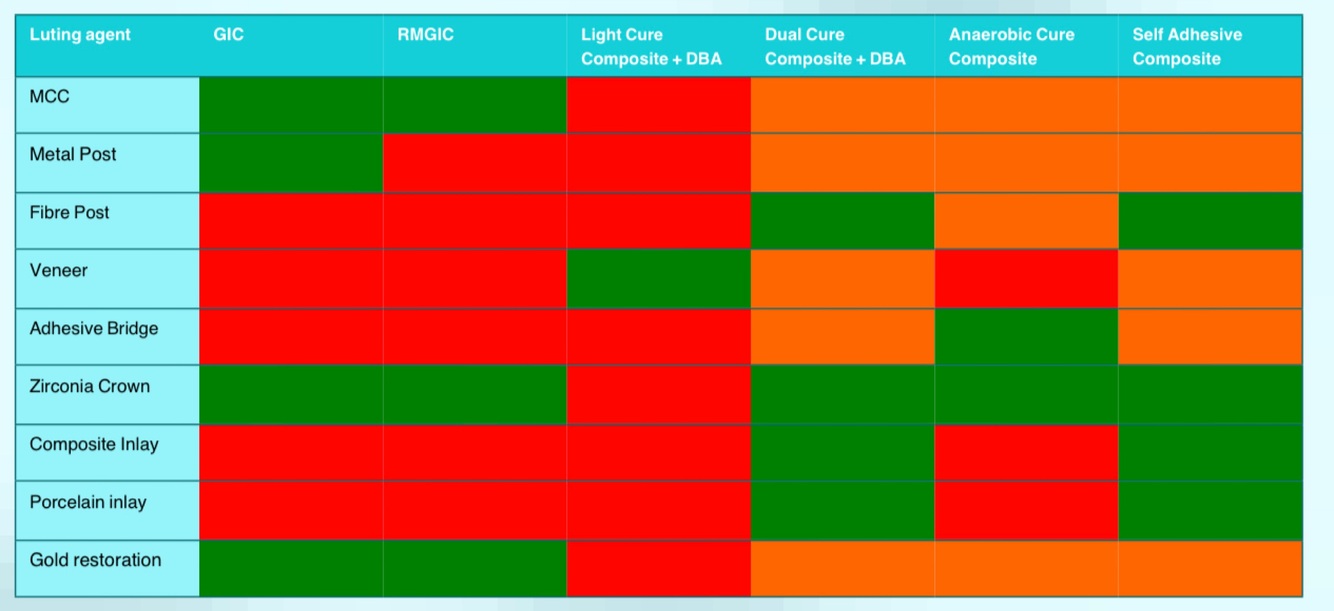
How does GIC bond to metal?
Acid base The carboxylic acid group on the GIC reacts with the metal oxide on the metal. This forms waster and a salt. The salt then reacts with the carboxylic acid to form a chemical bond to the metal surface.