Opioid Analgesics
No description yet. This curated deck is ready for daily study.
Card preview (24)
What is the difference between nociceptive and neuropathic pain?
• Nociceptive pain - tissue damage • Neuropathic pain - brain/nerve damage
List some major analgesic drugs
• Opioids • NSAIDS • Tricyclic antidepressents • Anti-convulsants (Na+ channel blockers) • Ca2+ channel blockers • Cannabinoids
What is the difference between opiates and opioids?
• Opiates - come from a poppy (sleep producing), eg. morphine, codeine • Opioids - endogenous/synthetic compounds produce morphine-like effects
What are endogenous opioids, examples?
Produced by the body itself eg. endorphin, enkephalin
Name some opioid drugs
• Morphine • Diamorphine • Codeine • Methadone
What specific class of receptors do opioids act at?
G-protein-couples receptors, all linked to Gi/Go - this means it leads to a decrease of Adenylate Cyclase activity, so less PKA.
What are the 3 major subtypes of opioid receptors?
• MOP (µ) (mu) • DOP (δ) (delta) • KOP (κ) (kappa)
Which subtype receptor is often associated with actions of morphine and is most prominently linked to analgesia?
MOP (mu)
Where are opioid receptors found, in reference to the pain pathway? What does opioid receptor stimulation lead to in each of these?
• Periphery -> less signal to dorsal horn • Dorsal horn -> less ascending signals (to thalamus) • Periaqueductal grey matter -> MORE descending signals All reduce pain coming through spinal cord
*RECAP* What happens at any synapse when reached by an action potential?
• AP arrives, depolarisation • VGCC open, Ca2+ influx • Rise in Ca2+ triggers NT vesicle release • NT binds to post-synaptic membrane • -> post-synaptic firing! woo
There are mu (μ) receptors present on the nociceptive fibre pre-synaptic mebmrane and on the post-synaptic dorsal horn neurone membrane. What does stimulation of the opioid μ receptors lead to?
NOCICEPTIVE (presynaptic) • Stimulation of μ -> inhibits VGCCs -> decrease NT release • K+ efflux -> hyperpolarisation -> decrease neuronal firing -> decrease VGCCs -> decrease NT release DORSAL HORN (postsynaptic) • K+ efflux -> hyperpolarisation -> decrease neuronal firing ALL of this in turn reduces nociceptive conduction
What’s the difference between the mechanism of action between NSAIDs and opioids?
Opioid analgesics relieve pain by acting directly on the central nervous system. NSAIDS act primarily in peripheral tissues to inhibit the formation of pain-producing substances such as prostaglandins. They are a milder form of painkillers.
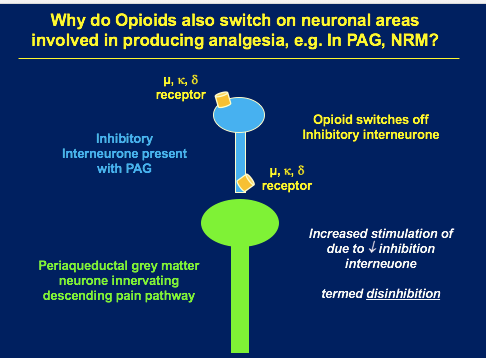
Opoids also act in periaqueductal grey interneurones by activating disinhibition leading to analgesia. How does this work?
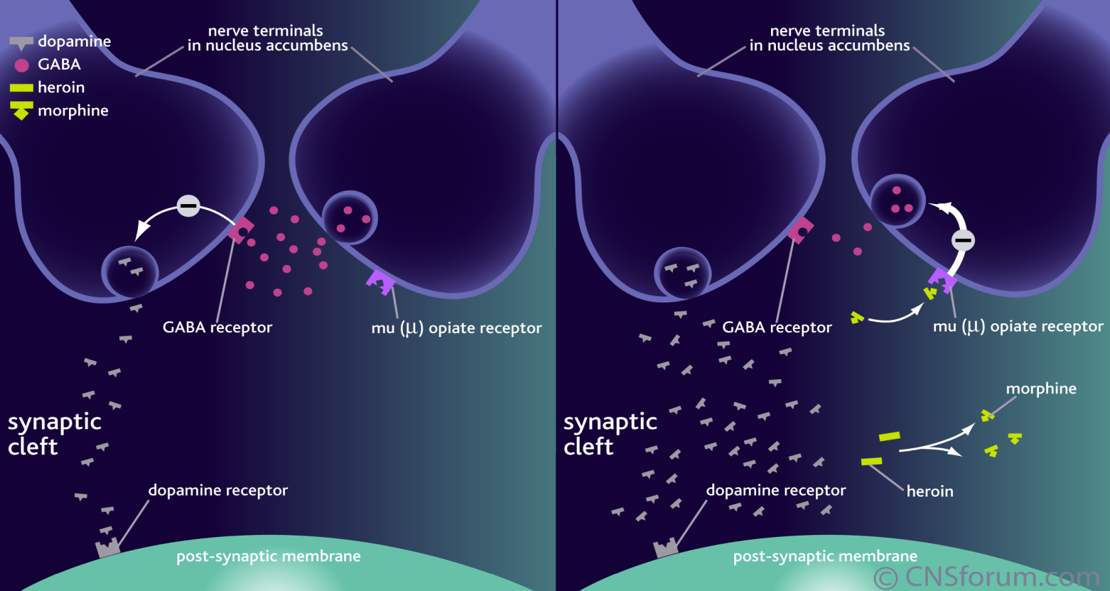
Opioids produce a powerful sense of ‘well being’ and euphoria, how does this happen?
Opioids increase domaine neurotransmission, caused by disinhibition of GABAnergic interneurones in reward areas
How do opioids result in respiratory depression?
Opioid receptors found in medullary regions involved in generating activity of respiration • > control drive to inspiration • > contain chemoreceptors to modulate said drive If opioid receptors stimulated, the chemoreceptors become less sensitive to PCO2 so not being able to respond properly to CO2 levels by changing resp rate.
How are opioids used for coughs?
They suppress cough reflex, eg. codeine binds to opioid receptors to switch off cough reflex
Why is morphine often given with anti-emetics, such as metoclopramide?
Opioids can trigger vomitting by stimulating chemoreceptor trigger zone in area postrema.
What effect do opioids have on pupils?
Stimulate oculomotor nerve and increase parasympathetic activity causing pupil constriction. Important for diagnosing opioid overdose
What actions does loperamide (an opioid) have in the GI tract?
• Increase GI tone -> can lead to constipation • Therefore used for diarrhoea • Doesn’t cross BBB • Reduce absorption of other drugs
Why should opioid use be avoided in asthmatics?
As opioids result in histamine release, lead to inflammatory-like response, local rendess, itching, if response goes systemic -> bronchoconstriction and hypotension!
Describe characteristics of codeine
• Least potent • Mild analgesia • Combined with NSAIDs
What is good about methadone?
• Oral delivery • Long half life -> only one hit • Prevents withdrawal symptoms • Full agonist
Why is diamorphine the drug of choice over morphine?
Pro-drug, has increased lipid solubility so get a ‘quicker hit’ from it.
Why do we give opioids via IV/IM and not orally?
As they have poor bioavailability