Spectroscopy CHP 12 - 13
No description yet. This curated deck is ready for daily study.
Card preview (24)
What are the spin state and quantum number of 13Carbon?
quantum number (I): 1/2 spin state: 2 (+1/2 and -1/2)
What are the spin state and quantum number of 1Hydrogen?
quantum number (I): 1/2 spin state: 2 (+1/2 and -1/2)
What are the spin state and quantum number of 2Hydrogen?
quantum number (I): 1 spin state: 3
In a magnetic field, different spin states have different energies. The difference in energy between the spin states is dependent on the magnitude of the applied magnetic field. How is the spin aligned in the higher (excited) energy state?
The spin is -1/2 aligned against the applied field in the excited state
In a magnetic field, different spin states have different energies. The difference in energy between the spin states is dependent on the magnitude of the applied magnetic field. How is the spin aligned in the lower (ground) energy state?
The spin is +1/2 aligned with the applied field in the ground state
Name this Spectra
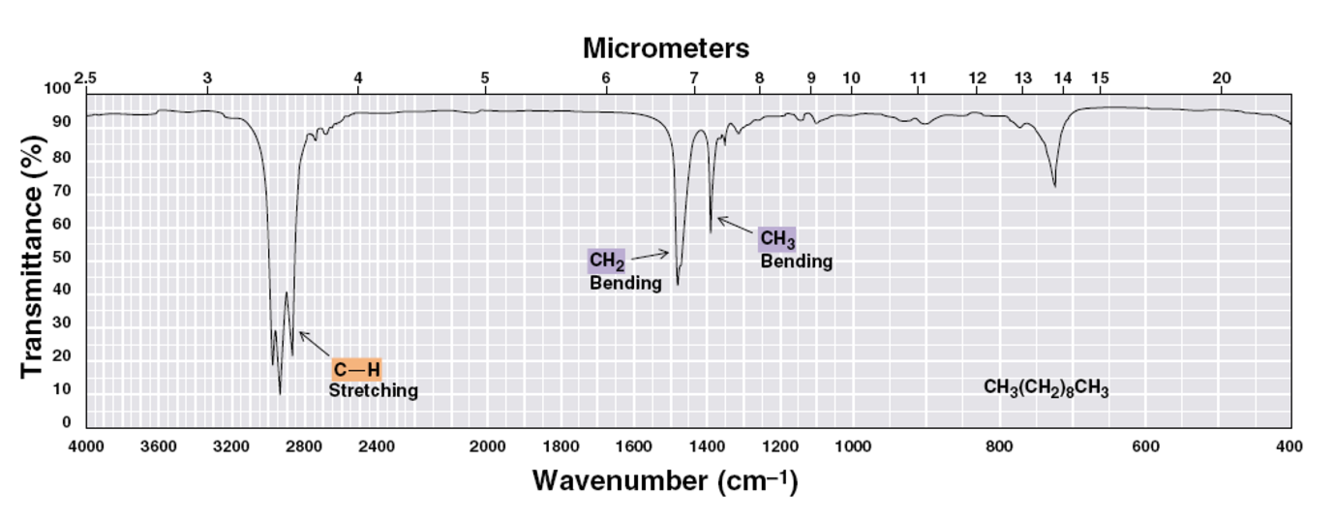
Alkane
Name this Spectra
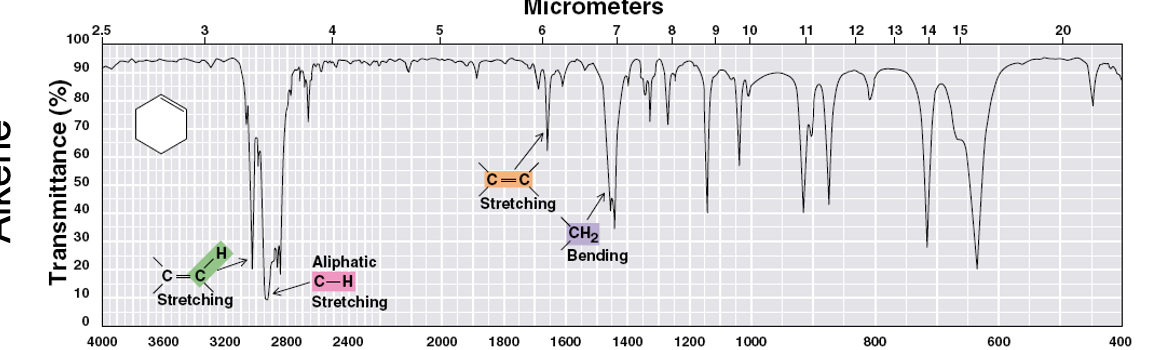
Alkene
Name this Spectra
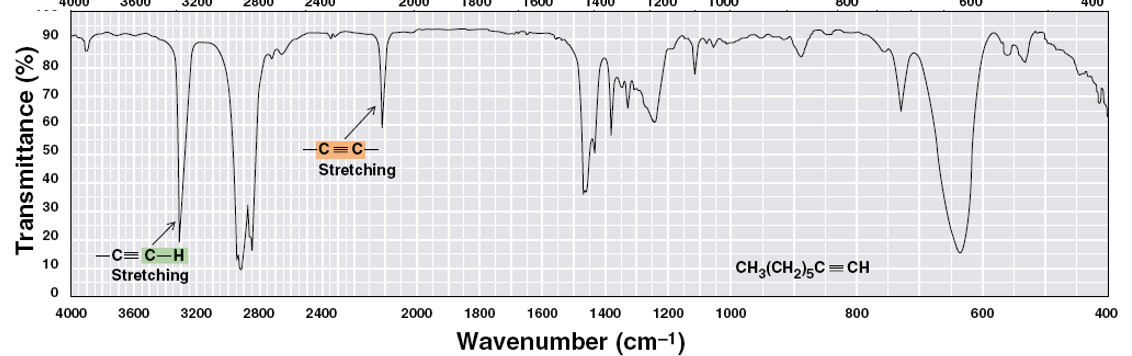
Alkyne
Name this Spectra
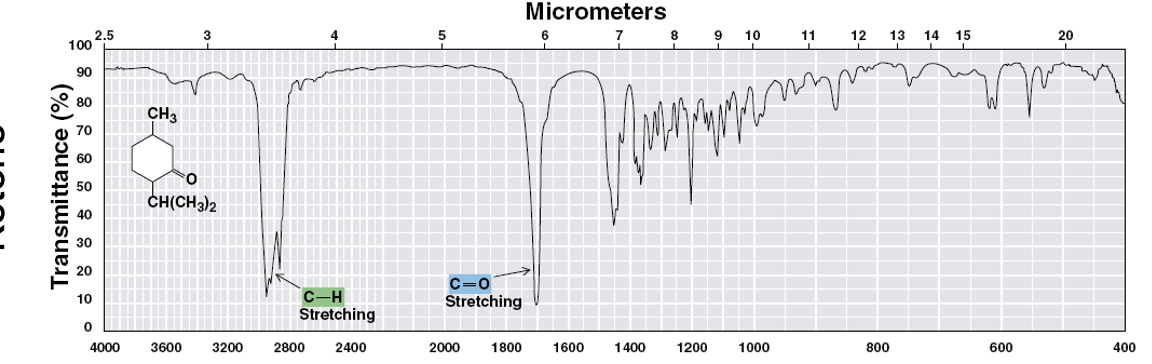
Ketone; part of the Carbonyl family
Name this Spectra
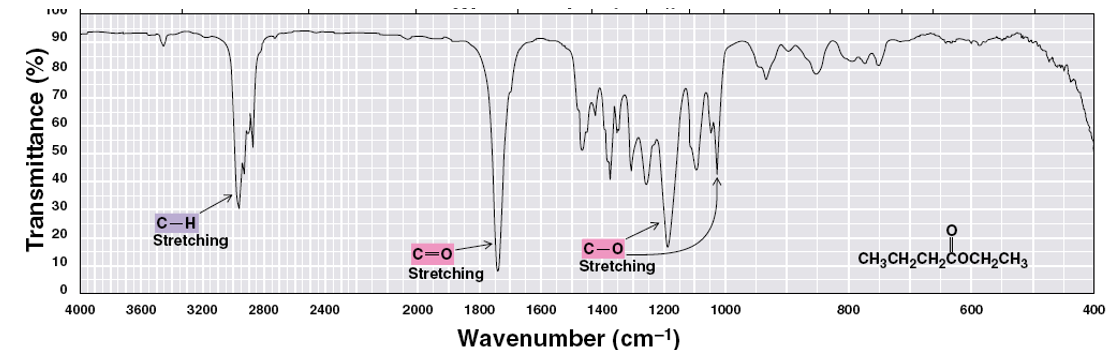
Ester; part of the Carbonyl family
Name this Spectra
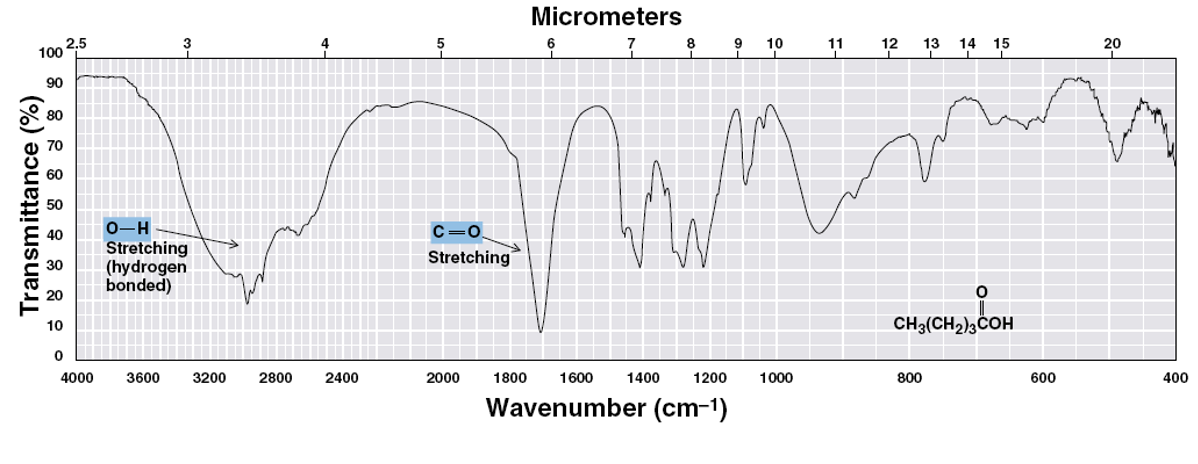
Carboxylic Acid
On a spectrum, where are Aldehydes, ketones, esters, acids, and amides found?
Zone 4. Check for signals near 1700 cm-1
On a spectrum, where are OH, NH, and NH2 found?
Zone 1. Check for signals near 3400 cm-1
On a spectrum, where are alkanes, alkenes, and alkynes found?
Zone 2. Check for signals near 3000 cm-1. Sp2 to the left and Sp3 to the right
On a spectrum, where are Alkynes and cyano groups found?
Zone 3. Check for signals near 2200 cm-1.
On a spectrum, where are alkenes found?
Zone 5. Check for signals near 1600 cm-1
How many zones is the IR spectrum divided into?
Five zones
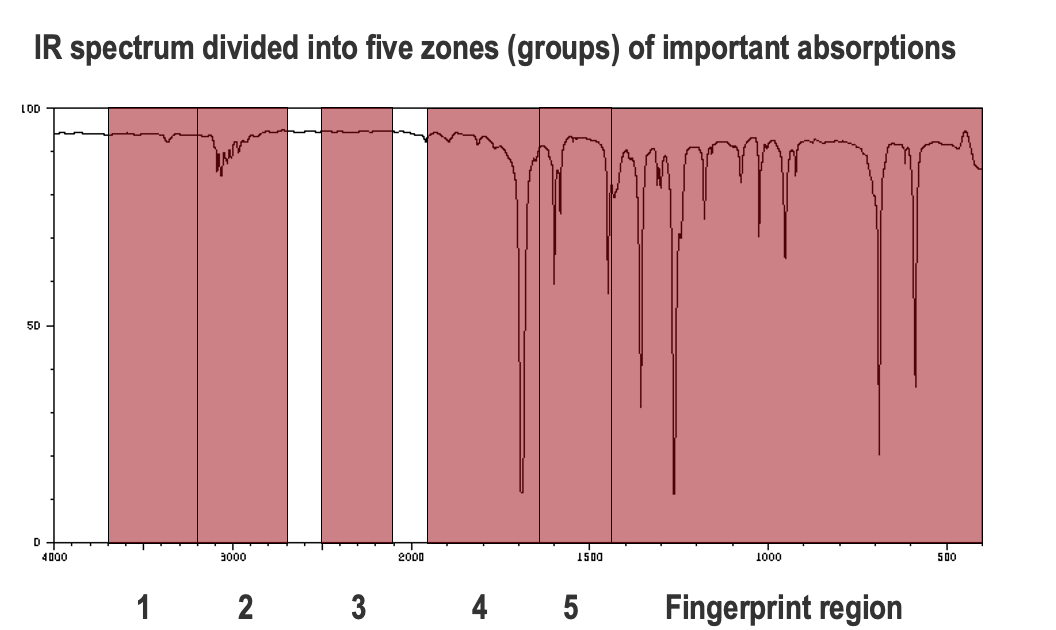
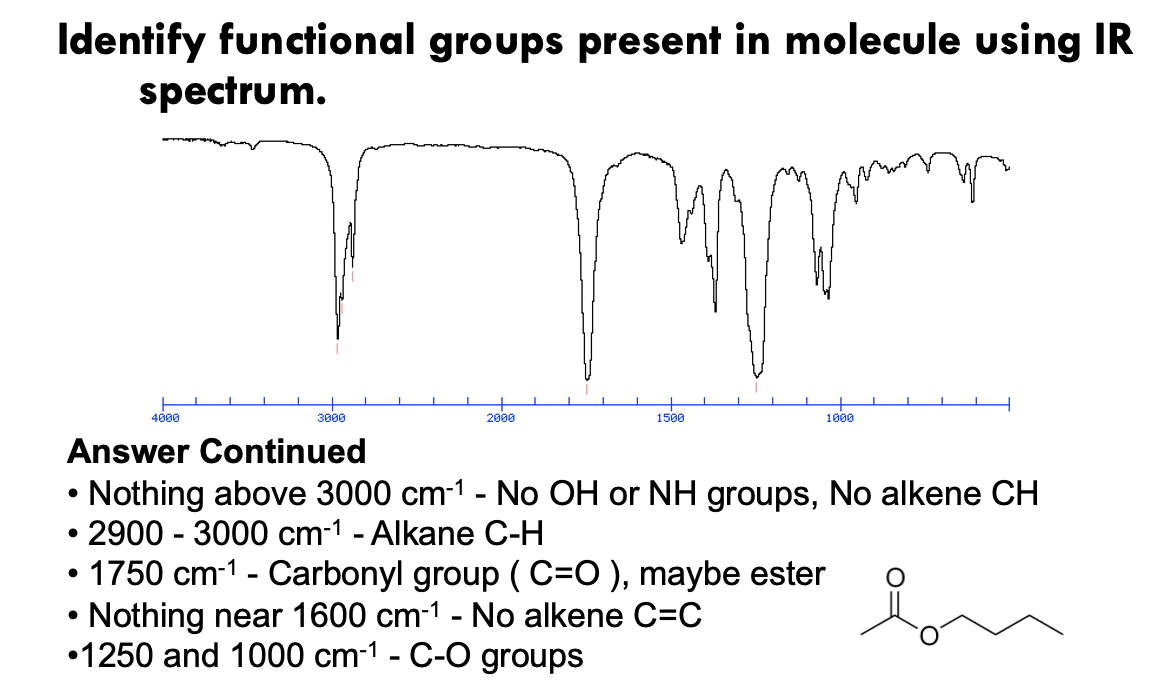
Identify functional groups present in molecule using IR spectrum.
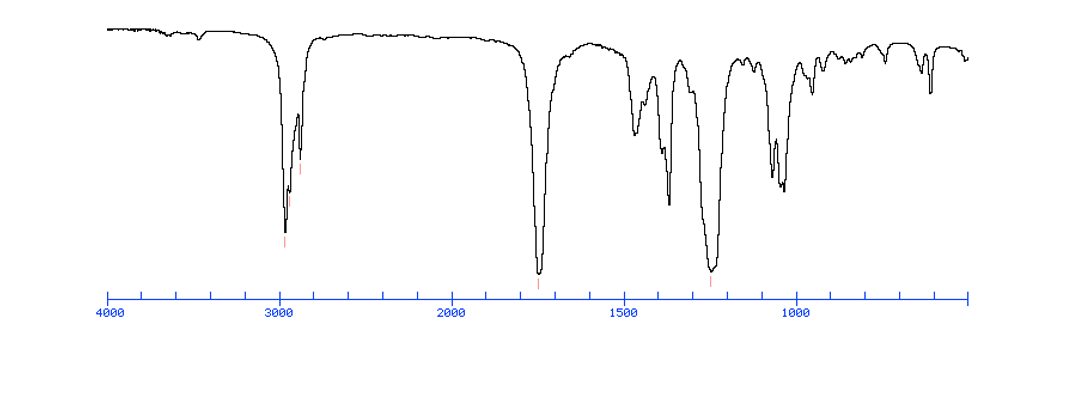
Coupled with other information (not given here) to get the actual structure, The unknown compound is the ester Butyl Acetate.
An unknown has the molecular formula C10H15N. Is the amine primary (R-NH2), secondary (R2N-H), or tertiary (R3N)?
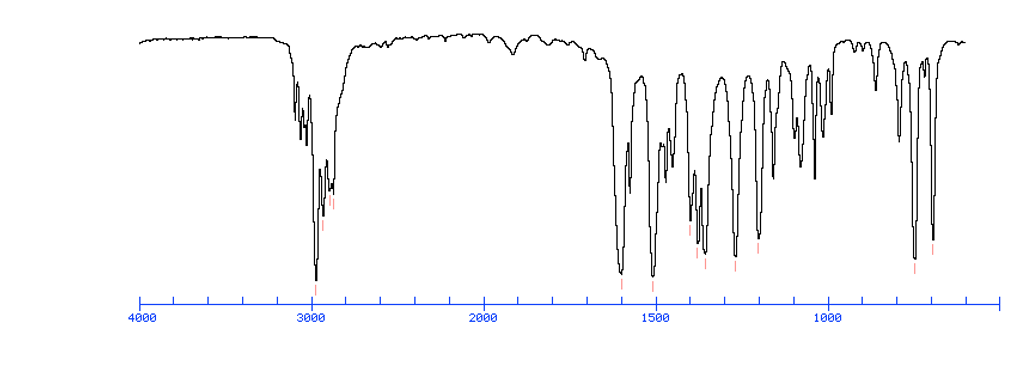
tertiary (R3N) has 0 peaks
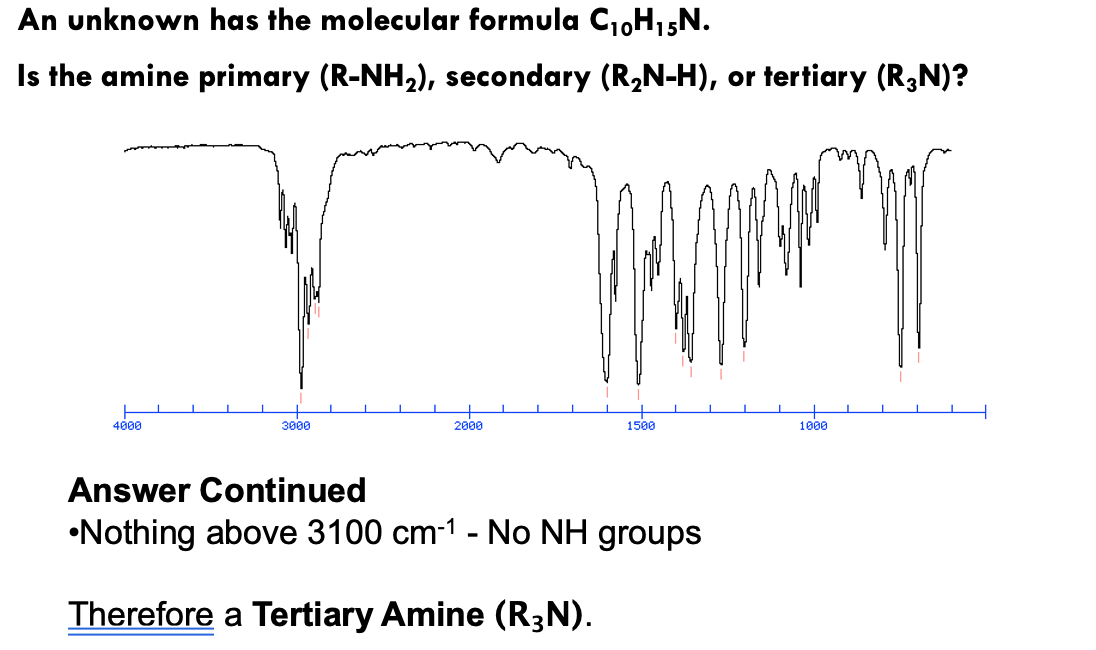
An unknown has the molecular formula C8H11N. Is the amine primary (R-NH2), secondary (R2N-H), or tertiary (R3N)?
primary (R-NH2) has 2 peaks
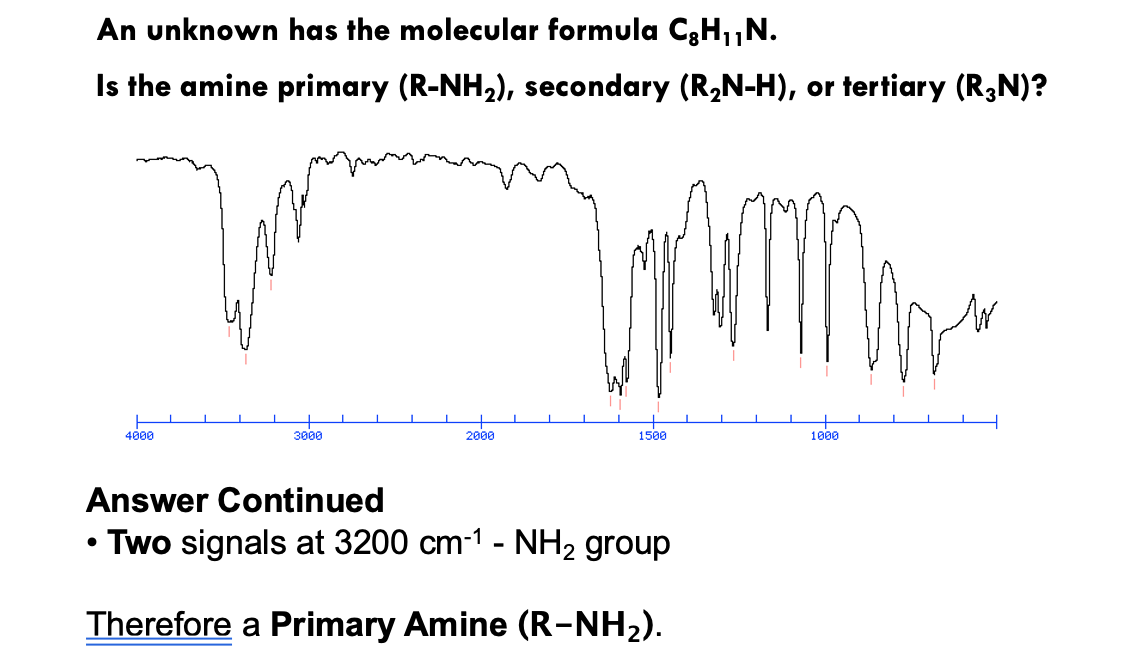
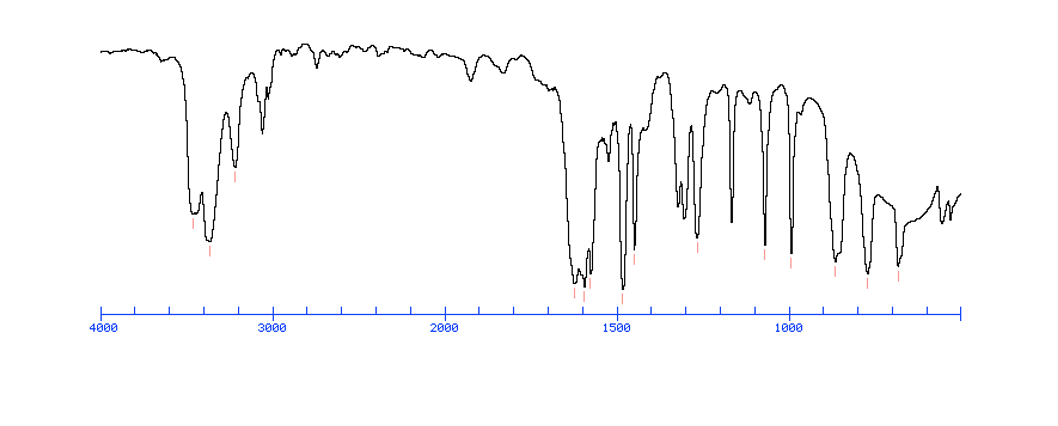
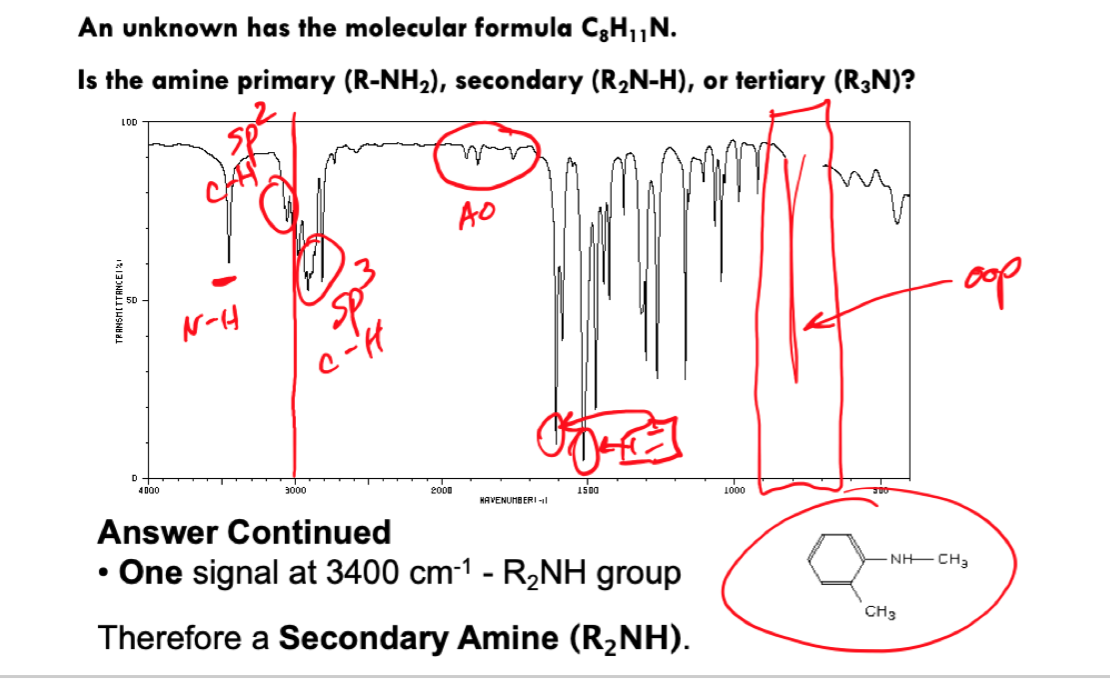
An unknown has the molecular formula C8H11N. Is the amine primary (R-NH2), secondary (R2N-H), or tertiary (R3N)?
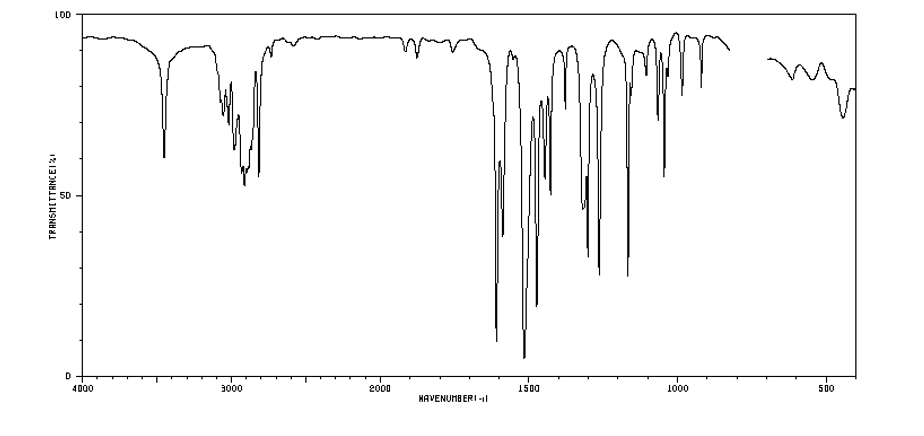
secondary (R2N-H) has 1 peak
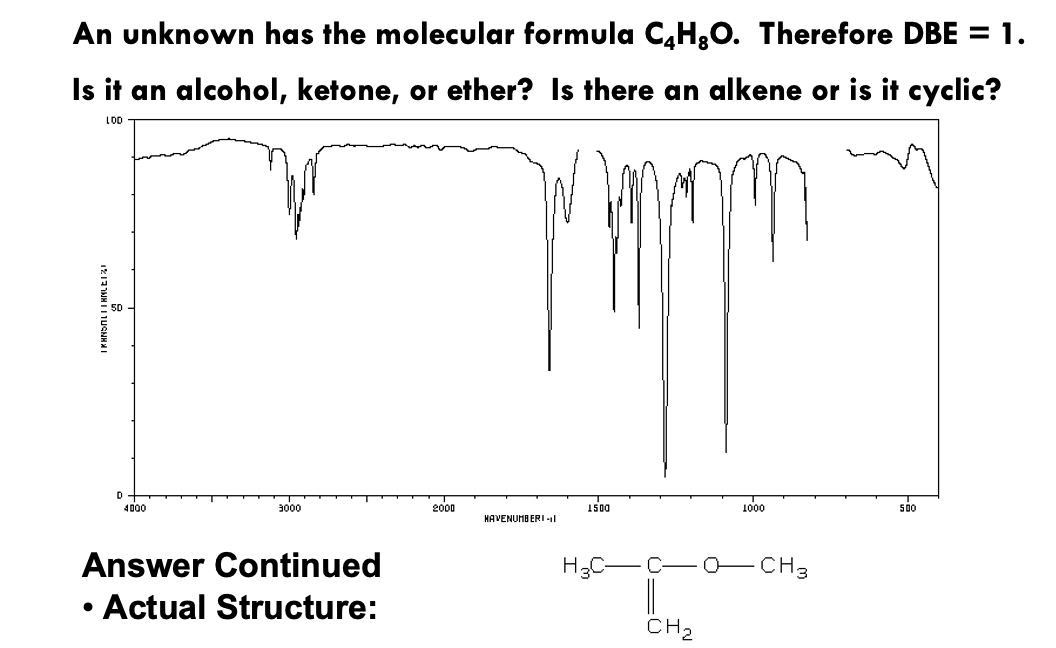
An unknown has the molecular formula C4H8O. Therefore DBE = 1. Is it an alcohol, ketone, or ether? Is there an alkene or is it cyclic?
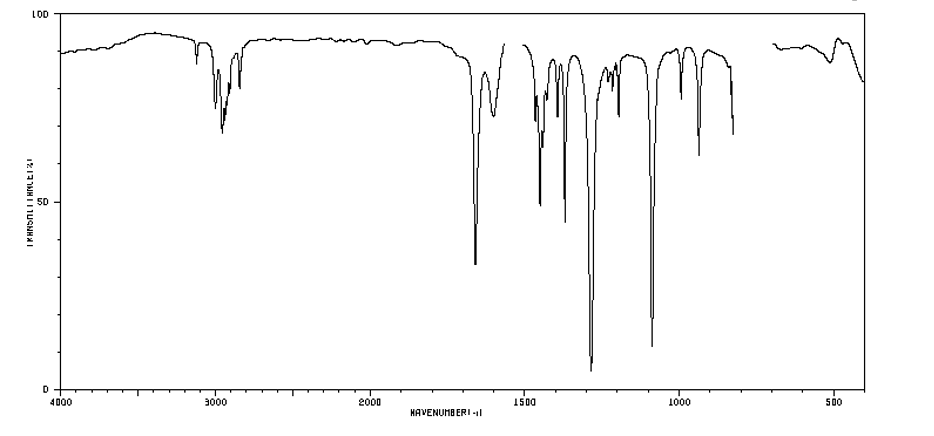
• No signals above 3100 cm-1. Therefore Not An Alcohol. • No signals around 1720 cm-1. Therefore Not A Ketone. • Strong signals around 1280 and 1100 cm-1. Therefore An Ether with Two Different C-O Bonds. • Medium signal around 1650 cm-1. Therefore An Alkene.
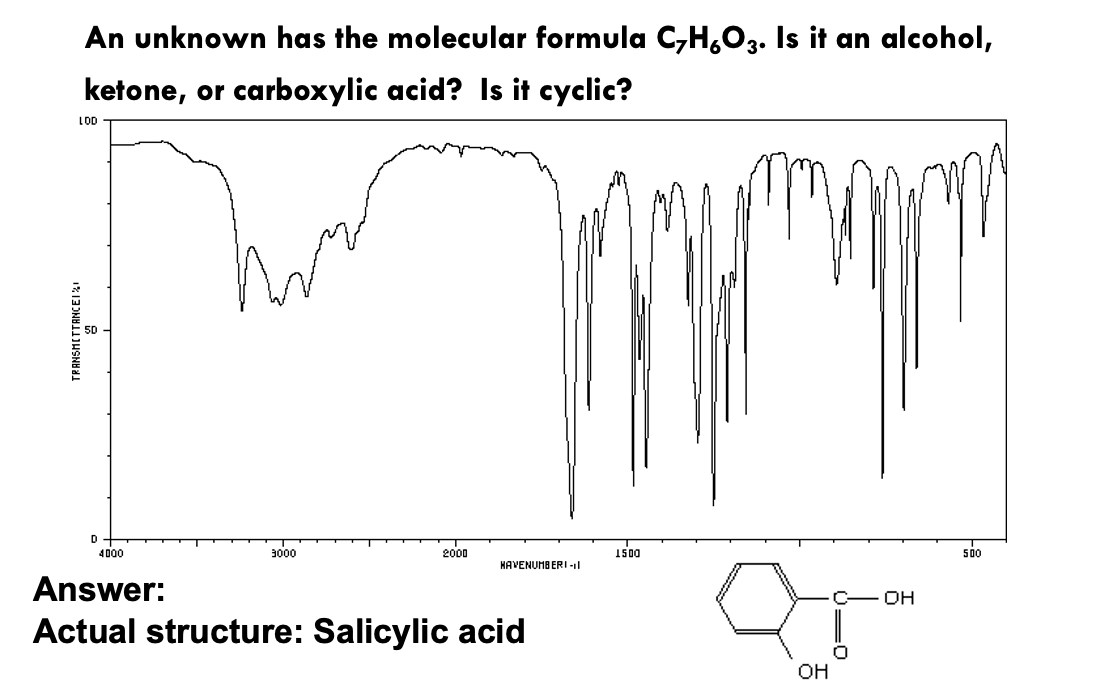
An unknown has the molecular formula C7H6O3. Is it alcohol, ketone, or carboxylic acid? Is it cyclic?
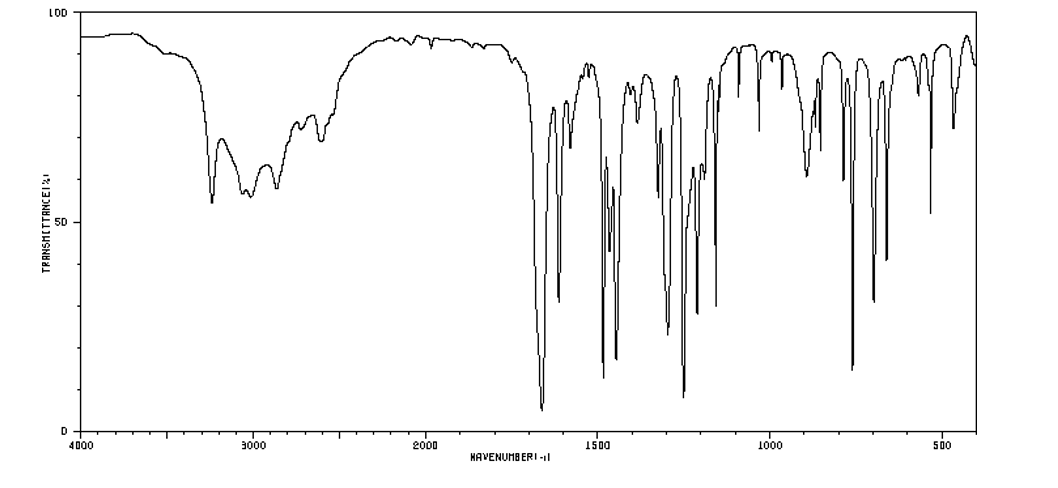
• Medium signal around 3240 cm-1. Therefore free alcohol. • Very broad signal around 3013 cm-1. Therefore carboxylic acid. • Strong signal around 1662 cm-1. Confirms carboxylic acid. • Medium signals around 1613 and 1484 cm-1. Therefore alkene (specifically benzene ring).
What are the steps in solving proton NMR spectroscopy?
• Find the MF • Calculate the DBE (UN #) • Make sure that all protons are accounted for in the H-NMR • Read all signals on H-NMR • Find “end pieces”, repeating units and work your way inward to solve for structure