1 - Principles of chemistry (b) Elements, compounds and mixtures
No description yet. This curated deck is ready for daily study.
Card preview (10)
How is a substance classified as an: 1. Element 2. Compound 3. Mixture
• A pure substance that consists of only one type of atom • Two or more different elements that are chemically bonded together • Two or more different elements, not chemically bonded together
Will a pure substance’s melting/boiling point be fixed, or a range of temperatures? Why?
The melting and boiling points of a pure substance will be fixed because it is pure, and all particles of the substance have the same properties and will change state at the same temperature.
Will a mixture’s melting/boiling point be fixed, or a range of temperatures? Why?
A mixture’s boiling point will be over a range of temperatures. This is because the mixture consists of different types of particles, which will have different properties and therefore different melting/boiling points. This means it will melt over a range of temperatures as the different parts will begin melting at different points.
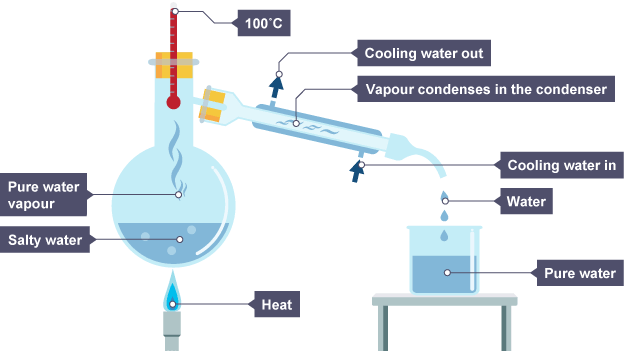
What experiment would you do to separate a solvent from the solute when you want the solvent (e.g. getting water from salt water)? How would you do this?
You would use Simple distillation E.G. Salt and Water The solution is put in a flask and heated, as the water evaporates before the salt, the water rises in the flask and into a leibig condenser. The Leibig condenser has cool water flowing through it, which cools the evaporated water, and the condensed water then runs into a collecting flask.
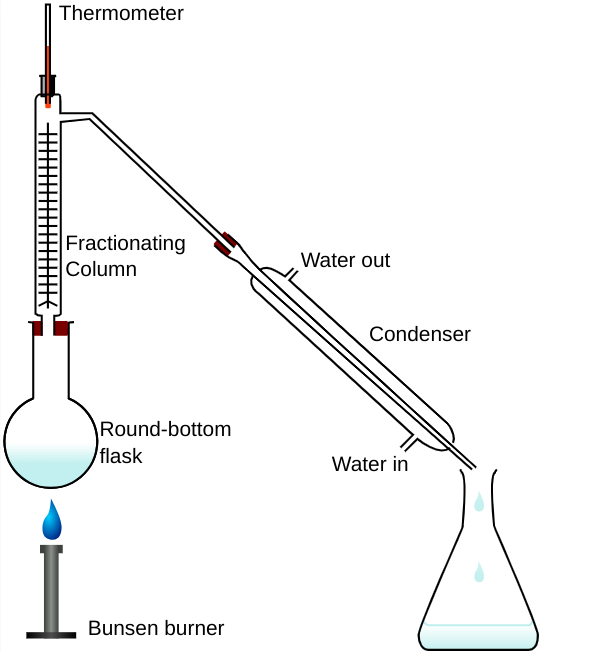
What experiment would you use when you want a specific liquid from a mixture, when they have two different boiling points that are close? E.g. separating the water from cola or petrol from crude oil. How would you do this?
You would use fractional distillation E.G. Cola Put the mixture in a flask and heat to a specific temperature. The water has the lowest boiling point, and so will evaporate first, leaving the flavouring and syrup etc behind. However, as the other ingredients have similar boiling points, the water will rise through a fractionating column, which has a spiral to slow down the rate of rise. As they reach the top, the column is cooler, so any other evaporating ingredients that evaporated early will condense and run back down into the flask. The water then goes through a Liebig condenser, where it condenses and runs into a collecting flask.
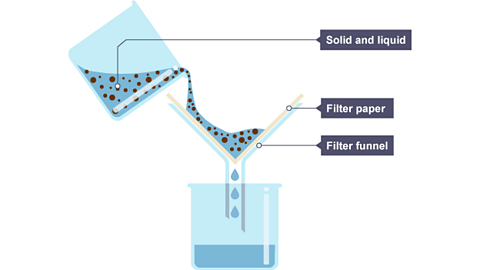
What process would you use to obtain the liquid in a mixture which contains a solid not dissolved in a liquid? E.g. Sand and water How would you do this?
You would use filtration E.g. Sand and water The mixture is poured into a filter funnel above a beaker. Filter paper is placed in the funnel. The mixture is poured in, and the small holes of the filter funnel allow water through, but the sand can’t fit through, and so remains as a residue.
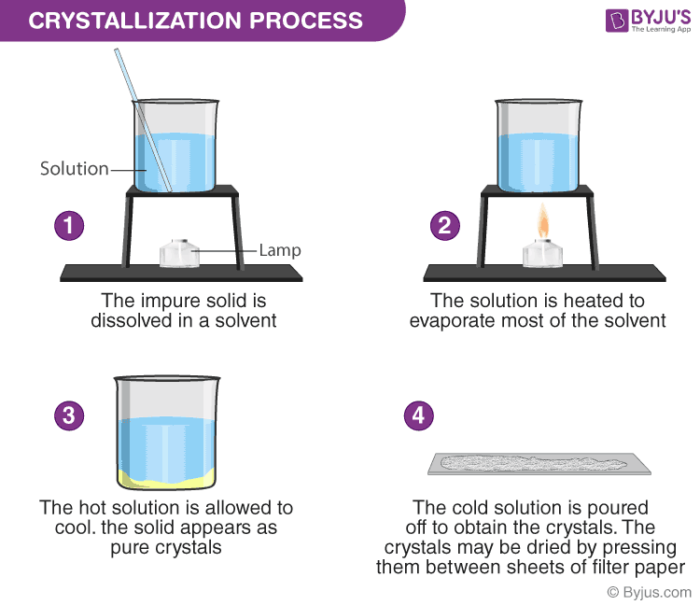
What method would you use to obtain solid crystals from a solution? How would you do this?
You would use crystallisation An impure solid dissolved in a solvent will be heated to evaporate most of the solvent. The solution will cool, and solid crystals will appear at the bottom of the solution. The cold solution is then poured off to get the crystals, which you can dry using filter paper.
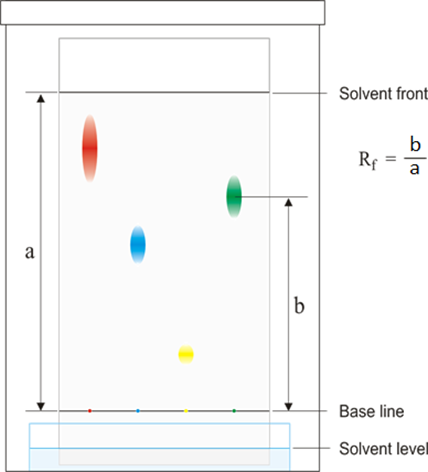
What method would you use to separate a mixture of soluble substances and find what they are made of (e.g. different inks/dyes)? How would you do this?
You would use paper chromatography The inks/dyes are placed on a dotted pencil line on paper, sitting above solvent, while the bottom of the paper touches the solvent. The solvent will spread up the paper, and take the inks/dyes with it, showing the different colours.
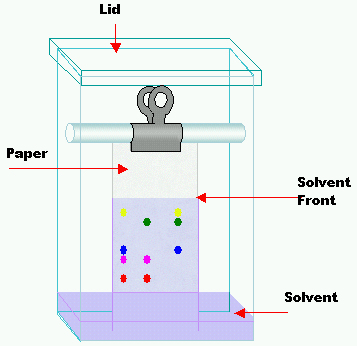
How does a chromatogram provide information about the composition of a mixture?
It provides information as it shows the different components. If it shows up as just one dot of colour and no other colours, it is a pure substance. If it has two or more colours, it is a mixture. It can also be used to identify substances, and also make more of substances/quatify them as you know their components.
What is an Rf value? How can it be calculated? How can it be used to identify a component of a mixture?
An Rf value (retention factor) is how far a substance travels relative to a solvent. It is calculated by dividing the distance travelled by the substance by the distance travelled by the solvent. It can identify a substance because by comparing it’s Rf value to other known substances, it can help identify the substance because the Rf value is always the same in the same solvent.