ChemPath: Paediatric Clinical Chemistry
No description yet. This curated deck is ready for daily study.
Card preview (24)
What is the average birthweight of male babies born at term?
3.3 kg
List some common problems in LBW babies.
• Respiratory distress syndrome • Retinopathy of prematurity • Intraventricular haemorrhage • Patent ductus arteriosus • Necrotising enterocolitis
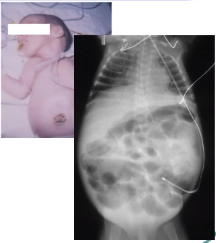
What is necrotising enterocolitis?
• Inflammation of the bowel wall progressing to necrosis and perforation • Characterised by bloody stools, abdominal distension and intramural air (pneumatosis intestinalis)
In the developing fetus, when do: • Nephrons develop • Start producing urine • Have fully competent nephrons • Achieve functional maturity of glomerular function
• Nephrons develop = week 6 • Start producing urine = week 10 • Have fully competent nephrons = week 36 • Achieve functional maturity of glomerular function = 2 years
What are the implications of the large SA:V ratio of babies?
• Low GFR for surface area • Results in slow excretion of solute load • Limited Na+ available for H+ exchange
List some key differences of the neonatal kdineys compared to adult kidneys and their implications.
• Short proximal tubule so lower reabsorptive capability • Reduce reabsorption of bicarbonate leading to a propensity to acidosis • Loop of Henle and distal collecting ducts are short and juxtaglomerular leading to reduced concentrating ability (maximum urine osmolality of 700 mmol/kg) • Distal tubule is relatively unresponsive to aldosterone leading to persisten sodium loss and reduced potassium excretion (sodium loss of 1.8 mmol/kg/day, and upper limit of K+ of 6 mmol/L in neonates)
Why does glycosuria occur at a lower plasma glucose level in neonates?
Short proximal tubule means that they have a lower ability to reabsorb
Describe how body water content is different in neonates compared to adults.
Term neonates are 75% water compared to 60% in adults (and 85% in preterm infants)
What happens to the body water content in the first week of life?
• Pulmonary resistance drops and you get release of ANP leading to redistribution of fluid • This can lead to up to 10% weight loss within the first week of life • Roughly 40 mL/kg loss in preterm infants
How are the daily fluid and electrolyte requirements different in neonates compared to adults?
• Sodium, potassium and water requirements are higher NOTE: sodium requirements are particularly high in preterm neonates (<30 weeks), so plasma Na+ should be measured daily in these patients. K+ supplements should be given once urine output > 1mL/kg/hr has been achieved
Why do babies have higher insensible water loss?
• High surface area • Increased skin blood flow • High respiratory rate and metabolic rate • Increased transdermal fluid loss NOTE: skin is not keratinised in premature infants
Drugs can cause electrolyte disturbances in neonates. Give examples of drugs that an do this and briefly describe the mechanism.
• Bicarbonate for acidosis (contains high Na+) • Antibiotics (usually sodium salts) • Caffeine/theophylline (for apnoea) - increases renal Na+ loss • Indomethacin (for PDA) - causes oliguria NOTE: growth can also cause electrolyte disturbance
What is hypernatraemia usually caused by in neonates?
• Dehydration NOTE: usually uncommon after 2 weeks NOTE: food poisoning and osmoregulatory dysfunction are differentials
What is hyponatraemia usually caused by in neonates?
Congenital adrenal hyperplasia
Outline the pathophysiology of congenital adrenal hyperplasia.
• Most commonly caused by 21-hydroxylase deficiency • Leads to reduced cortisol and aldosterone production and shunting of 17-OH progesterone and 17-OH pregnenelone which goes towards androgen synthesis
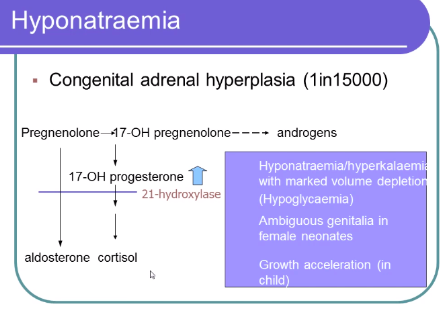
Outline the clinical features of congenital adrenal hyperplasia.
• Hyponatraemia/hyperkalaemia • Hypoglycaemia • Ambiguous genitalia in female neonates • Growth acceleration
List three reasons for neonatal hyperbilirubinaemia.
• High level of bilirubin synthesis • Low rate of transport into the liver • Enhanced enterohepatic circulation
How much bilirubin can 1 g/L of albumin bind?
10 µM/L
How much albumin does the average term neonate have? How much bilirubin can this albumin bind?
34 g/L of albumin 340 µM/L of bilirubin
What is the issue with free bilirubin?
It can cross the blood-brain barrier leading to kernicterus
What are the three bilirubin thresholds in neonates?
• No treatment • Phototherapy • Exchange transfusion
List some causes of neonatal jaundice.
• G6PD deficiency • haemolytic anaemia (ABO, rhesus) • Crigler-Najjar syndrome
What is prolonged jaundice?
Jaundice that lasts >14 days in term babies or >21 days in preterm babies
List some causes of prolonged jaundice.
• Prenatal infection/sepsis • Hypothyroidism • Breast milk jaundice