Exam 3
No description yet. This curated deck is ready for daily study.
Card preview (24)
Lashley’s experiment
Lesioned different parts of the brain: -learning/remembering maze was not impaired by local cortical legion anywhere BUT: larger the lesion, greater the impairment (engram is everywhere)
Kandel’s initial research
made first intracellular recordings of APs from hippocampal neurons (in cats) ended up working with aplysia later on with Tauc
characteristics of aplysia
• abdominal ganglion has only about 300 neurons • neuron cell bodies are big • identical organization of nervous system in all aplysia
Kandal and Tauc’s initial experiment: what did they do? initial conclusions?
intracellular recordings from neurons found ones that got EPSP when they stimulated nerve 1, but not when stimulated nerve 2 conclusions: a cell w/ an axon in nerve 1 makes excitatory synapse on test nuron; no neurons w/ an axon in nerve 2 directly synapse onto test neuron
Kandal and Tauc’s major experiment: what did they do?
stimulate nerve 2 repetitively for a few seconds test to see if amplitude of response to stimulating nerve 1 was larger or smaller (was larger)
homosynaptic facilitation and depression
repetitive stimulation of anueron leads to either transient increase (facilitation) or decrease (depression) in response amplitude
hetersynaptic facilitation
repetitive stimulation of one neuron changes the response to stimulation of another neuron
simple behaviors mediated by the aplysia abdominal ganglion
gill and siphon: respiratory organis gentle tap to siphon causes gill to withdraw repetitive taps causes less and less response (habituation)
sensitization in aplysia
behavioral event analogous to heterosynaptic facilitation gentle tap to siphon causes gill to withdraw give electrical shock to tail responses to sphon tap is larger, more rapid, longer lasting gill withdrawal
cells involved in gill withdrawal
sensory neurons respond to siphon tap motor neurons cause gill to withdraw tail sensory neurons contact interneuron 5-HT
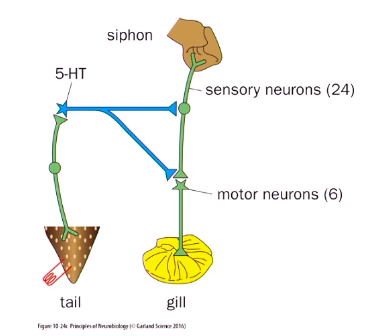
where is the locus of non-associative learning
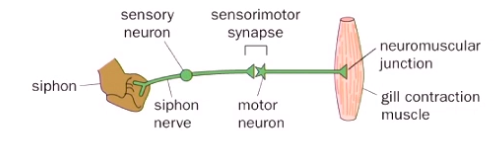
habituation occurs at sensory motor synapses
how does habituation and facilitation work on molecular level?
habituation: decrease in release probability of NT release sensitization: increase in release probability
short term and long term sensitization
single shock produces short term sensitization only multiple shocks gives changes that are larger and persist for days
what do interneurons in aplysia release and what does it do
L29 facilitator interneuron releases serotonin
adding what 3 molecules can cause synaptic facilitation
serotonin (5-HT), cAMP, PKA
how does PKA increase transmitter release
PKA phosphorylates voltage independent “leak” K channel (gKs) and shuts it off, slowing spike repolarization calcium channels stay open longer so more calcium enters more transmitter is release, thus sensitization
whats the easiest way to study long term sensitization
motor neuron and one or more sensory neurons in a cell culture directly apply serotonin with a pipette
long term sensitization requires what
new protein synthesis protein synthesis inhibitor Anisomycin prevents long term sensitization to serotonin
Kelsey Martin’s long term sensitization experiment
single sensory neuron innervates 2 motor neurons apply 5 pulses of 5-HT only near MN2 only SN-MN2 synapses facilitated (something beyond transcription/translation required for sensitization)
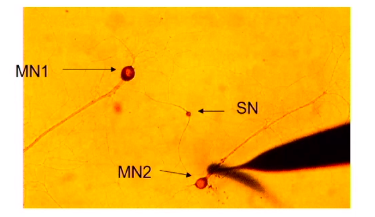
2 models to explain synapse specificity observed in Martin’s experiment
synpases that see 5x serotonin are marked: 1) RNA/protein synthesis are near nucleus, but the new protein is only incorportated into synapses that were marked by 5HT 2) RNA synthesis is in the nucleus, but protein synthesis occurs in marked-presynaptic terminals, not in cell body (CORRECT)
experiment by Martin to determine why synapse specificity occurs
put photoswitchable tag on newly translated proteins initally glows green, turns red w/ UV light (all pre-existing protein glows red) look for where the new green proteins are RESULT: only branches that saw 5-HT make new protein, even though mRNA is in all branches
how did they find the first learning mutant drosophila (5 steps)
forward genetics • feed EMS to male flies (random mutations) • cross to WT females • outcross offspring separately (offspring each carry different mutations) • make inbred lines of new mutations • test for any phenotype of interest
how did they measure defect in learning in drosophila mutants
• before odorant-shock pairing, flies have no preference for odor A or B • associate odor A with electric shock • WT flies choose odor A
fruit flies odor learning: performance index
-performance index = (flies avoiding odor A - flies avoiding odor B)/total flies index = 1: learning; index = 0: no learning