Lecture 6 – Modelling Data
No description yet. This curated deck is ready for daily study.
Card preview (3)
In what scenarios do we encounter or need to deal with temporal data?
• Data indexed with time or dates • Data about change, transformation and occurrences • Time series data Temporal phrases Era: AD 2020, 20 Jan 2020 CE * Calendar: Lunar, Hebrew, Chinese, etc. * Time zone: 1pm AEST, 1pm UTC+10:00 * Submultiples: 13:00.001 * Years do not have the same number of days * Months have different numbers of days * It can be difficult to identify the day of the week, day of the month and week in the year * Years and months start on different days * Even specific time phrases can be very complicated to parse! Counting time: * Time is not decimal * Months and years have different numbers of days * Be careful how you compare time elements * Socially, not all time periods are the same ➡ weekends ➡ holidays ➡ pay periods
Statistical Modelling
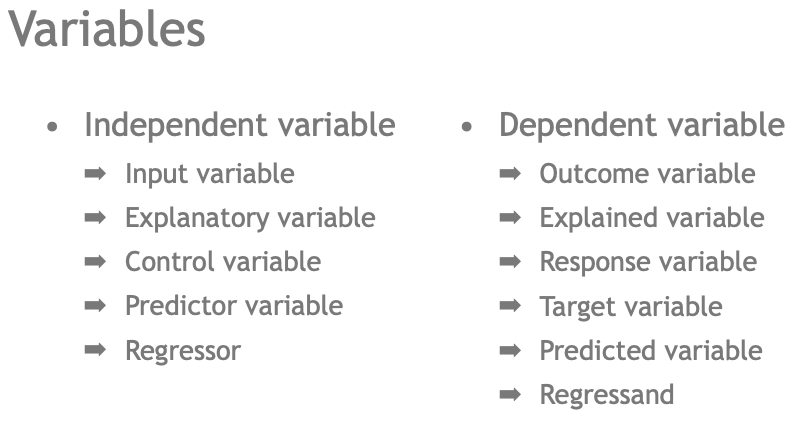
• Models represent aspects of a scenario to help us understand it. • Statistical models represent the relationships between variables ➡ Independent variable(s) ➡ Dependent variable • A model can be used to predict about the dependent variable, given information about the independent variable(s) • Rather than trying to use all data about the scenario, the model just reduces the data set to a low dimensional summary.
Causation & Correlation
Causation: Causation indicates that one event is the result of the occurrence of the other event –> cause and effect (e.g. it rains –> the street is wet) Correlation: Correlation is a statistical measure that describes the size and direction of a relationship between two or more variables –> does not automatically mean that the change in one variable is the cause of the change in the values of the other variable. !!! Causation implies correlation (normally); BUT, Correlation does not imply causation !!!