S1) Lay Beliefs
No description yet. This curated deck is ready for daily study.
Card preview (17)
What are lay beliefs?
• Lay beliefs are how people understand and make sense of health and illness • They are constructed by people with no specialised knowledge & are socially embedded
Identify the 3 definitions for the different perceptions of health
• Negative definition • Functional definition • Positive definition
What is the negative definition of health?
Negative definition – health equates to the absence of illness
What is the positive definition of health?
Positive definition – health is a state of wellbeing and fitness
What is the functional definition of health?
Functional definition – health is the ability to do certain things
Describe the nature of lay theories about health and illness
• Complex and sophisticated • Draw on cultural, social and personal knowledge • Medical information may be rejected if it is incompatible with competing ideas with good evidence
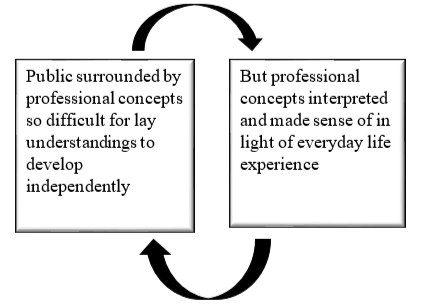
What is the interplay between lay beliefs and medical information?
What is health behaviour?
Health behaviour is activity undertaken for purpose of maintaining health and preventing illness
What is illness behaviour?
Illness behaviour is the activity of ill person to define illness and seek solution
What is sick role behaviour?
Sick role behaviour is the formal response to symptoms, including seeking formal help and action of person as patient
Using the example of smoking, describe how health behaviour changes across socioeconomic groups?
• Higher social class: I. Positive definition of health II. Focus on long term investments • Disadvantaged groups: I. Focus on improving immediate environment II. Smoking is a coping mechanism & may be normalised behaviour
Illustrate the illness iceberg
• Over a two week period about 75% of the population experience 1/more symptoms of ill health: I. For approx 50% of all symptoms – no action II. For 35% of symptoms – use lay-care III. For 12% of symptoms – consultation with GP • Most symptoms never get to a doctor
Identify 5 factors which influence illness behaviour
• Culture • Lay referral • Tolerance threshold • Information and understanding • Visibility, frequency and persistence of symptoms
What is lay referral?
Lay referral is the chain of advice-seeking contacts which the sick make with other lay people prior to / instead of seeking help from health care professionals
Provide 4 reasons as to why lay referral is important
One understands: • Why people have delayed seeking help • Why and when people consult a doctor • Use of health services and medication • Use of alternative medicines
In terms of disease, provide 4 reasons for why people delay seeking medical advice
• Symptom experience • Symptom evaluation • Knowledge of disease • Experience of and attitudes towards health professionals
What are the three broad groups involving adherence to medication?
• “Deniers and distancers” • “Accepters” • “Pragmatists” (when symptoms appear)