C3 Energy
No description yet. This curated deck is ready for daily study.
Card preview (17)
What are the units of energy?
Joules, J, or kilojoules, kJ. Calories are used for food, one calorie is 4.2 Joules.
How would you measure the energy change from burning a fuel?
The energy released when fuels burn can be measured by simple calorimetry, e.g. by heating water in a glass or metal container.
What equation would you use to find a value for the energy change in burning a fuel?
Q = mc ΔT Energy change = mass x specific heat x temp change
To what does m refer, in Q = mc ΔT?
m is the mass of the liquid being heated
How would you measure the energy change during a neutralisation reaction between an acid and an alkali?
The energy change can be calculated from the measured temperature change of the solution when the reagents are mixed in an insulated container.
Draw the simple energy level diagram for an exothermic reaction
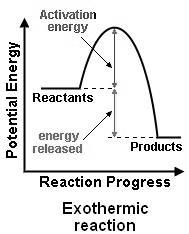
What is activation energy? (Have you shown it on the diagrams?)
The minimum amount of energy needed to start the reaction. It is shown as the distance between the energy of the reactants and the highest energy shown on the curve.
Draw the simple energy level diagram for an endothermic reaction.
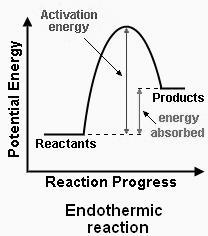
What is needed to break bonds in a chemical reaction?
Energy must be supplied to break bonds, i.e. bond breaking is endothermic.
What is released when bonds are formed in a chemical reaction?
Energy is released when bonds are formed, i.e. bond making is exothermic.
Use the idea of bond breaking and bond making to explain an exothermic reaction.
In an exothermic reaction, the energy given out by making new bonds is greater than the energy needed to break existing bonds.
Use the idea of bond breaking and bond making to explain an endothermic reaction.
In an endothermic reaction, the energy needed to break existing bonds is greater than the energy released from forming new bonds.
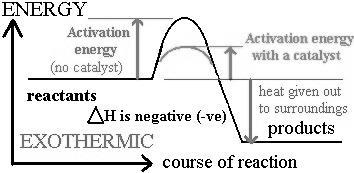
Explain how catalysts work.
Catalysts provide a different pathway for a chemical reaction that has a lower activation energy.
Show how a catalyst works using an energy level diagram
In modern cars hydrogen gas can be burned as a fuel. Name the reaction and provide the equation.
Combustion. Hydrogen + oxygen → water 2H2 + O2 →2H2O
Why is hydrogen preferred to petrol?
The only waste product is water, whereas petrol produces carbon dioxide and water.
Hydrogen can also be used in fuel cells, how does this compare to combustion?
The fuel cell produces electricity and drives an electric motor. This is cleaner than petrol combustion and the electric motor has fewer parts than an internal combustion engine.