U1-3-3 - Bonding and Attractions in Elements
No description yet. This curated deck is ready for daily study.
Card preview (12)
Why do covalent networks have high m.p./b.p.?
Strong covalent bonds are broken to melt/boil them, this requires a lot of energy.
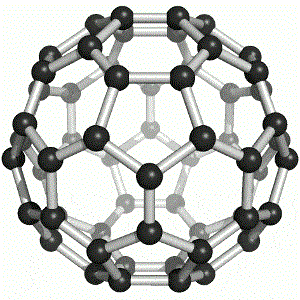
What are fullerenes?
Molecular forms of carbon, e.g. C60
Intermolecular forces/van der Waals forces
Forces (attractions) between molecules
Forces of attraction between temporary dipoles and induced dipoles.
London dispersion forces
What causes temporary dipoles to form in atoms and molecules?
Any one of: uneven distribution of electrons electron cloud ‘wobble’ movement of electrons in the molecule
LDF strength increases as …
the no. of electrons increases.
London dispersion forces
Forces of attraction between temporary dipoles and induced dipoles.
Oxygen atoms have 8 electrons, neon atoms have 10 electrons. Neon atoms have more electrons, but LDFs are stronger in oxygen. Why?
Oxygen is diatomic (O2) and oxygen molecules have more electrons (16) than neon atoms (10).
In covalent molecular substances, the boiling and melting point depend on …
… the strength of intermolecular forces. (stronger forces = higher b.p./m.p)
What is wrong with this statement? “When water boils, covalent bonds are broken.”
Water is covalent molecular - only weak van der Waals forces are broken, not strong covalent bonds.
What is wrong with this statement? “When boron boils, covalent bonds are broken.”
Nothing - boron is a covalent network, so covalent bonds are indeed broken.
Structure of noble gases
Monatomic They exist as single atoms