Unit 6: General Biochemistry
暂无描述。系统推荐的高质量记忆内容,适合每天坚持背诵学习。
卡片预览 (24 张)
B1.1.1 What are the chemical properties of a carbon atom? Why is it so important? What is a covalent bond?
Carbon can form 4 stable covalent bonds with many different types of atoms Creating stable/complex structures and molecules. Covalent bond: a bond created by the sharing of electrons between two atoms
B1.1.2 What is a condensation reaction? What is a glycosidic bond?
A reaction that removes water to form a bond between two molecules and requires energy. Condensation reactions: remove water to form a bond between two molecules - Requires energy - If it is a bond between two monosaccharides (simple sugars) it is a glycosidic bond
B1.1.2 What are disaccharides?
Two monosaccharides bonded together, such as maltose.
B1.1.2 Define polysaccharide.
Many monosaccharides bonded together, for example, amylopectin.
B1.1.2 What are 1-4 and 1-6 linkages in carbohydrates?
1-4 linkages → linear (n1 car – n4 carbon) (e.g. maltose) 1-6 linkages → branched (amylopectin)
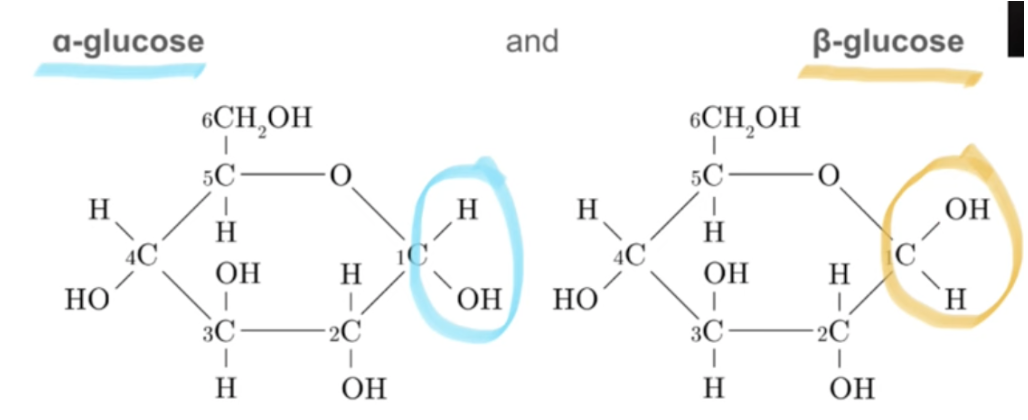
B1.1.2 What are the two forms of glucose? How do you draw them?
Alpha glucose and Beta glucose.
B1.1.3 What is digestion in the context of polymers? Hydrolysis?
The chemical breakdown of larger molecules into small molecules, typically by hydrolysis. Hydrolysis: Adding water to break the bonds of polymers
B1.1.4 What is a monosaccharide? What are the types of monosaccharides?
Monosaccharide: simple sugar - Triose : 3 carbon sugars - Pentose : 5 carbon sugars : ribose, deoxyribose - Hexose: 6 carbon sugars 5C and 6C forms ring with an oxygen atom
B1.1.4 What is the most important monosaccharide? Why
Most important monosaccharide → Glucose: C6H12O6 - Soluble in water (polar) - Small - Stable - Produces energy when oxidized (cell respiration)
B1.1.5 What are polysaccharides? What are their general features? What are their different functions?
Polysaccharides: Many monosaccharides bonded together They are all: - Not soluble (implications in transportation, osmolarity) - No fixed size But might have different in functions: - Structural support → Cellulose in cell walls of the plants - Energy storage → Glycogen (in animals) and starch (in plants)
B1.1.6 What is cellulose?
Cellulose: Structural component in plants’ cell walls - B-glucose with **1-4 **glycosidic bonds, linear Explanation: Since glucose molecules are polar they have partially negative and positive poles and when they are parallel to each other they can form hydrogen bonds that hold the chains together So it is very strong → it’s a structural component
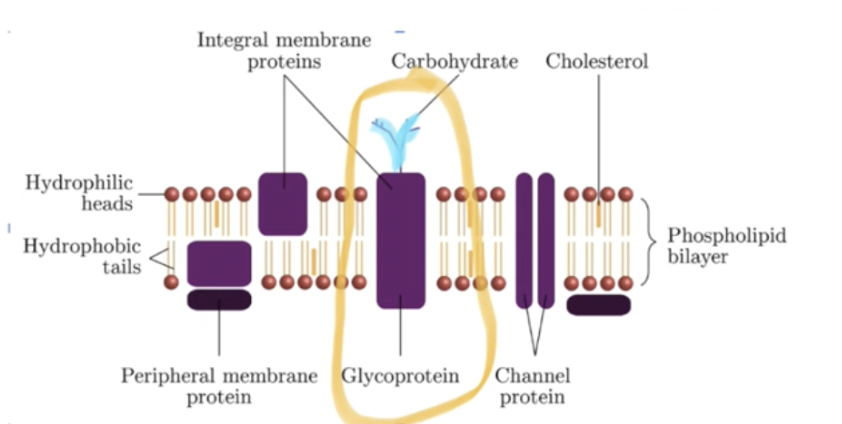
B1.1.7 What role do glycoproteins play?
Glycoprotein: Polypeptide with attached carbohydrate chain - On the cell membrane with chains facing outwards - Outside of the cell, the carbohydrate chain is used for the cell-to-cell recognition - Cells approach and then glycoproteins recognizes
B1.1.8 What are the hydrophobic properties of lipids? Types of lipids?
All lipids are hydrophobic - Non-polar, non-soluble in water Types: Fats, oils, waxes and steroids
B1.1.9 What are fatty acids? What molecules can we form?
Fatty acid Carbon chains, with hydrogens attached to them. Methyl group (CH3) - Carbon chain – Carboxyl group (COOH) We can make a triglyceride or phospholipids through condensation reactions - Triglyceride: glycerol + 3 fatty acid chains - Phospholipid: glycerol + 2 fatty acids + phosphate group
B1.1.10 What is the difference between saturated and monounsaturated and polyunsaturated fatty acids?
Fatty acid types: aren’t identical, can come in several different forms - Saturated - Monounsaturated - Polyunsaturated Saturated fatty acids - Have single bonds - Straight - Are solid at room temperature - E.g. butter and margarine Monounsaturated fatty acids - Contain one double bond (bending the chain) - Are liquid at room temperature. Polyunsaturated fatty acids - Contain more than one double bond between 2 carbons (multiple bendings) Has two types - Cis-unsaturated fatty acids - Trans-unsaturated fatty acids
B1.1.11 What is the role of adipose tissue?
Adipose tissue - Stores energy as **triglycerides **under the skin and around organs - Provides thermal insulation, not good heat conductors, so they help keep organisms warm - Are good shock absorbers (protection) Triglycerides are great for storing energy long-term - Stable - Insoluble → do not affect osmolarity - Energy-dense (9cal/g compared to carbs 4 cal/g)
B1.1.12 What is a phospholipid bilayer? What role does it have in a cell?
When you place phospholipids in watery solutions they arrange in a bilayer - Tails pointing inwards (away from water) - Heads pointing outward (towards the water) Role: - Helps compartmentalize the cells - They determine the permeability, polar molecules like glucose can’t pass from the hydrophobic tails Steroids are non-polar lipids so they can pass through Ex: testosterone, 3 six-sided rings, and one five-sided ring
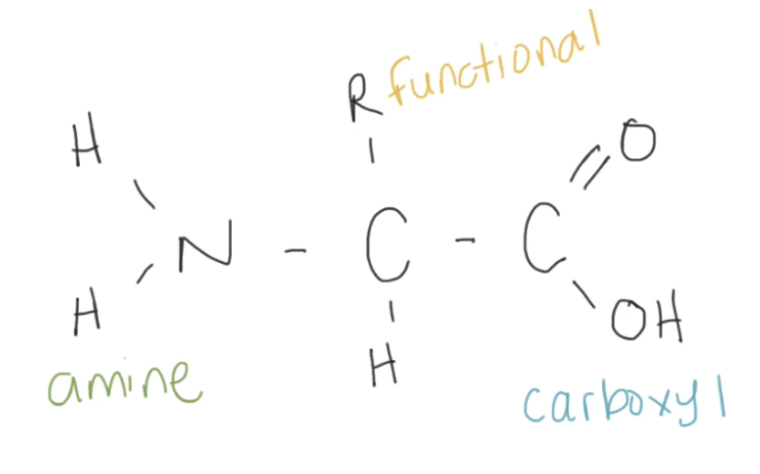
B1.2.1 What are amino acids? What is the general structure of an amino acid?
• Amino acids are the building blocks of proteins • 20 different types of amino acids NH2 amine group - central carbon - COOH carboxyl group - hydrogen and R group R group changes but the rest is identical for the rest
B1.2.2 What is a dipeptide and polypeptide? How are they formed? What is the bond between amino acids?
Dipeptide: 2 amino acids Polypeptide: many amino acids **Condensation reactions: **remove water to form a peptide bond between amino acids
B1.2.3 What are essential amino acids? Dietary requirements for amino acids?
20 different amino acids Plants can produce all 20 amino acids. Humans can only make** 9 **of them so we need to consume 11 of it in our diet Many animal proteins do have all of the essential amino acids but if you have a vegan or plant-based diet we need to eat the variety of foods to make sure that we get all types of amino acids.
B1.2.5 How does pH and temperature affect protein structure?
Changes in pH and temperature can lead to denaturation, a permanent change in protein structure and function. A protein’s function is very specific to its shape
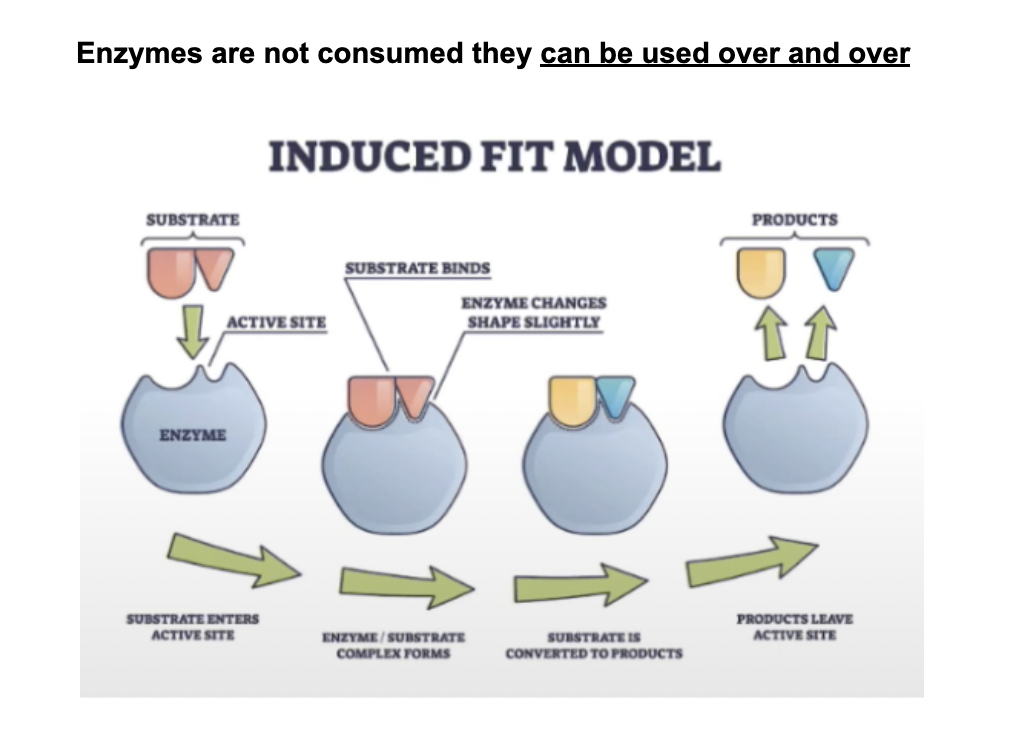
C1.1.1 What are enzymes, what is their role? What is metabolism?
Catalysts that increase the rate of chemical reactions Are not consumed, can be reused Are protein-based. Metabolism: all of the enzyme-catalysed reactions in a cell Enzymes are substrate-specific (each substrate in each reaction needs its own enzyme) Lots of different enzymes
C1.1.3 What are anabolic and catabolic reactions?
• Anabolic: small → bigger, forming bonds, requires energy (e.g., photosynthesis) • Catabolic: big → smaller, breaking bonds, releases energy (e.g., cell respiration, hydrolysis)
C1.1.5 What is the induced-fit model of enzyme action?
The active site of an enzyme changes shape for substrate binding, facilitating the reaction. After product is released, the active site returns to its original shape