Aromatic
No description yet. This curated deck is ready for daily study.
Card preview (24)
Describe the bonding in benzene
Each carbon is covalently bonded to 2C’s and 1 H Each C atom has 1 unbonded e- in its p orbital P orbitals overlap to give a ring of delocalisation above and below the plane This ring gives it stability
What gives benzene stability
Each C atom has 1 unbonded e- in its p orbital P orbitals overlap to give a ring of delocalisation above and below the plane This ring gives it stability
Where does the ring of delocalisation lie
Above AND below the plane
Describe the shape of benzene
Trigonal planar arrangement around each carbon giving a bond angle of 120 degrees Therefore benzene is planar
Describe the bond length in benzene
Intermediate between single and double bond
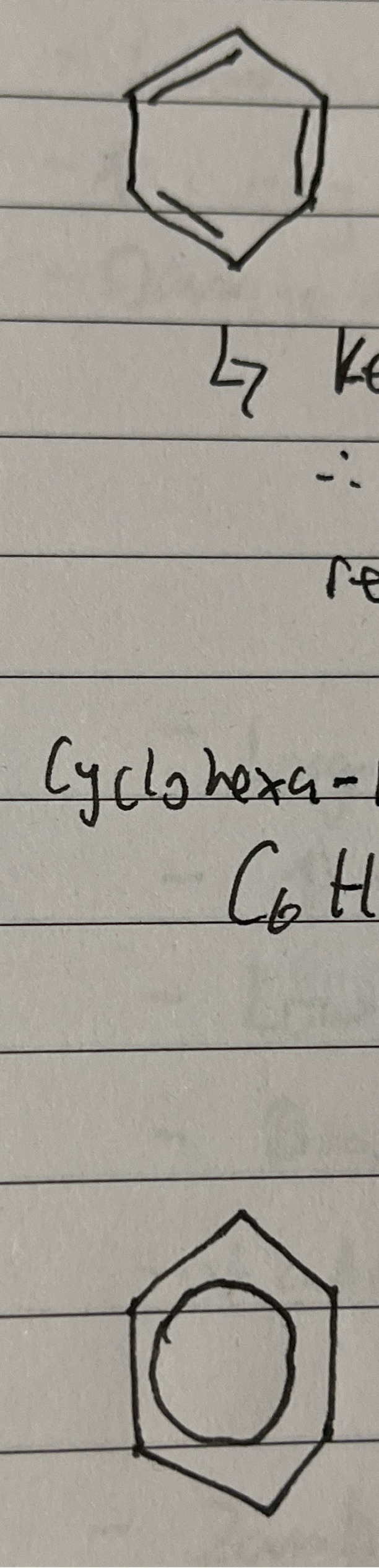
Draw the both structures of benzene
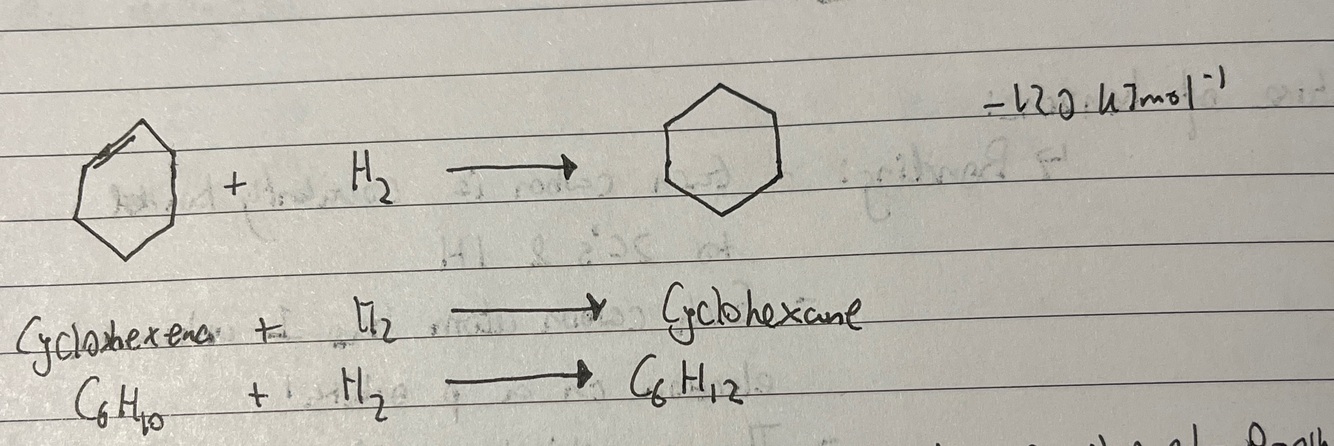
Write the equation for the hydrogenation of cyclohexene stating the enthalpy change for the reaction
Write the equation for the hydrogenation of cyclohexa-1,4-diene and cyclohexan-1,3-diene, for both isomers, stating the enthalpy change for each reaction
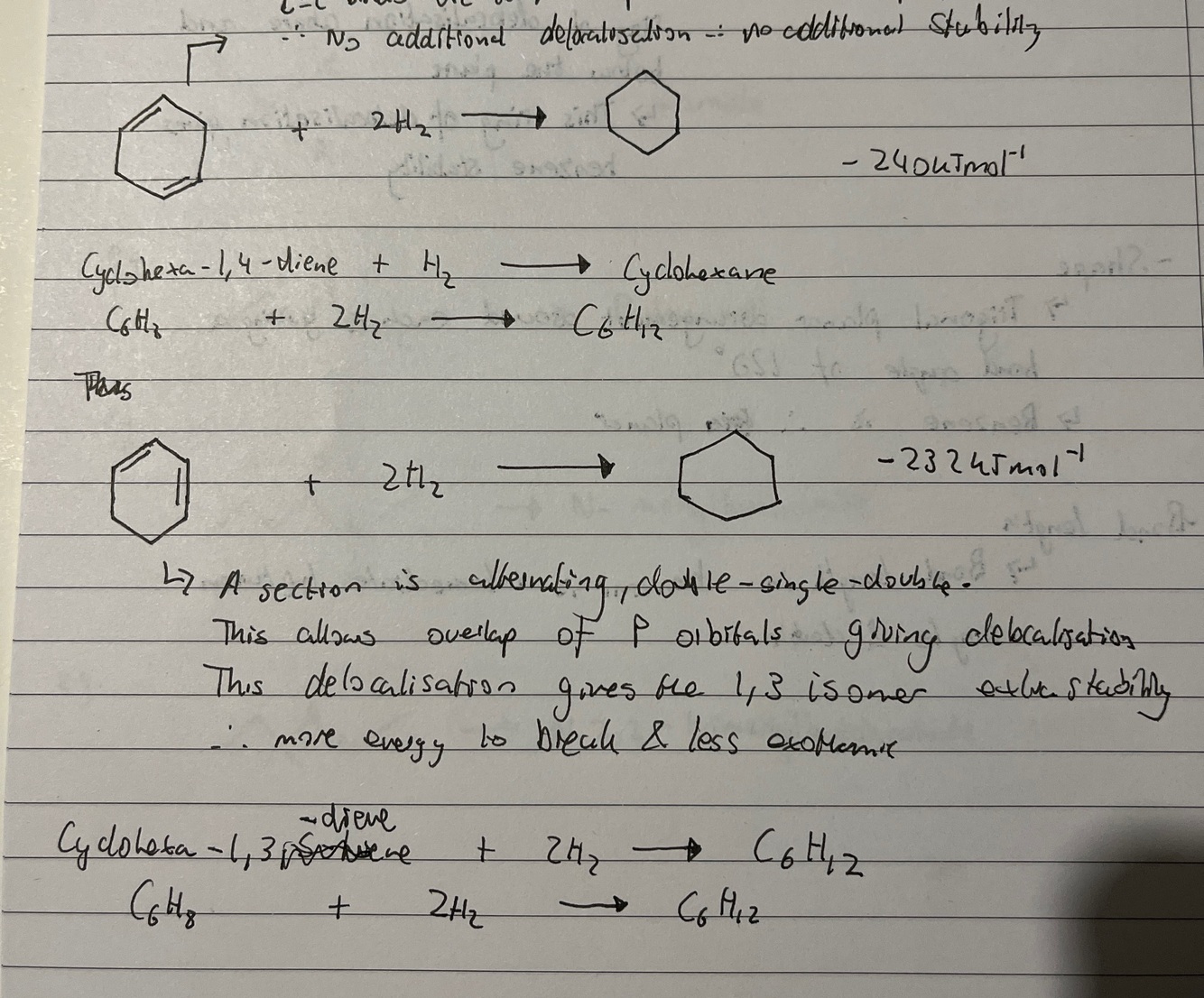
Explain why the enthalpy change for the hydrogenation of cyclohexa-1,4-diene and cyclohexan-1,3-diene are different
C=C bonds in 1,4 diene are too far apart to allow overlap of p orbitals, so there is no additional delocalisation and no additional stability In 1,3 diene, a section of the molecule is alternating, double single double bond. This allows for the overlap of p orbitals giving delocalisation which gives the 1,3 isomer extra stability and more energy is required to break the structure and so is less exothermic
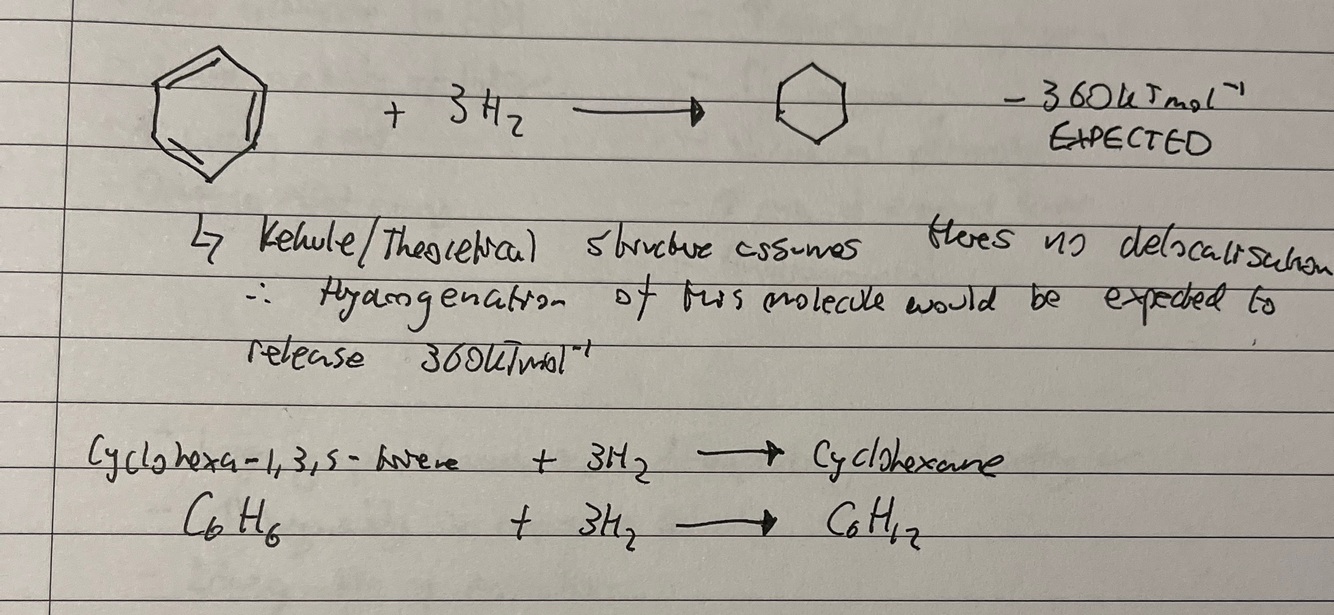
Write an equation for the THEORETICAL hydrogenation of benzene, stating the expected enthalpy change
Write an equation for the ACTUAL hydrogenation of benzene, stating the expected enthalpy change
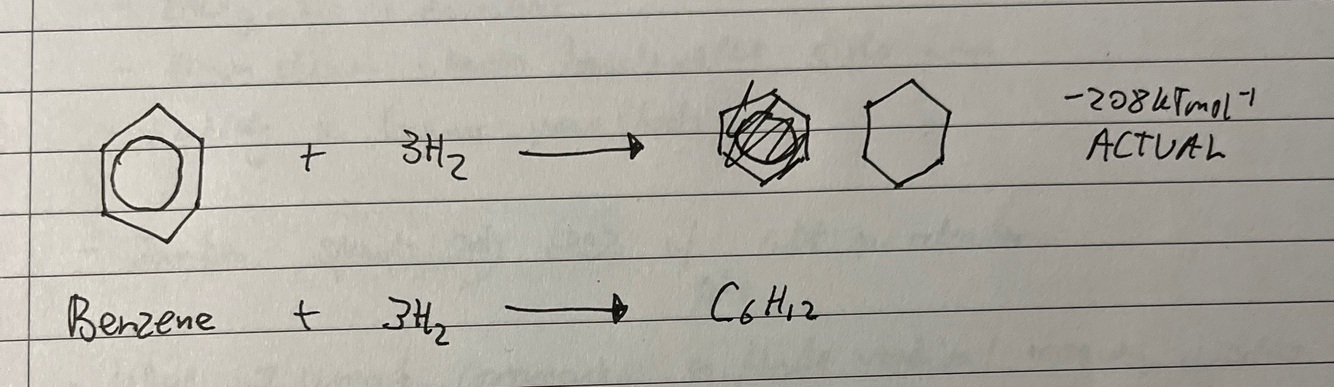
Explain why the theoretical value for the hydrogenation of benzene differs from the actual value
Kekule/theoretical structure assumes there is no delocalisation of p electrons/no delocalised ring which confers stability to the molecule
How much more stable is the actual structure of benzene compared to kekules structure
Benzene is 152KJmol-1 more stable (360 - 208) Hydrogenation of benzene is 152KJmol-1 less exothermic than the theoretical molecule
What are the 2 electrophiles which can react with benzene in electrophilic substitution
Nitronium ion (NO2+) Acylium ion (RCO+)
What is the name of the mechanism for the nitration of benzene
Electrophilic substitution
What is the name of the mechanism for the acylation of benzene
Electrophilic substitution
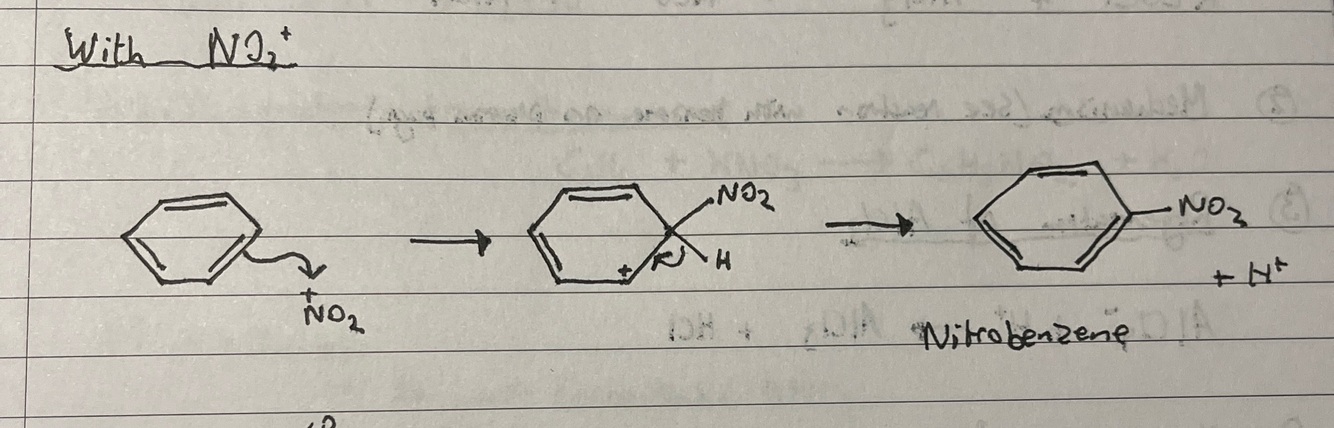
Name and outline the mechanism for the nitration of benzene
Electrophilic substitution
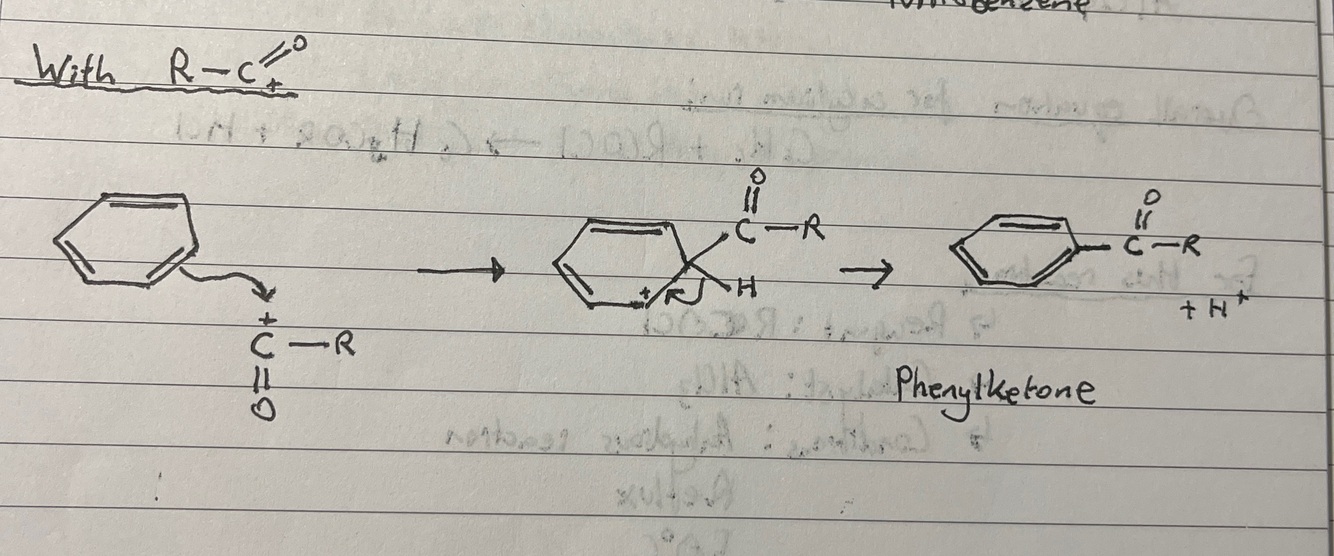
Name and outline the mechanism for the acylation of benzene
Electrophilic substitution
What are the 3 stages in either nitration or acylation of benzene
1- Generation of electrophile 2- Mechanism 3 - Regeneration of catalyst
What catalyst is used in the acylation of benzene?
AlCl3
Write an equation for the generation of the acylium ion
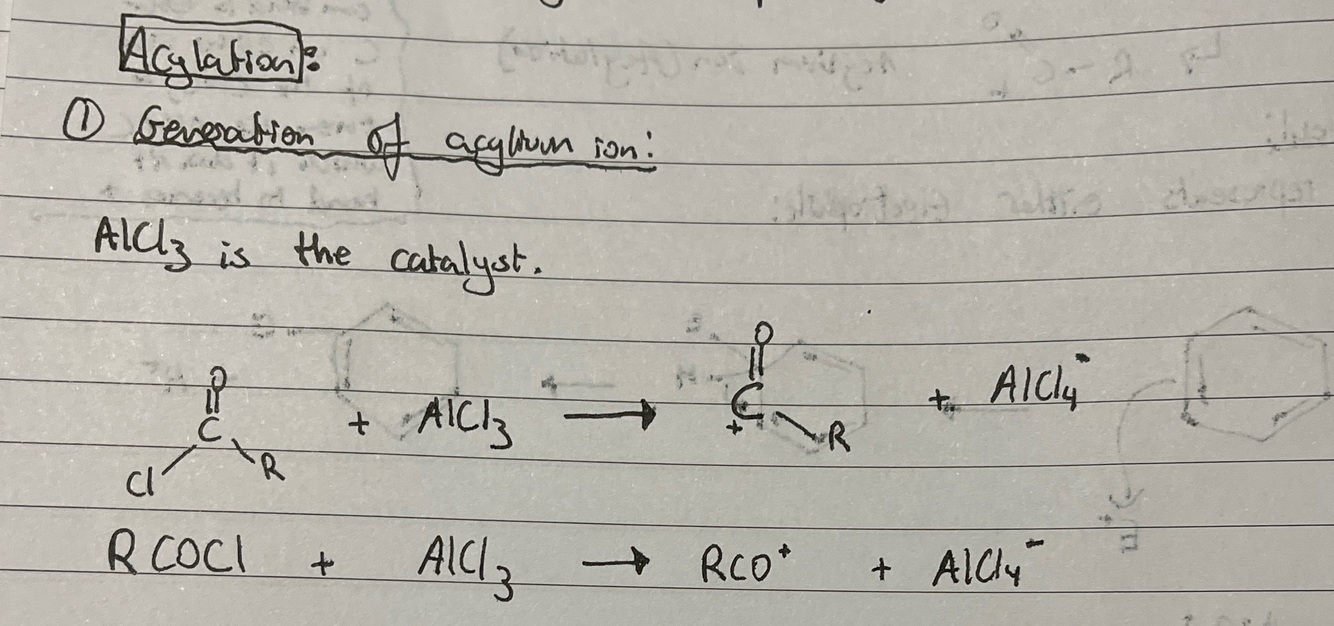
Write an equation for the regeneration of the catalyst used in the acylation of benzene
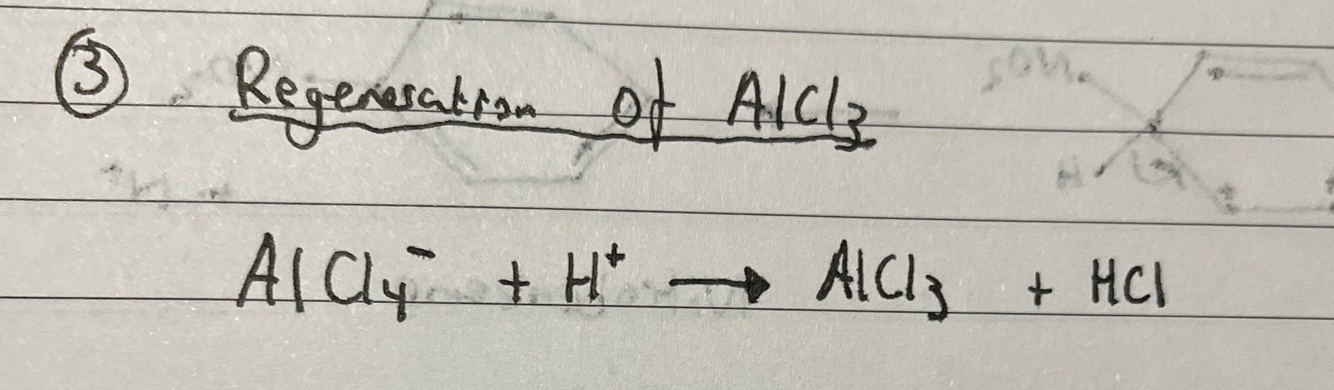
What is the overall equation for the acylation of benzene
C6H6 + RCOCl —> C6H5COR + HCl

What is the reagent, catalyst and conditions required for the acylation of benzene
Reagent: RCOCl Catalyst: AlCl3 Conditions: Anhydrous conditions, reflux, 50 degrees C AlCl3 must be anhydrous