yr1 calculations
No description yet. This curated deck is ready for daily study.
Card preview (24)
DEFINITION: The mole
The mole is the amount of substance in grams that has the same number of particles as there are atoms in 12 grams of carbon-12.
DEFINITION: Relative atomic mass
Relative atomic mass is the average mass of one atom compared to one-twelfth of the mass of one atom of carbon-12
DEFINITION: Relative molecular mass
Relative molecular mass is the average mass of a molecule compared to one-twelfth of the mass of one atom of carbon-12
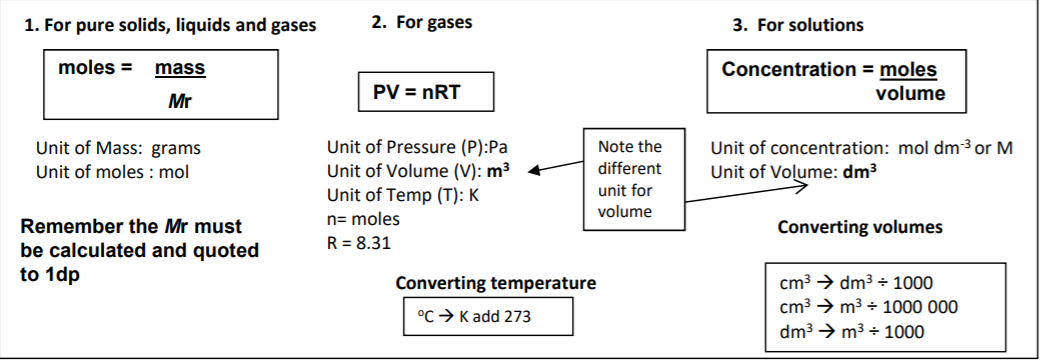
3 equations to calculate moles:
Avogadro’s Constant (L)
There are 6.022 x 10²³ atoms in 12 grams of carbon-12. Therefore explained in simpler terms ‘One mole of any specified entity contains 6.022 x 10²³ of that entity’:
The equation for Avogadro’s constant
No of particles = moles of substance (in mol) X Avogadro’s constant
Example 3 : How many atoms of Tin are there in a 6.00 g sample of Tin metal?
moles = mass/Ar = 6.00/ 118.7 = 0.05055 mol Number atoms = moles x 6.022 x 1023 = 0.05055 x 6.022 x 1023 = 3.04 x10²²
density
mass over volume
Empirical formulae
An empirical formula is the simplest ratio of atoms of each element in the compound
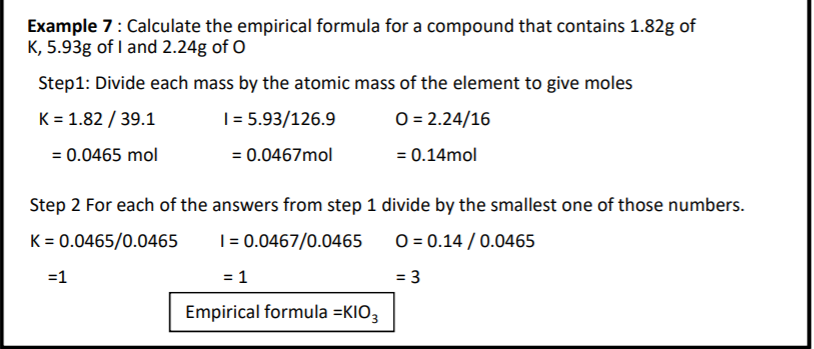
Example 7 : Calculate the empirical formula for a compound that contains 1.82g of K, 5.93g of I and 2.24g of O
Molecular formula from empirical formula
: A molecular formula is the actual number of atoms of each element in the compound
Example 8 : work out the molecular formula for the compound with an empirical formula of C3H6O and a Mr of 116
C3H6O has a mass of 58 The empirical formula fits twice into Mr of 116 So molecular formula is C6H12O2
Hydrated salt
A Hydrated salt contains water of crystallisation
Example 9 Na2SO4 . xH2O has a molar mass of 322.1, Calculate the value of x
x=10 Molar mass xH2O = 322.1 – (23x2 + 32.1 + 16x4) = 180 X = 180/18 =10
Method of heating the crucible 6 steps
• Weigh an empty clean dry crucible and lid. • Add 2g of hydrated calcium sulfate to the crucible and weigh again • Heat strongly with a Bunsen for a couple of minutes • Allow to cool • Weigh the crucible and contents again • Heat crucible again and reweigh until you reach a constant mass ( do this to ensure the reaction is complete).
How lid improves accuracy while heating the crucible?
The lid improves the accuracy of the experiment as it prevents loss of solid from the crucible but should be loose fitting to allow gas to escape
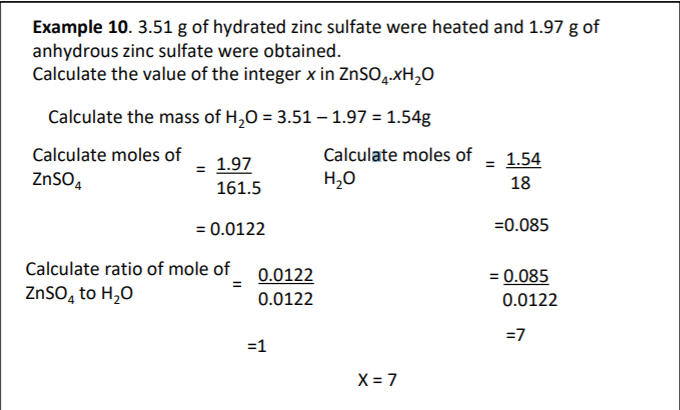
Example 10. 3.51 g of hydrated zinc sulfate were heated and 1.97 g of anhydrous zinc sulfate were obtained. Calculate the value of the integer x in ZnSO4 .xH2O
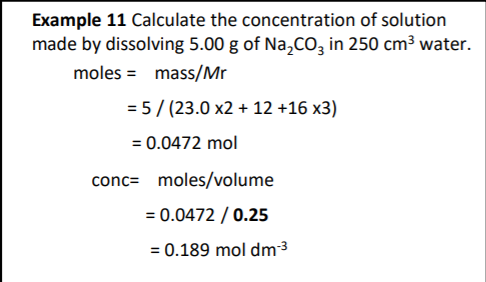
Example 11 Calculate the concentration of solution made by dissolving 5.00 g of Na2CO3 in 250 cm3 water
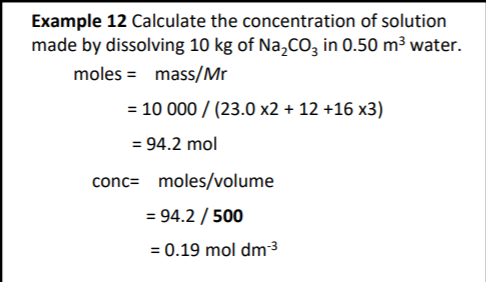
Example 12 Calculate the concentration of solution made by dissolving 10 kg of Na2CO3 in 0.50 m3 water
Making a solution 11
• Weigh the sample bottle containing the required mass of solid on a 2 dp balance • Transfer to the beaker and reweigh sample bottle • Record the difference in mass • Add 100cm3 of distilled water to the beaker. Use a glass rod to stir to help dissolve the solid. • Sometimes the substance may not dissolve well in cold water so the beaker and its contents could be heated gently until all the solid had dissolved. • Pour the solution into a 250cm3 graduated flask via a funnel. • Rinse beaker and funnel and add washings from the beaker and glass rod to the volumetric flask. • make up to the mark with distilled water using a dropping pipette for the last few drops. • Invert flask several times to ensure a uniform solution. Remember to fill so the bottom of the meniscus sits on the line on the neck of the flask. With dark liquids like potassium manganate, it can be difficult to see the meniscus
Diluting a solution
• Pipette 25cm3 of original solution into a 250cm3 volumetric flask • make up to the mark with distilled water using a dropping pipette for the last few drops. • Invert flask several times to ensure a uniform solution. Using a volumetric pipette is more accurate than a measuring cylinder because it has a smaller uncertainty Use a teat pipette to make up to the mark in a volumetric flask to ensure the volume of solution accurately measured and one doesn’t go over the line.
Calculate newly diluted concentration
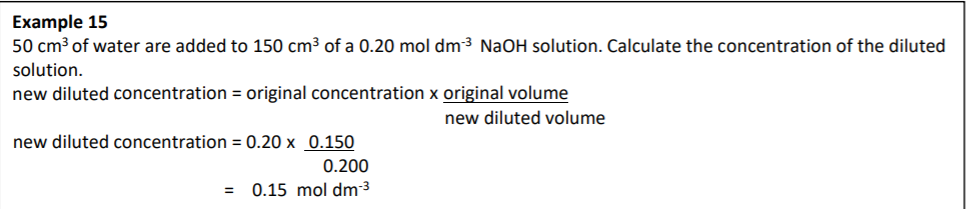
new diluted concentration = original concentration x original volume over new diluted volume
Example 15 50 cm3 of water are added to 150 cm3 of a 0.20 mol dm-3 NaOH solution. Calculate the concentration of the diluted solution
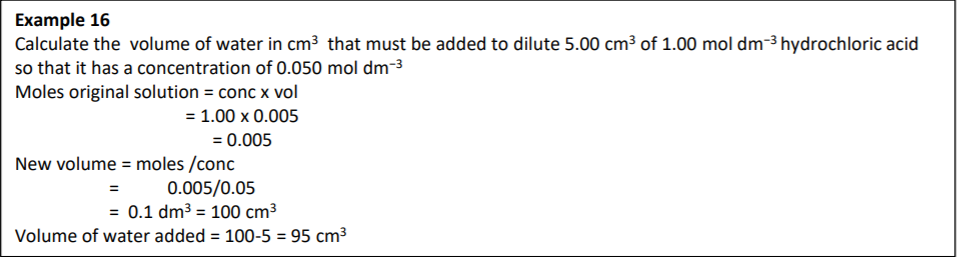
Example 16 Calculate the volume of water in cm3 that must be added to dilute 5.00 cm3 of 1.00 mol dm−3 hydrochloric acid so that it has a concentration of 0.050 mol dm−3