Electronic configuration
No description yet. This curated deck is ready for daily study.
Card preview (24)
Define an electron configuration and explain what it represents
The electron configuration of an atom shows the arrangement of electrons in energy levels, sublevels, and orbitals according to increasing energy. It reveals how electrons are distributed around the nucleus and therefore explains the chemical and physical behaviour of the element. Each configuration obeys three fundamental principles: - Aufbau principle – electrons occupy the lowest-energy orbitals first; - Pauli exclusion principle – each orbital can hold a maximum of two electrons with opposite spin; - Hund’s rule – electrons fill degenerate orbitals singly with parallel spins before pairing. Examiner phrase: “The electron configuration describes the quantum-mechanical distribution of electrons responsible for an element’s reactivity, ionisation energy, and position in the periodic table.”
Define the principal quantum number and explain its physical meaning.
The principal quantum number 𝑛 identifies the main energy level or shell occupied by an electron. - It indicates both the average distance from the nucleus and the overall energy of the electron. - As 𝑛 increases, electrons reside farther from the nucleus and possess higher energy. - Each shell can hold a maximum of 2𝑛^2 electrons (e.g. n = 1 → 2 e⁻; n = 2 → 8 e⁻; n = 3 → 18 e⁻; n = 4 → 32 e⁻). - These discrete shells provide the basis for the quantised nature of atomic energy levels observed in emission spectra.
Explain the difference between shells, subshells, and orbitals.
A shell is a main energy level (n = 1, 2, 3…). - Each shell is divided into subshells—s, p, d, f—of slightly different energies. - Each subshell contains one or more atomic orbitals, three-dimensional regions of space where there is a 90 % probability of finding an electron. | Subshell | Orbitals | Max e⁻ | Shape | |———–|———–|——–|——-| | s | 1 | 2 | spherical | | p | 3 | 6 | dumbbell (x, y, z) | | d | 5 | 10 | clover / complex | | f | 7 | 14 | multi-lobed | These orbitals overlap in energy across shells, explaining anomalies such as 4s filling before 3d.
Describe and justify the order of filling of atomic orbitals (Aufbau sequence).
Electrons occupy orbitals in order of increasing energy, which generally follows the pattern 1s < 2s < 2p < 3s < 3p < 4s < 3d < 4p < 5s < 4d < 5p < 6s < 4f < 5d < 6p < 7s < 5f < 6d < 7p. - The 4s subshell is filled before 3d because it is slightly lower in energy when empty. - they fill to minimise repulsion and maximise stability (maximises attraction to the nucleus) - by filling seperate lower energy orbitals first, the atom’s repulsion is reduced - atoms naturally arrange themselves to have the lowest possibble total energy (most stable configuration Examiner tip: state “electrons fill orbitals in increasing energy order (lowest first) to achieve the minimum-energy, most stable arrangement.”
Explain why 4s fills before 3d but is emptied first when forming ions.
• Before occupation, the 4s orbital is lower in energy than 3d, so electrons enter 4s first. • After the 3d orbitals begin to fill, the additional nuclear charge pulls the 3d orbitals slightly lower, making 4s higher in energy. • Therefore, during ionisation the 4s electrons are removed first. • This explains why transition-metal cations such as Fe²⁺ and Cu²⁺ have configurations based on 3d electrons even though 4s was filled first.
State and explain the exceptions to the Aufbau principle for chromium and copper.
• Chromium: [Ar] 3d⁵ 4s¹ (not [Ar] 3d⁴ 4s²) • Copper: [Ar] 3d¹⁰ 4s¹ (not [Ar] 3d⁹ 4s²) A half-filled (d⁵) or fully filled (d¹⁰) subshell provides extra stability due to symmetrical distribution and exchange energy between unpaired electrons. Thus one electron from 4s is promoted to 3d to achieve this stable configuration. Exam phrase: “These deviations arise because half-filled and filled d-subshells lower total energy through exchange stabilisation.”
Define Hund’s rule and describe its importance.
• Hund’s rule states that electrons occupy degenerate orbitals singly and with parallel spins before any pairing occurs. • This maximises total spin and minimises electron–electron repulsion, producing the lowest possible energy for that subshell. • For example, in a 2p subshell, the three electrons occupy pₓ, pᵧ, p_z separately before pairing.
Define the Pauli exclusion principle and discuss its consequence for orbital occupancy.
• No two electrons in an atom can have the same four quantum numbers (n, l, mₗ, mₛ). • Therefore, each orbital can contain a maximum of two electrons with opposite spins (↑↓). • This principle ensures that each electron in an atom has a unique quantum identity and explains why orbitals must pair spins antiparallel when fully occupied.
Describe how electron spin is represented and why it matters.
• Electron spin is a fundamental property represented by arrows (↑ or ↓) in orbital diagrams. • Electrons with the same spin repel each other more strongly; opposite spins partially cancel magnetic effects. • Spin pairing and Hund’s rule together explain subtle differences in atomic energies and magnetic properties (e.g., paramagnetism of unpaired d-electrons in transition metals).
Explain the concept of ‘degenerate orbitals’.
• Degenerate orbitals are orbitals within the same subshell that have identical energy (e.g. the three 2p orbitals). • degenerate orbitals make up a subshell • They remain equal in energy unless an external magnetic or electric field, or electron–electron interaction in multi-electron atoms, breaks their symmetry. • Recognising degeneracy is essential when applying Hund’s rule and explaining spectral fine structure. • A line emission spectrum is observed only for a low-pressure gas because the atoms act independently; at higher pressures, collisions between atoms cause line broadening and continuous spectra
Relate electron configuration to successive ionisation energies.
• Successive ionisation energies rise gradually as each additional electron is removed from the same shell but show large jumps when a new, inner shell begins to be ionised. • This pattern reveals the number of electrons in each shell and confirms the predicted electron configuration of the atom. Example: Magnesium’s large jump after the second ionisation shows a stable 2+ ion with a full inner shell ([Ne]).
Define the term ‘ground state’ and ‘excited state’ in electron configurations.
• The ground state is the most stable, lowest-energy arrangement of electrons in an atom. • An excited state occurs when one or more electrons absorb energy and occupy higher energy levels. • Excited configurations are temporary; when electrons return to the ground state they emit photons whose frequencies correspond to the energy difference between levels.
Link electron configurations to the block structure of the periodic table.
The periodic table is divided according to the orbital type being filled: - s-block: valence electrons in s orbitals (Groups 1–2). - p-block: valence electrons in p orbitals (Groups 13–18). - d-block: transition elements filling (n – 1)d orbitals. - f-block: lanthanoids/actinoids filling (n – 2)f orbitals. This pattern directly reflects successive filling of orbitals and explains periodicity in chemical properties and ionisation energies.
Describe how to deduce the electron configuration of an ion.
• Write the configuration of the neutral atom. • Identify electrons in the highest principal energy level (outermost shell). • For cations, remove these electrons first; for anions, add to the lowest available orbital. Example: Fe = [Ar] 3d⁶ 4s² → Fe²⁺ = [Ar] 3d⁶ (4s electrons removed). Rule: electrons are lost from 4s before 3d in transition metals.
Explain the stability pattern of half-filled and full subshells.
Half-filled (e.g. d⁵) and full (e.g. d¹⁰) subshells possess enhanced stability due to: - Symmetrical electron distribution, which minimises repulsion. - Exchange energy, the stabilisation gained from parallel spins exchanging positions. - The electrons that are present in the different orbitals of the same subshell are capable of exchanging positions with one another. This principle accounts for the special cases of Cr and Cu and influences many transition-metal ion configurations.
Describe how orbital diagrams are represented and what information they provide.
Orbital diagrams show the energy distribution and spin of electrons in an atom. Each box represents one orbital, and arrows (↑ or ↓) show electron spin. Orbitals are arranged vertically or horizontally in order of increasing energy, following the Aufbau sequence. Examples: - Hydrogen: 1s¹ → ⬜↑ - Carbon: 1s² 2s² 2p² → three 2p boxes each with one ↑ to satisfy Hund’s rule. Orbital diagrams help visualise unpaired electrons, which determine magnetic properties and chemical bonding behaviour.
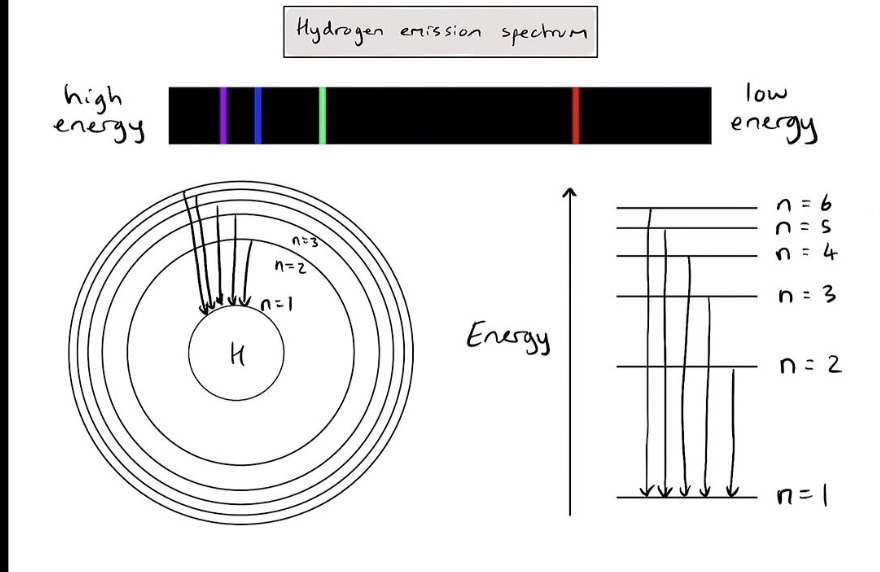
Explain how the hydrogen emission spectrum supports the existence of discrete energy levels.
• Each line in hydrogen’s emission spectrum corresponds to a photon of specific energy emitted as an electron falls between two discrete energy levels. • Because only certain frequencies appear, the electron can possess only quantised energy values—not a continuum. • As lines converge at higher frequencies (blue end), energy levels get closer together, approaching the ionisation limit, where the electron escapes the atom completely. “The line spectrum of hydrogen provides direct evidence that electrons occupy discrete energy levels within the atom.”
Explain the difference between a full and a shorthand electron configuration. Why is the shorthand form useful?
• Full configuration: lists all occupied orbitals (e.g. Na = 1s² 2s² 2p⁶ 3s¹). • Shorthand configuration: replaces core electrons with the symbol of the preceding noble gas (e.g. Na = [Ne] 3s¹). The shorthand notation simplifies writing, highlights valence electrons (which control reactivity), and shows periodic trends across groups. Exam phrase: “The noble-gas core represents a stable inner shell, allowing focus on the outer electrons responsible for chemical properties.”
Define ionisation energy and relate it to electron configuration.
Ionisation energy (IE) is the energy required to remove one mole of electrons from one mole of gaseous atoms to form cations: X(g) → X⁺(g) + 𝑒− • The magnitude of IE depends on nuclear charge, shielding, distance from the nucleus, and subshell structure. • Electrons in inner shells (lower n) are closer and more strongly attracted, so large jumps between successive IEs reveal the completion of a shell. • For instance, a large jump after the second IE in Mg indicates a stable [Ne] core → confirms configuration 1s² 2s² 2p⁶ 3s².
Define the convergence limit and link it to ionisation energy.
• The limit of convergence is the point in an emission spectrum where spectral lines merge into a continuum at high energy. • It represents transitions where the electron moves from a bound level (n₁) to n → ∞, meaning the electron is no longer bound to the nucleus. • The energy corresponding to this frequency equals the first ionisation energy of the atom, E=hf=hc/λ.
Outline how electron configurations explain periodicity across a period.
Across a period, electrons are added to the same principal energy level while the number of protons increases. → Nuclear charge increases, but shielding remains constant, causing stronger attraction between nucleus and electrons. → Atomic radius decreases, ionisation energy increases, and electronegativity rises. These predictable changes stem directly from the systematic filling of orbitals (e.g. 2p¹ → 2p⁶).
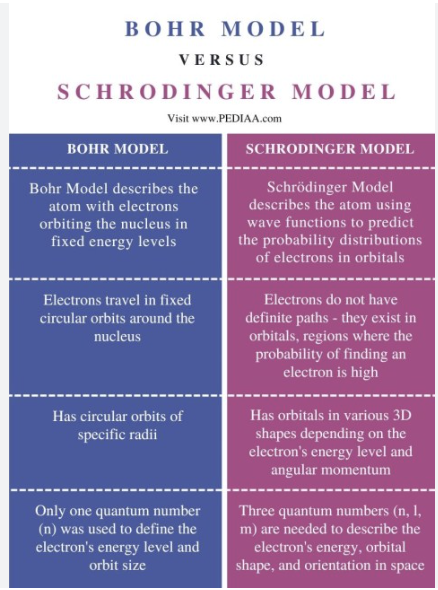
Describe how the sublevel model refines Bohr’s original model of the atom.
• Bohr proposed electrons move in circular orbits at fixed distances from the nucleus, explaining hydrogen’s spectrum but failing for multi-electron atoms. • The modern quantum model, developed from Schrödinger’s equation, divides shells into sublevels (s, p, d, f) and describes electrons as probability clouds (orbitals) rather than fixed paths. • This model accounts for the fine structure in spectra and the complex periodic trends in multi-electron atoms. “Bohr’s model quantised the orbit; the Schrödinger model quantised energy and shape.”
Explain why elements in the same group have similar chemical properties.
• Elements in the same group share the same number of valence electrons in the outermost shell, leading to identical valence-shell configurations (e.g. all Group 1 metals have ns¹). • Because chemical reactions involve only these outer electrons, atoms with the same valence configuration exhibit similar reactivity and form compounds with analogous stoichiometry (e.g. LiCl, NaCl, KCl).
Explain the difference between Bohr’s orbit and Schrödinger’s orbital.
• Bohr’s orbit: a circular path at a fixed distance and energy from the nucleus. • Schrödinger’s orbital: a 3D region of space where there is a 90% probability of finding an electron. • Orbitals incorporate wave–particle duality and uncertainty; exact electron positions cannot be known. • This shift from deterministic to probabilistic understanding marked the birth of quantum mechanics.