3.2 Alkanes
No description yet. This curated deck is ready for daily study.
Card preview (24)
What is an alkanes?
A saturated hydrocarbon containing C-H bonds only
What is the general formula of an alkane?
Cn H2n+2
Are their bonds polar? why/why mot?
Nonpolar- Cabon and Hydrogen have similar electronegativities
Do they have intermolecular forces? Why?
Only van der Waals forces of attraction- bonds are non-polar
Are they soluble in water? why?
Insoluble because hydrogen bonds in water are stronger than alkanes’ van der Waals forces of attraction
How reactive are alkanes?
Very unreactive
Which reactions will alkanes undergo?
Combustion and reaction with halogens
What is crude oil? How is it former? Is it renewable?why?
A mixture of fractions (hydrocarbons with similar boiling points and properties) Formed at high temperatures and pressures deep below earth’s surface over millions of years –> Therefore non-renewable
Name the fractions from high to low boiling point.
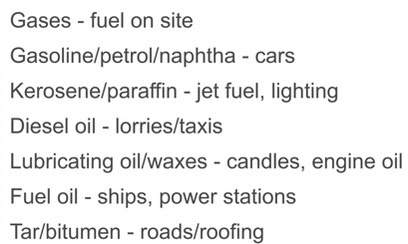
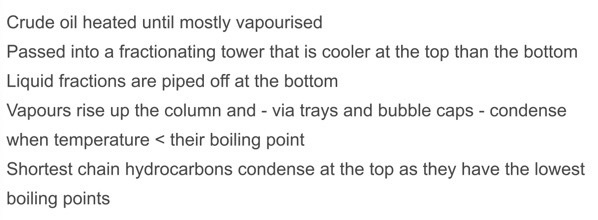
What is fractional distillation and how does it work?
What is fracking and how is it done?
Natural gas held within shale rock Drill into shale, force pressurised water and sand into rock to fracture it, collect gas HCl and methanol added to break up shale and prevent corrosion
Pros/cons of fracking?
Advantages- gas supply for many years, reduces imported gas and electricity. Disadvantage- lots of traffic to local area concern about amount of water used, chemical addditives can pollute water supplies, can cause small earthquakes, combust CH4—> CO2 —> global warming
Why are alkanes cracked?
To turn long-chain alkanes, which are very not economically valuable, into shorter chain alkane (more economically valuable as can be used as a fuel) and an alkene (more reactive, starting point for many products)
What are the conditions for thermal cracking?
700-1200 K temp Up to 7000 kPa pressure
What is the intermediate for this reaction?
Free radicals
What are the main products of thermal cracking?
Alkenes
What are the conditions for catalytic cracking?
Lower temp (720K) Lower pressure (but above atmospheric) Zeolite catalyst (SiO2 and Al203) with a honeycomb structure to give a large surface area.
What are the main products of catalytic cracking?
Cycloalkanes, aromatic hydrocarbons, branched alkanes
Write an equation for the combustion of propane

What is a fuel?
Something which releases heat energy when combusted
What are the five main fuels comprising of alkanes?

What is incomplete combustion and what products are formed in the case of alkanes?
Combustion in a limited supply of oxygen CO- carbon monoxide- poisonous C-carbon- particulates - soot - global dimming
Which type of hydrocarbons are most likely to undergo incomplete combustion?
Longer chains
What is the environmental impact of carbon monoxide?
It is toxic/poisonous