Our Sun
No description yet. This curated deck is ready for daily study.
Card preview (24)
Sun Facts • Surface Temperature • Central Temperature • Mass • Current Composition
• Surface temp = 5800K • Central temp = 107 K • Mass = 1030 kg • Current composition: • 92.1% H • 7.8% He
Energy Production - Overview
Energy is produced by fusion in which, simply, hydrogen is converted into helium: •4H →He + energy • (n.b. other fusion processes take place as well, some of which are more important for other types of stars) • Because the total mass afterwards is less than the total mass before, then energy is released because: E = mc2
The Proton-Proton Chain: Step 1
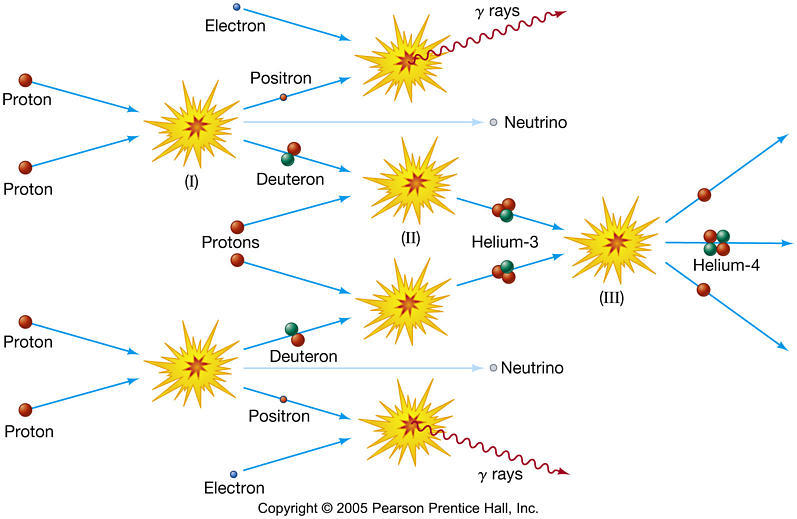
Step 1: • Two protons (hydrogen nuclei, 1H) interact producing: • The hydrogen isotope deuteron (2H) • A neutrino, ν • A positron, e+ • Subsequently the e+ annihilates with an e- producing two gamma rays, γ
The Proton-Proton Chain: Step 2
Step 2 • The 2H nucleus from the first step collides with a third proton. • A helium isotope 3He is formed and another gamma-ray photon is released.
The Proton-Proton Chain: Step 3
Step 3 • Two 3He nuclei collide • A different helium isotope with two protons and two neutrons 4He is formed and two protons are released.
The Proton-Proton Chain: Pictorial Summary
Why doesn’t the Sun collapse under its own weight?
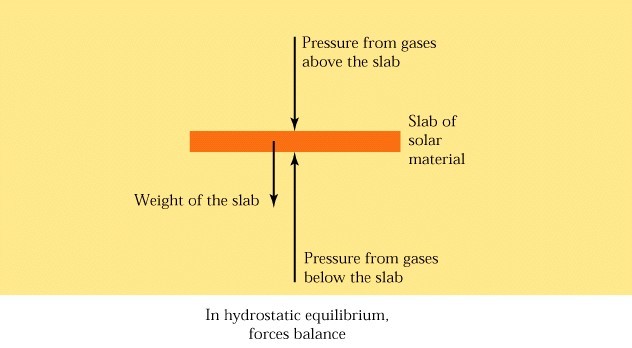
Maintaining the balance: • Because the Sun is not a solid object it retains it shape through a balance of forces. • Gravity is trying to crush it • Fusion is producing escaping energy which counteracts gravity Note that this balance applies throughout the Sun, even though the actual temperatures and pressures will change enormously with radius.
Temperature/Density vs distance from the centre of the Sun - graph
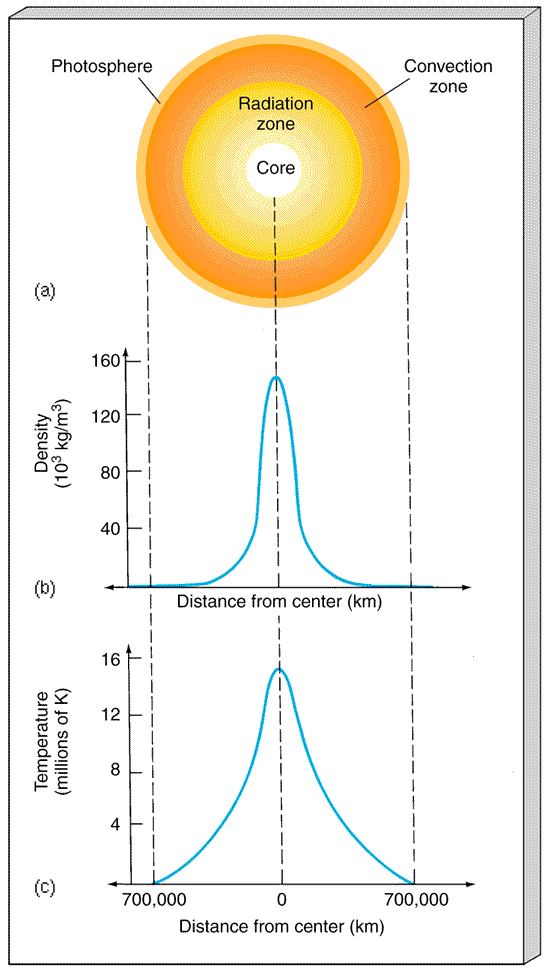
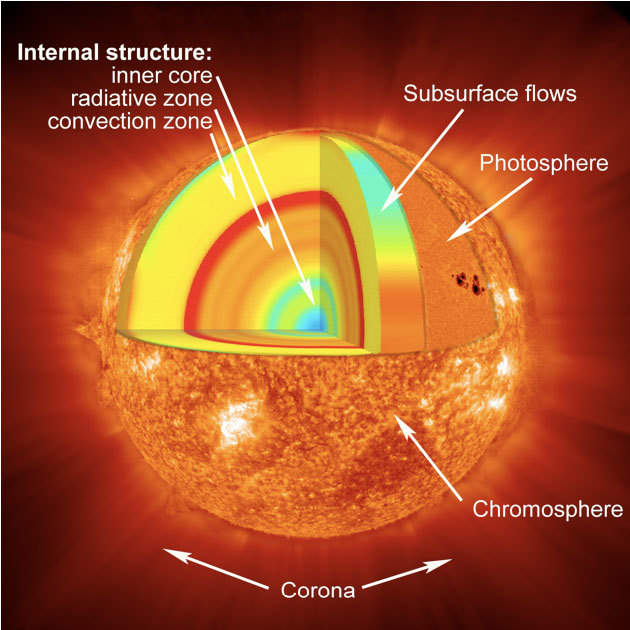
Sun - Cross Section
Reason for the Suns surface moving up and down
• The Sun “rings” at a range of frequencies. • Typical periods are around 5 minutes and result in the sun’s surface moving up and down about 10m.
How do we study the Solar Fusion process?
Solar neutrinos • If we wish to check on the solar fusion process, then we need to use a neutrino telescope. • This is because heat energy takes about 1 million years to reach the surface and so we need something more direct • Neutrinos escape at the speed of light and reach the earth in 8 minutes.
Photosphere - General Information
• The outer layer from which all visible photons arise. • Note the presence of Sun Spots (see later) and the effect called Limb Darkening (next slide).
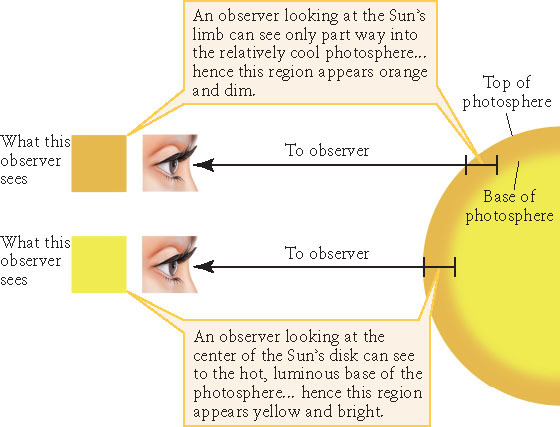
Limb Darkening - General Information
• Because of scattering off H- ions, the visible photons can only travel a fixed distance inside the sun. • Remember temperature is falling with radius and since F=σT4 a small change in T makes a big change in F.
Solar Granules - General Information
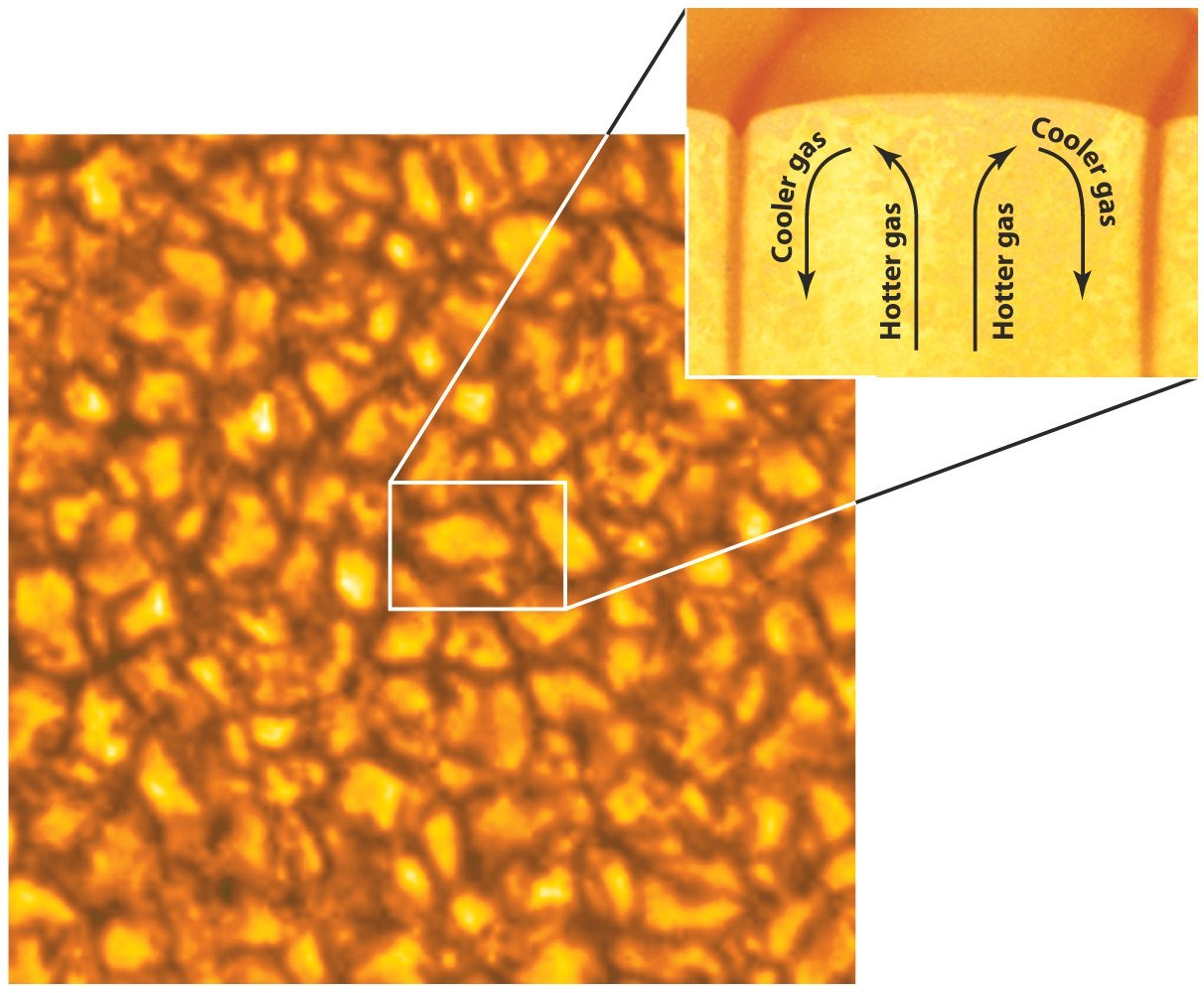
• Solar granules are convective cells about 1000km wide. • Doppler imaging allows us to map out the rising and falling parts of the suns surface.
Chromospheres - General Information
• This may be considered to be the solar atmosphere. Very tenuous, and much hotter (25000K) than the photosphere (6000K). • Normally invisible to the human eye except during Total Eclipses.
Solar Atmosphere - Information and Components
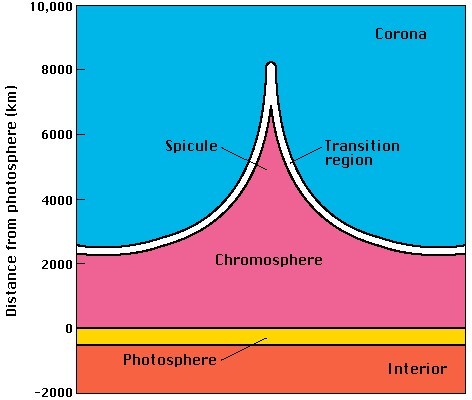
• This may be considered to be the solar atmosphere. Very tenuous, and much hotter (25000K) than the photosphere (6000K). • Normally invisible to the human eye except during Total Eclipses • The three components of the solar atmosphere. • Nb the photosphere is only 400 km thick.
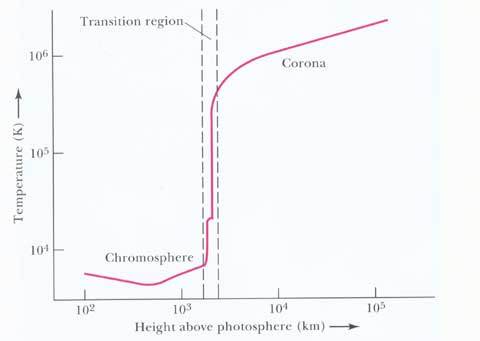
Solar Atmosphere - Temperature profile
• Temperature profile through the solar atmosphere. • The high temperatures in the corona are due to particles being rapidly accelerated along magnetic field lines. (Remember, temperature is a measure of how fast the atoms are moving)
The Corona - Is it smooth?
• The corona is far from smooth as this UV image shows. • Coronal holes are even more visible in the X-ray band.
Sunspots - What are they?
• Regions of relative coolness in the photosphere. • Remember the Stefan-Boltzman Law : radiated flux = σT^4 • They have intense magnetic fields (0.3Tesla) - some 5000 times stronger than the earth’s magnetic field – and this can be measured directly using the Zeeman effect • Mapping the Sun’s magnetic field. Sunspots are normally made up of north and south magnetic polarities
Solar Rotation
• Period = 25d at the equator and 35d at the poles. • This is known as differential rotation.
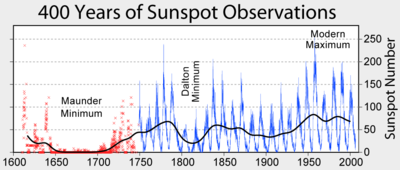
Sunspot Cycle
• The 11 year sunspot cycle. The most recent maximum was in 2011.
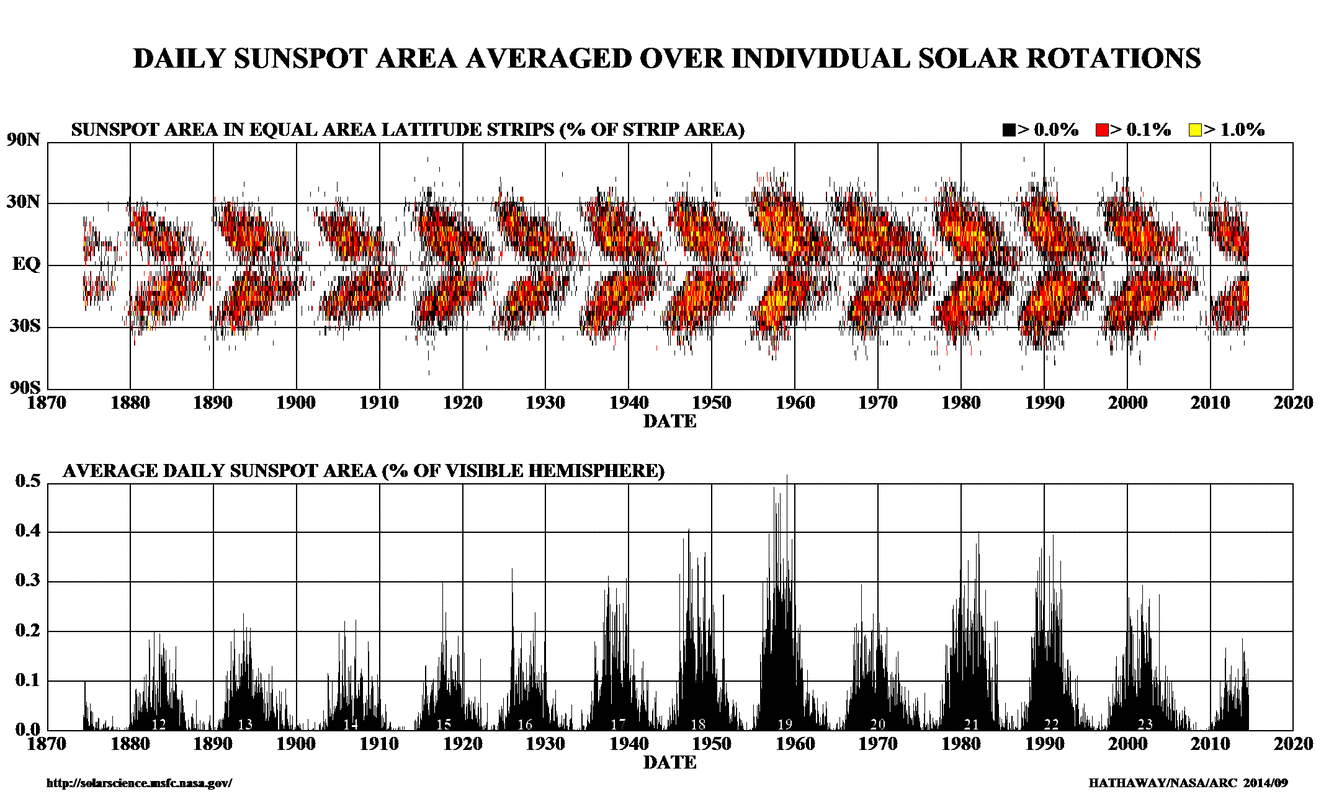
Butterfly Diagram - average latitude of Sunspots
The “Butterfly” diagram shows that the average latitude of sunspots varies throughout the solar cycle
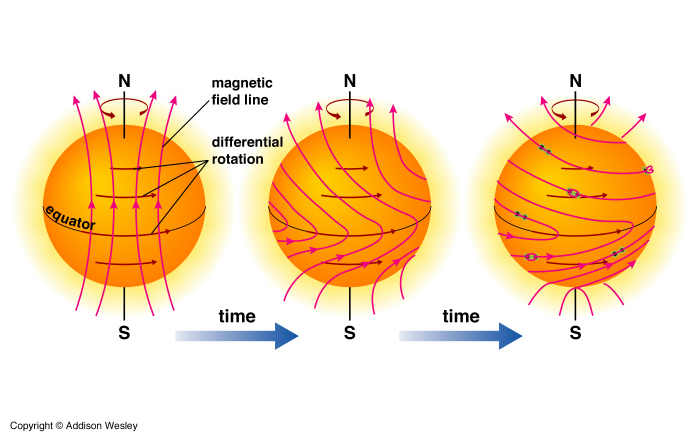
Differential Rotation and Sunspots
• Differential rotation leads to magnetic field entanglement producing sun spot groups. Differential rotation within the sun: • Surface and convective zones show strong differential rotation. • However, deeper in, the radiative zone seems to rotate like a solid body
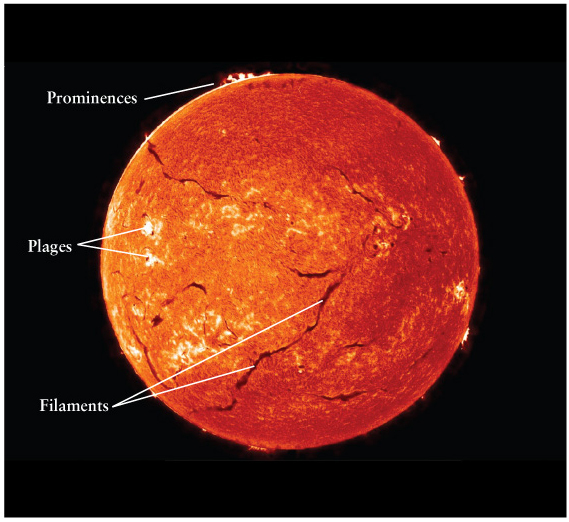
Structures associated with the Sun’s magnetic field
• An Hα image of the active sun (656 nm). • All three structures shown are associated with strong magnetic fields.