Blood Gases
No description yet. This curated deck is ready for daily study.
Card preview (24)
List body buffer systems (and which one is the most important)
• Bicarb (most important) • Proteins • Phosphates
When is body acid-base at equilibrium?
pH = pKa Equal conc of protonated and unprotonated spp. for given buffer system
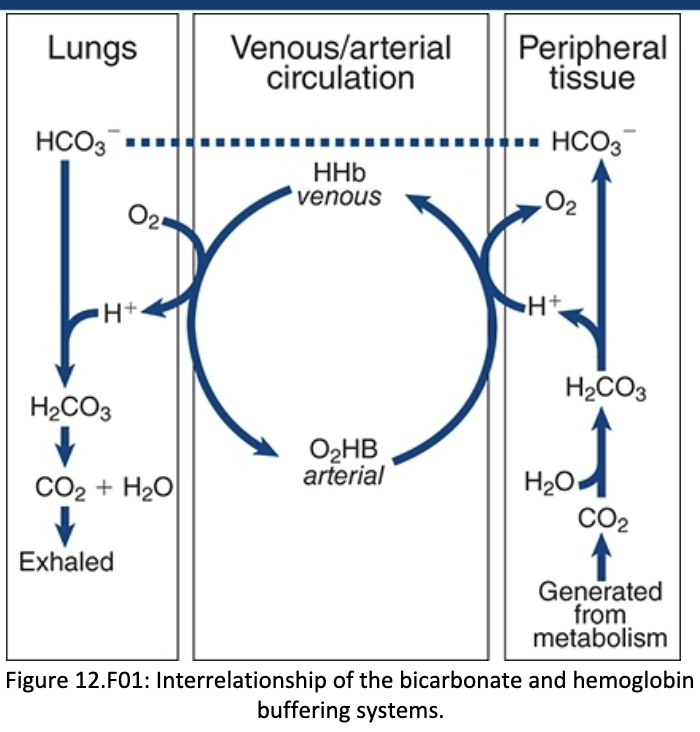
CO2 transport
CO2 + H2O -> H2CO3 -> HCO3 + O2 + H cation -> HHb venous
Two main kidney functions
• Reabsorb bicarb from glomerular filtrate in proximal tubule • Kidneys also excrete H+ for buffering capacity
How does increased plasma pH correlate with Na-H exchange and HCO3 reabsorption?
Both decreased Na-H exchange and HCO3 reabsorption
How does decreased plasma pH correlate with Na-H exchange and HCO3 absorption?
Both increased Na-H exchange and HCO3 reabsorption
Normal HCO3 to H2CO3 ratio and pH?
20:1 and pH = 7.0
Respiratory component of acid-base homeostasis
dissolved CO2 (dCO2) expelled by lungs
Metabolic component of acid-base homeostasis
How kidneys control bicarb conc by reabsorption or depletion
Reference range for pH
7.35-7.45
How does body compensate for metabolic acidosis?
Hyperventilation because the body compensates by altering the factor not associated with the primary process
Primary respiratory acidosis/alkalosis
Respiratory dysfunction caused by change in pCO2
Metabolic acidosis/alkalosis
Renal/metabolic dysfunction caused by change in bicarb level
Compensation
• Response to maintain acid-base homeostasis • Accomplished by organ not associated with primary process
Fully compensated
pH returned to normal range and bicarb: carbonic acid is approaching 20:1
Partially compensated
pH approaching normal
Uncompensated
pH abnormal and body has not started compensating for acid-base imbalance
Causes of metabolic acidosis
• Overdose of acid-producers (aspirin, ethanol, methanol, ethylene glycol) • Reduced excretion of H+ (renal tubular acidosis) • Excessive loss of bicarb from diarrhea (hyperchloremic acidosis)
Causes of respiratory acidosis
• Hypoventilation -> reduced CO2 expelled from lungs -> increased pCO2 (hypercarbia/hypercapnia) • Airway obstruction (COPD) • Drug overdose that leads to hypoventilation and increases pCO2 in blood • Decreased cardiac output (congestive heart failure) -> less blood presented to lungs and therefore higher pCO2
Causes of metabolic alkalosis
• Excessive loss of stomach acid through vomiting or nasogastric suctioning • Prolonged use of diuretics -> increased H+ renal excretion • Excess admin of sodium bicarb or excess ingestion of antacids • Hypokalemia causes H+ to shift intracellularly -> increased bicarb reabsorption in the kidneys
Causes of respiratory alkalosis
• High altitudes decrease pCO2 -> hyperventilation • Anxiety -> hyperventilation • Aspirin overdose stimulates hyperpnea • Pulmonary embolism or pulmonary fibrosis impair oxygen exchange
List primary and compensatory responses to metabolic acidosis
Primary - Increased H+ - Decreased pH - Decreased bicarb Compensatory Decreased PCO2 due to hyperventilation
List primary and compensatory responses to metabolic alkalosis
Primary - Decreased H+ - Increased pH - Increased bicarb Compensatory Increased PCO2 due to hypoventilation
Disturbances in which 7 conditions can result in hypoxia and poor tissue oxygenation?
• Binding of Hgb • Available atmospheric oxygen • Adequate ventilation • Gas exchange btwn lungs and arterial blood • Enough Hgb amt • Adequate blood flow to tissues • Ability of oxygen to release to tissues