Periodic table
No description yet. This curated deck is ready for daily study.
Card preview (14)
Each row is called Period which is
Each row is called a period and indicates the energy levels or shells occupied by the electrons around the nucleus of that element
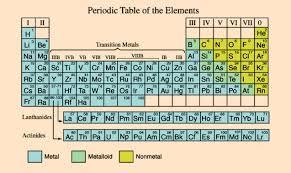
what is the periodic table
The periodic table is a table of the chemical elements in which the elements are arranged by order of atomic number
how are elements arranged in the periodic table
Elements in the periodic table are arranged in periods (rows) and groups (columns). Atomic number increases as you move across a row or period.
what are groups
Columns of elements help define element groups. Elements within a group share several common properties.
what are periods
Rows of elements are called periods. The period number of an element signifies the highest unexcited energy level for an electron in that element. The number of elements in a period increases as
what info can be found on the periodic table in the elements square
Each square on the periodic table gives information about an element. On many printed periodic tables you can find an element’s symbol, atomic number, and atomic weight.
elements are basically classified by what 3 major catorgories
Elements are classified according to their properties. The major categories of elements are the metals, nonmetals, and metalloids.
Group 1: Alkali Metals
The alkali metals are located in Group IA (first column) of the periodic table. Sodium and potassium are examples of these elements. Alkali metals form salts and many other compounds. These elements are less dense than other metals, form ions with a +1 charge, and have the largest atom sizes of elements in their periods. The alkali metals are highly reactive.
Group 2: Alkaline Earth Metals
The alkaline earths are located in Group IIA (second column) of the periodic table. Calcium and magnesium are examples of alkaline earths. These metals form many compounds. They have ions with a +2 charge. Their atoms are smaller than those of the alkali metals.
Groups 3-12: Transition Metals
he transition elements are located in groups IB to VIIIB. Iron and gold are examples of transition metals. These elements are very hard, with high melting points and boiling points. The transition metals are good electrical conductors and are very malleable. They form positively charged ions.
Groups 13-15: Not all Metals
Groups 13-15 include some metals, some metalloids, and some nonmetals. Why are these groups mixed? The transition from metal to nonmetal is gradual. Even though these elements aren’t similar enough to have groups contained within single columns, they share some common properties. You can predict how many electrons are needed to complete an electron shell. The metals in these groups are called basic metals.
Group 17: Halogens
The halogens are located in Group VIIA of the periodic table. Examples of halogens are chlorine and iodine. You find these elements in bleaches, disinfectants, and salts. These nonmetals form ions with a -1 charge. The physical properties of the halogens vary. The halogens are highly reactive.
Group 18: Noble Gases
The noble gases are located in Group VIII of the periodic table. Helium and neon are examples of noble gases. These elements are used to make lighted signs, refrigerants, and lasers. The noble gases are not reactive. This is because they have little tendency to gain or lose electrons
diagram of periodic table