B6 Organic Chemistry II
No description yet. This curated deck is ready for daily study.
Card preview (24)
Which model of benzene is this
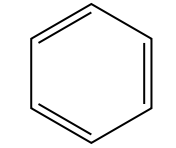
Kekulé’s model
Which model of benzene is this
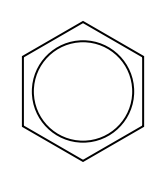
Delocalised model
Describe the structure and bonding in Kekulé’s model of benzene
• P-orbitals overlap to form pi-bonds • Pi-electrons are localised between carbon atoms • Alternating pi-bonds
What is the similarity between Kekulé’s benzene model and the delocalised benzene model
Both have overlap of p-orbitals
Describe the delocalised model of benzene
P-orbitals overlap to form pi-bonds, with pi-electrons delocalised into delocalised ring pi-system
What is the evidence to suggest that Kekulé’s model of benzene isn’t correct
• Carbon-carbon bond lengths are all the same size in benzene, but not in Kekule’s model • Enthalpy of hydrogenation of benzene is less exothermic than Kekule’s model • Benzene is less reactive than alkenes - bromination requires a catalyst for benzene but not for alkenes
Name this molecule
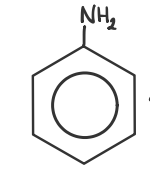
Phenylamine
Name this molecule
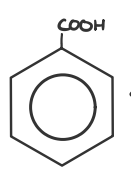
Benzonic acid
Catalyst for benzene electrophillic substitution - nitration
Concentrated Sulfuric Acid
Conditions for benzene electrophillic substitution - nitration, and why
Less than 50c to prevent further substitutions occuring
Inorganic product for benzene electrophillic substitution - nitration
Water
Electrohphile generator step for benzene electrophillic substitution - nitration

Mechanism step for benzene electrophillic substitution - nitration
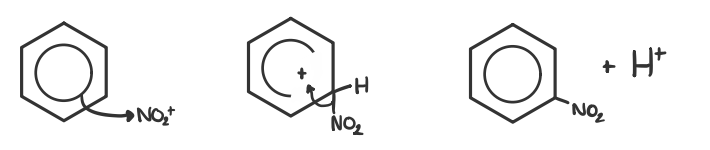
Catalyst regeneration step for benzene electrophillic substitution - nitration
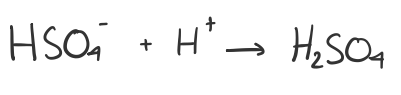
Catalyst for benzene electrophillic substitution - halogenation
Halogen carrier - AlCl3 or FeCl3
Inorganic product for benzene electrophillic substitution - halogenation
Hydrogen halide
Catalyst generation for benzene electrophillic substitution - halogenation

Mechanism for benzene electrophillic substitution - halogenation
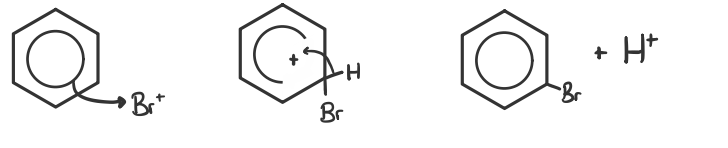
Catalyst regeneration for benzene electrophillic substitution - halogenation

Reactant for Friedel-Crafts alkylation
Haloalkane
Catalyst for Friedel-Crafts alkylation
Halogen carrier - AlCl3 or FeCl3
Inorganic product of Friedel-Crafts alkylation
Hydrogen halide
Reactant of Friedel-Crafts acetylation
Acyl chloride
Catalyst for Friedel-Crafts aceytlation
Halogen carrier - AlCl3 or FeCl3