Triels
No description yet. This curated deck is ready for daily study.
Card preview (24)
The Triels are
Group 13 elements They all have ₙs² ₙp¹ configuration
Why is the chemistry of triels dominated around their electron deficiency?
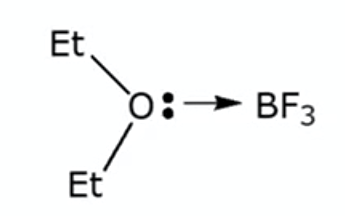
• They all have 3 valence electrons • So these elements can only ever have a minimum valance of three (3 covalent bonds) • So can only have 6 electrons around them • Which is short of a full ocetet • Therefore they are electron pair acceptors or lewis acids • e.g. BF₃ gaining a LP from diethyl ether
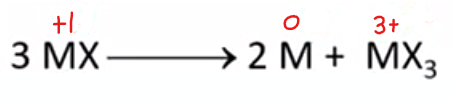
What is the term for the following reaction? 3MX → 2M + MX₃
• Disproportionation • two of the atoms are reduced (+1 to 0) • one atom is oxidised (+1 to 3+)
Why does the +1 oxidation state become more stable as the group descended
• Inert pair effect • (the tendency of the electrons in the outermost atomic s orbital to remain unionised or unshared in compounds of the group 13-16 elements)
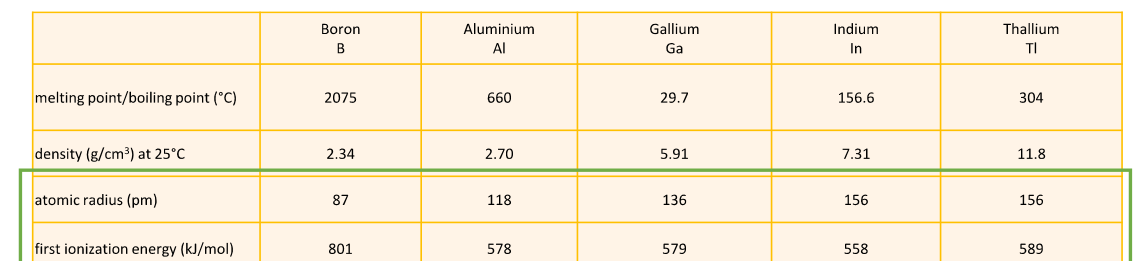
What happens to the size of the atom radius (pm) as you go down group 13?
• The atomic radii increases going down group 13 • This effect results from the fact outer electrons are being places in orbitals with increasing principial quantum numbers • Hence lie further away from the nucleus

What happens to the first ioniation energy (kJ/mol) as you go down group 13?
• Aluminium is lower than boron due to the outer electrons being further away from the nucleus, hence experiencing less nuclear charge • However it stabilises from aluminum • Ga, In and Tl are proceeded by d-block and f-block electrons which do not provide effective shielding (d-block and f-block contraction)
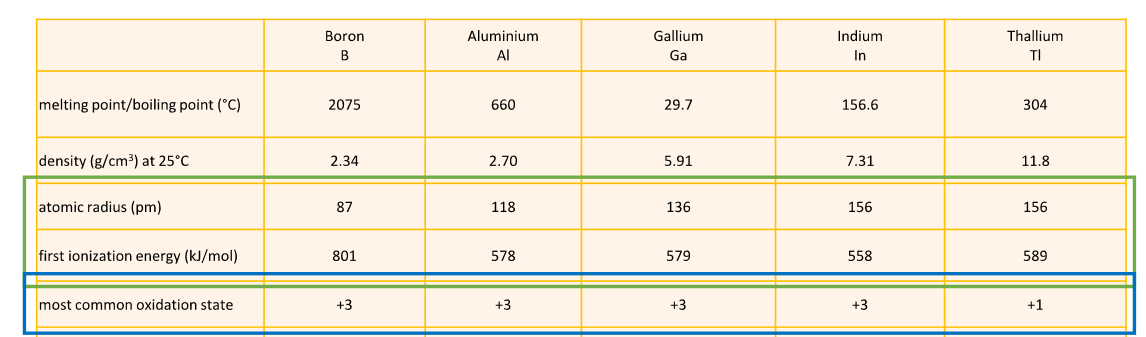
What are the most common oxidation states for group 13 elements?
• +3 is the most common oxidiation state • Apart from Thallium where it is +1 due to the inert pair effect
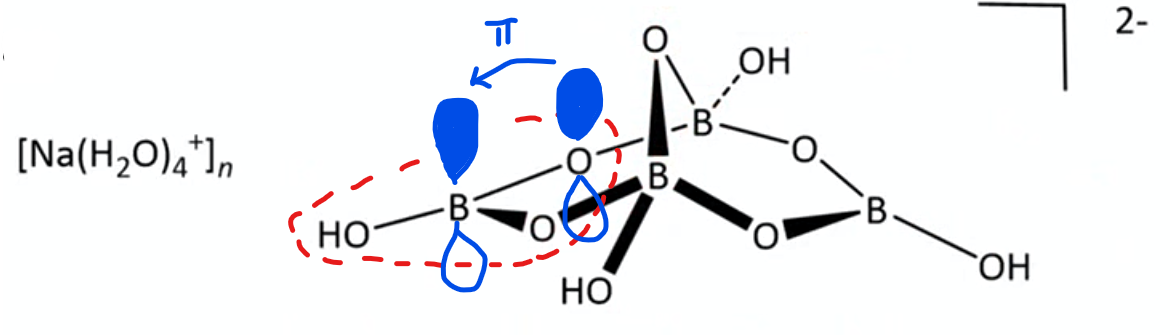
The complex shown below is borax What is the hybridisation of the boron unit on the left and how does this enable extra stability of the complex?
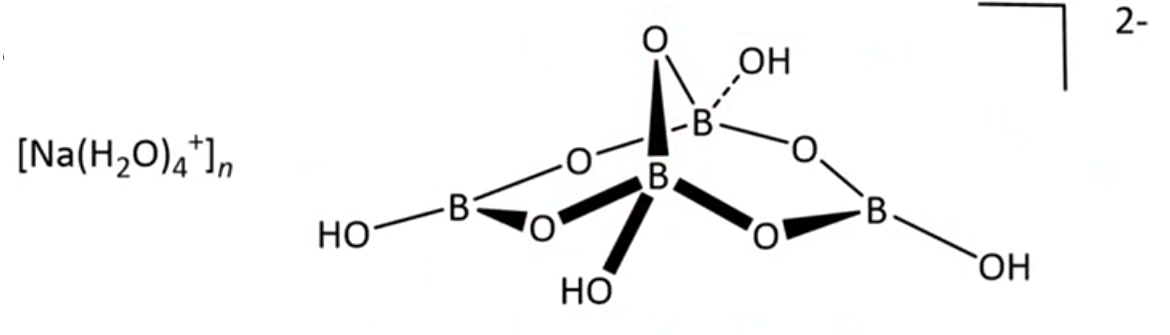
• the boron has a trigonal planar shape, hence is sp² hybridised • This means it has a empty p-orbital • This allows for oxygen to back donate some of its electron density (pπ-pπ interaction)
The complex shown below is borax What is the hybridisation of the central boron unit
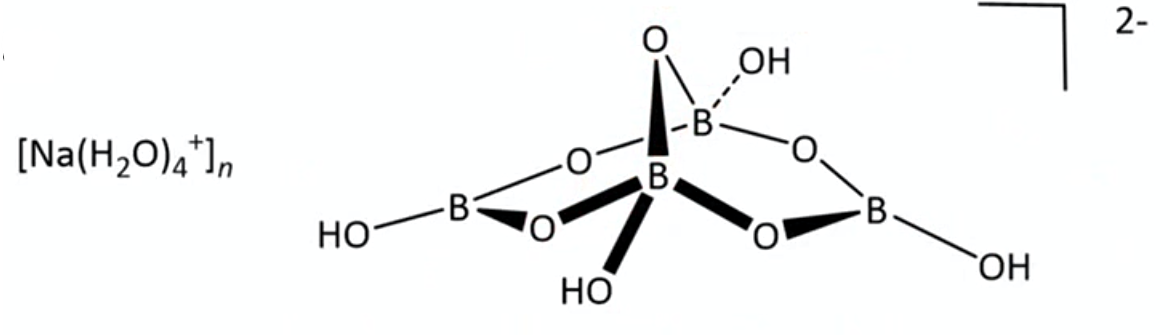
Central boron has a tetrahedral shape and is sp³ hybridised
How can BF₃ participate in π-bonding
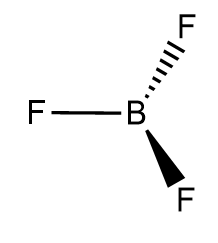
• The boron is sp² hybridised • uses all 3 valance electrons to form covalent bonds with F • The LP on fluorine can back donate to boron (pπ-pπ) giving some partial pi-bond character • This strengths the bond and locks boron into an sp³ planar geometry
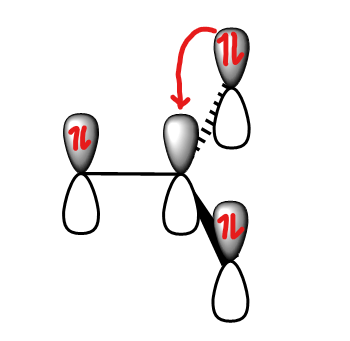
The π-bonding in BF₃ is not strong (large electronegativity difference between B and F) it still has a major influence on the properties How?
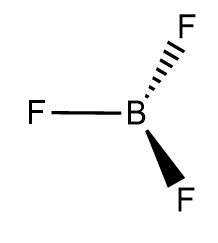
• Fluorine is the most electronegative compared to other halogens • Hence should be the strongest lewis acid (electron reciever) based on electron pulling ability • However: BI₃>BBr₃>BCl₃>BF₃ (it is the weakest) • This is due to π-bonding, which other larger halides cannot do due to large diffuse orbitals = poor overlap • The π-bonding means the boron in BF₃ is less electron deficient
How do the non-fluoride halides for group 13 bond, if they cannot π-bond well?
• The non-fluoride halides for the other elements dimeries, e.g.AlCl₃ (to Al₂Cl₆)
What is the product of the following reaction?
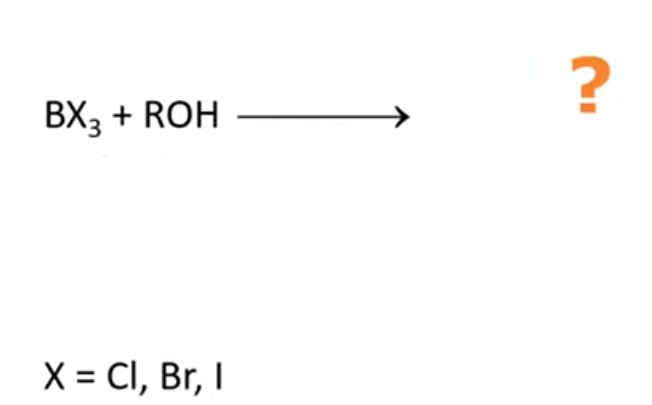
• We’ll firstly form a lewis acid-based addut (now tetrahdral with 4 bond, however a valency of 3) • HX can then be eliminated (e.g. HF) and form a trigonal planar trivalent boron again • If there is an excess of alcohol, X can be substituted multiple times for the alcohol
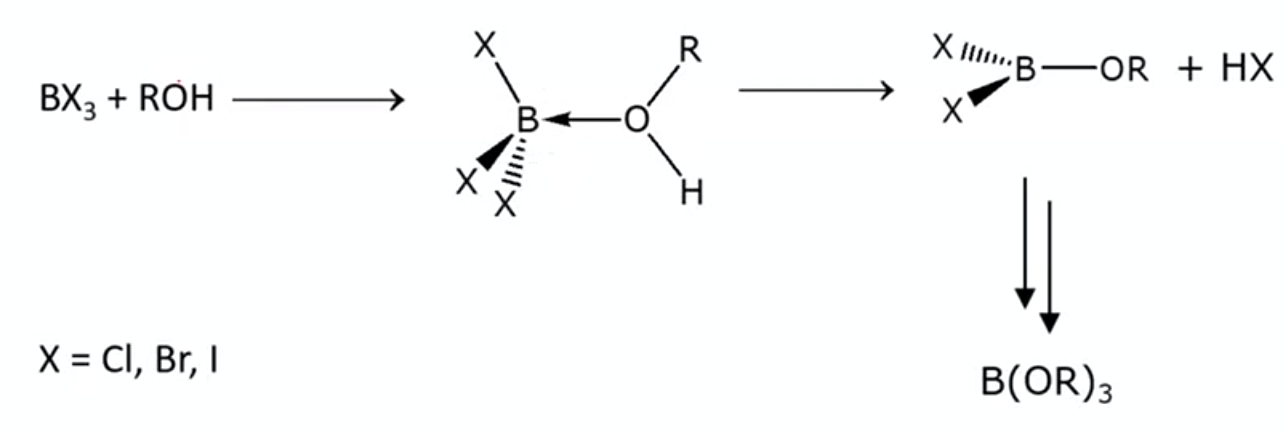
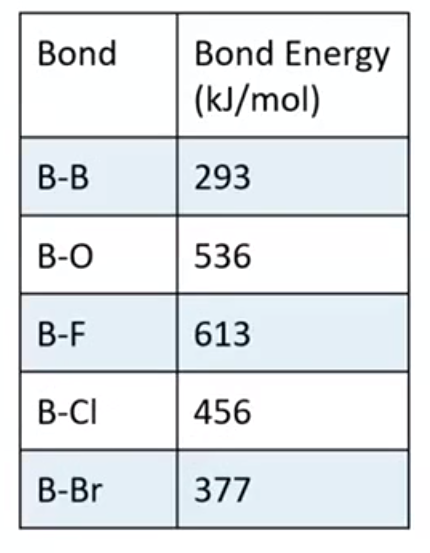
What halide can this following reaction not occur for?
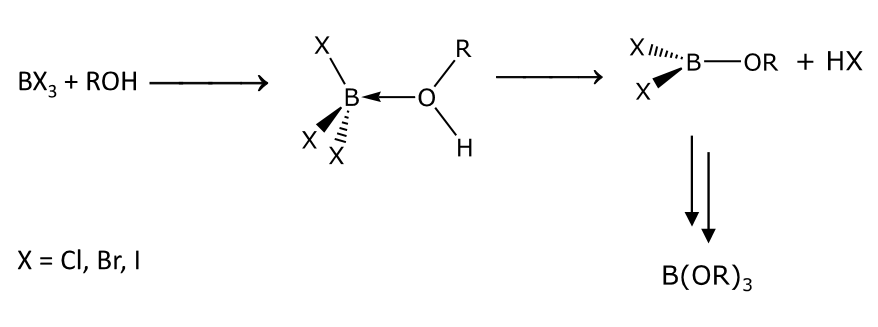
BF₃ resists Due to the strong B-F bonds There is no thermodynamic driving force for the second part of the reaction (breaking the B-F bond) But will still act as a lewis acid like in the first step
Across Al, Ga, In, which has the greater stability of the acid-base (Ligand) complex for fluoride
• MF₃L > MCl₃L > MBr₃L > MI₃L • (this is opposite if M was boron) • The reason for this is pπ-pπ back-donation can no longer occur as the valance orbitals are too far away (hence longer M-X bonds) • Therefore the trend is based soely on electronegativity
What is Borane? And what is the bonding and structure like?
• It is a boron hydride complex • B cannot π-bond with H (no lone pairs) - and the lack of electron density at boron because of this makes it a strong lewis acid • Hence forms a dimer
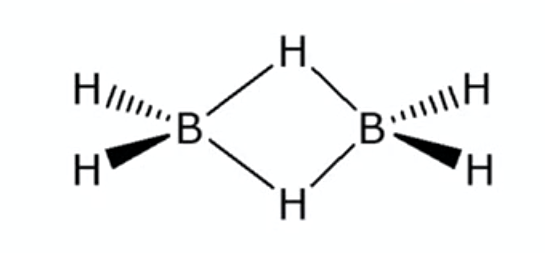
What is special about the planar B-H bonds in Borane
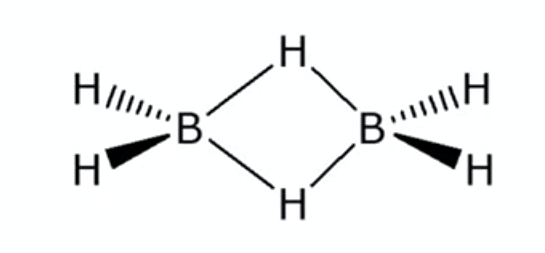
• The B-H-B (banana) bonds have 3 centres with 2 electrons • (ususally there should be 2 centres with 2 electrons) • AND valance bond theory fails here. It cannot account for this bonding are there is not enough valance electrons
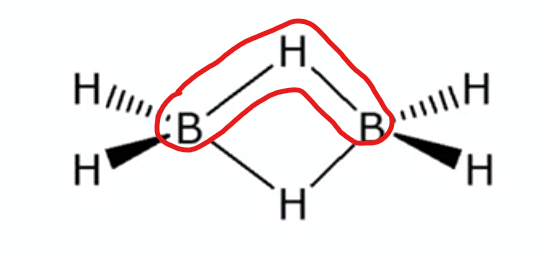
For each Boron atom in Borate, which orbitals do we have left to bond together the bridging B-H-B units?
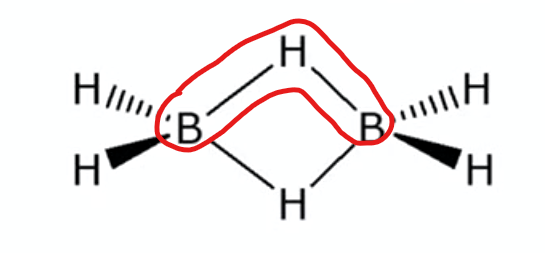
• Each boron atom is sp³ hybridised • For the dashed and wedged bonds 8 valence electrons are needed • Which 2x sp³ hybrids are used to form those bonds • Therefore remaining for the B-H-B bonds: 2x sp³ and 2x 1s orbitals from the bridging hydrogens
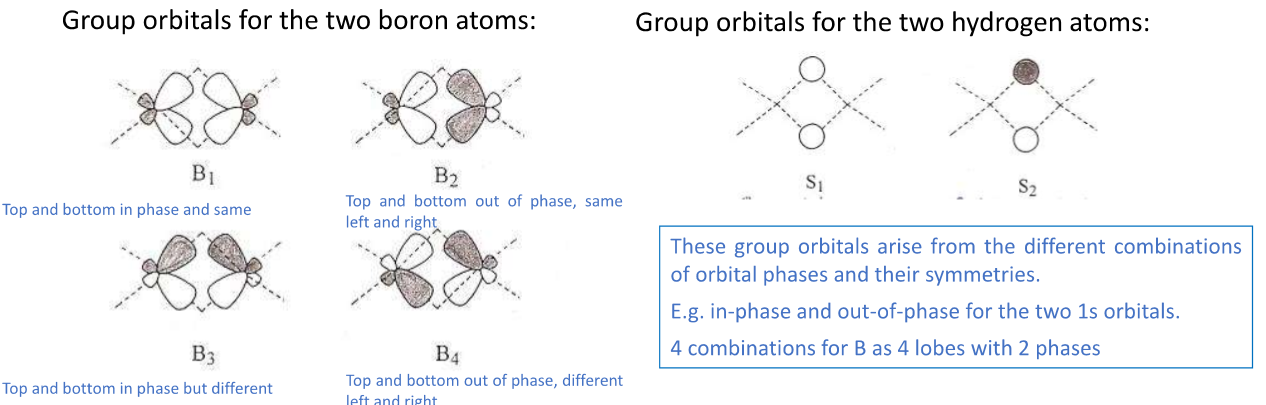
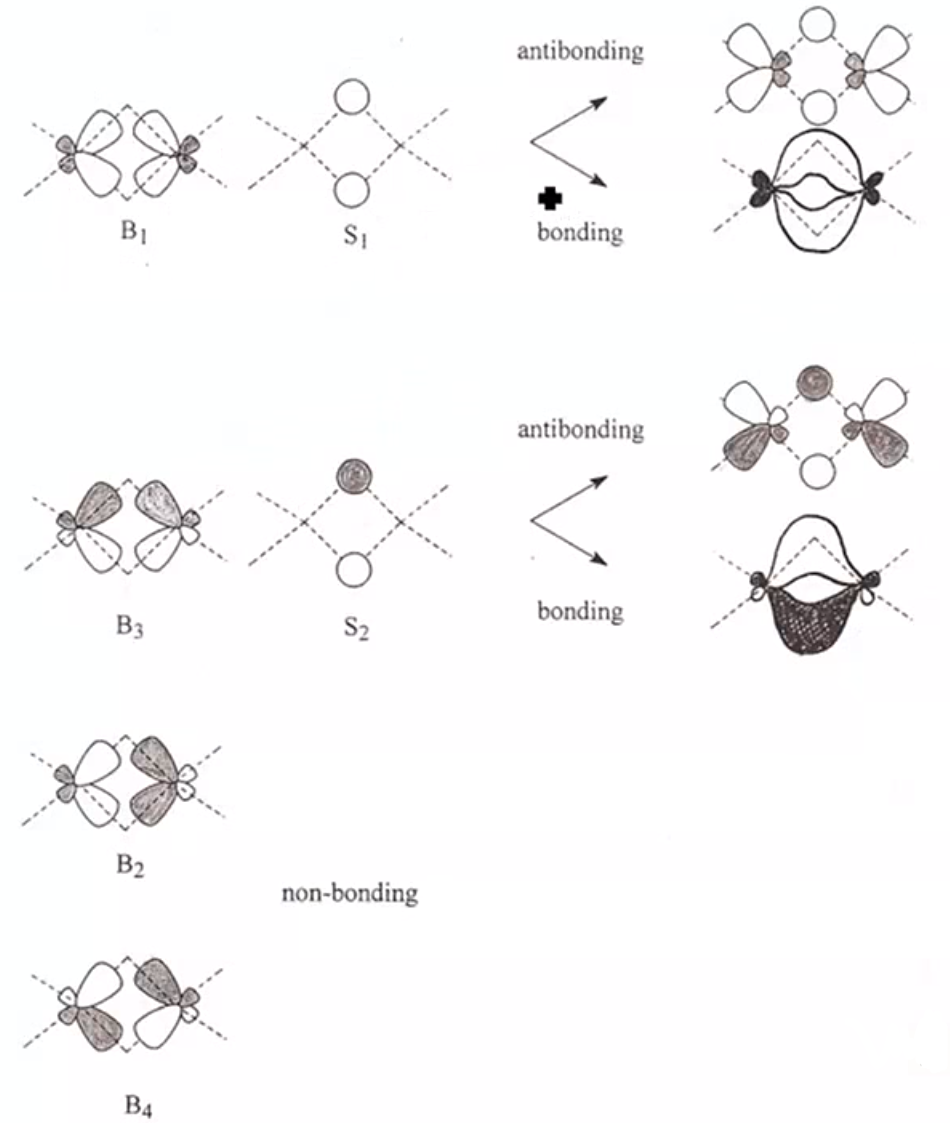
Which of the following orbitals from Boron and hydrogen can lead to a bonding interaction?
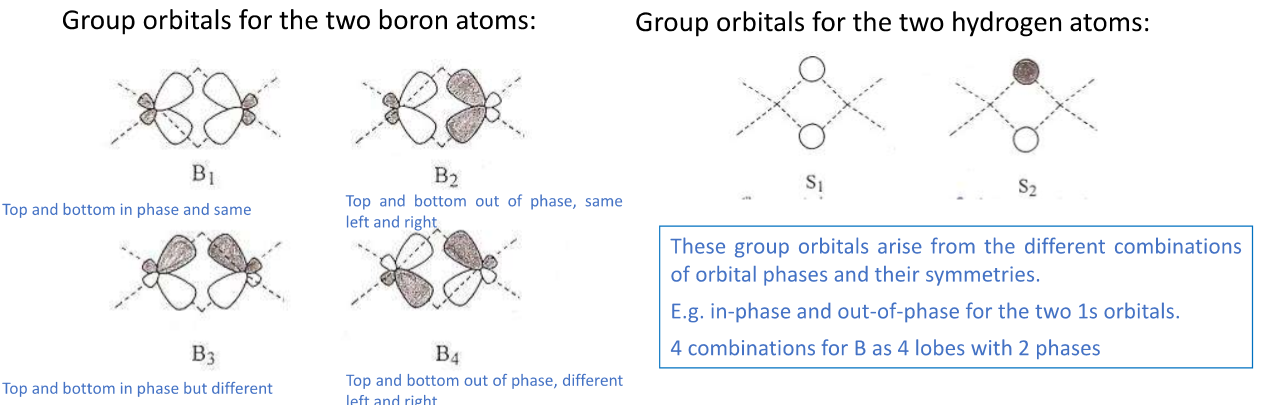
• B₁ and S₁ are of the same symmetry (in-phase and out-of-phase additions lead to bonding and antibonding MOs) • B₃ and S₂ are of the same symmetry (in-phase and out-of-phase additions lead to bonding and antibonding MOs) • B₂ and B₄ do not have complimentary symmetry to either S₁ or S₂ group orbitals (leading to non-bonding MOs)
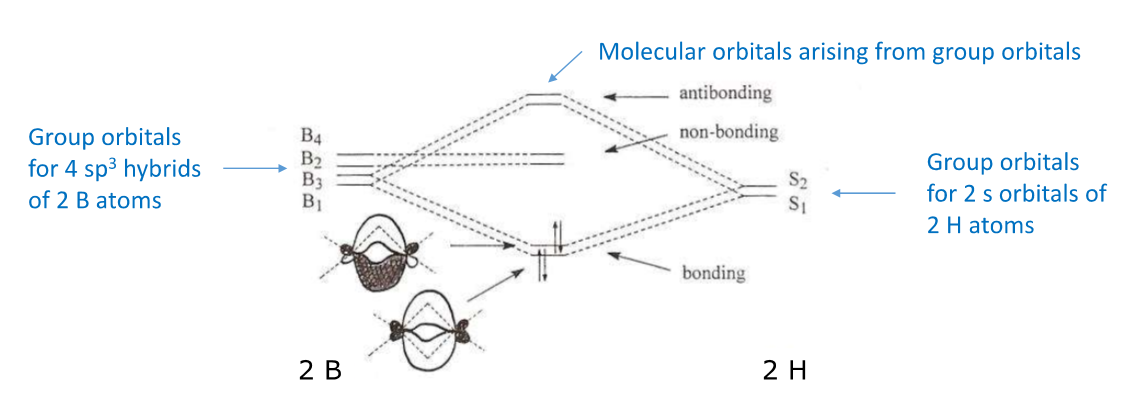
How many electrons are left to feed into the B-H-B planar (banana) bonds (hint: 12 valance electrons in total (6 from B’s; 6 from H’s))
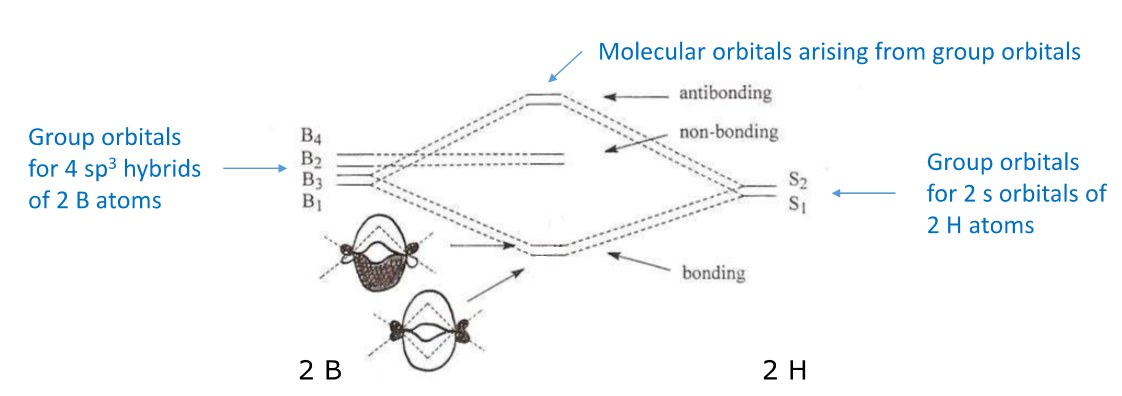
• valance electrons used up in forming the four terminal B-H bonds • Therefore 4 electrons to feed into the B-H-B units • 4 B-H bonds - each has a bond order of 1/2 - 2 electrons delocalised across each B-H-B bond • 3-centre 2-electron bond
What happens when you add a BH₃ dimer to other BH₃ units?
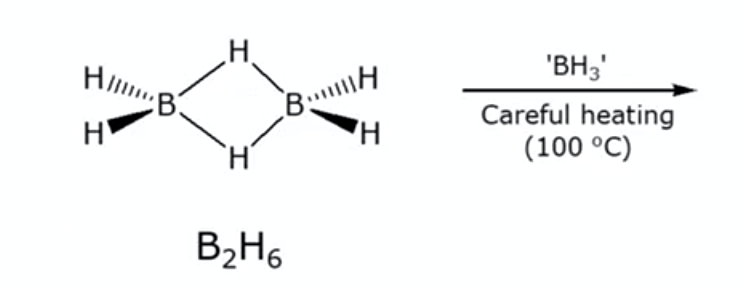
• Weak B-H-B bonds make the BH₃ dimer a good starting material for the preperation of BH clusters, or boranes • With the clusters having both regular and ‘banana’ B-H bonds
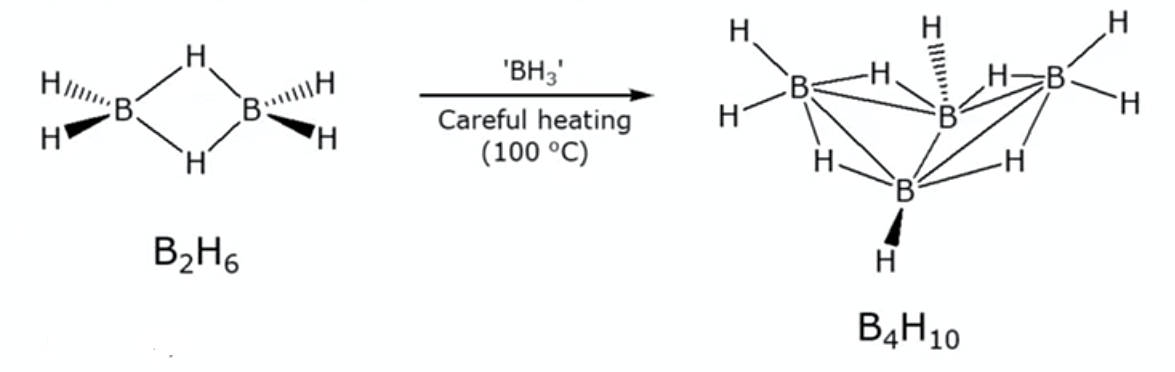
There are extensive covalent cluster chemistry of the boron hydrides that is not paralleled with heavier group 13 elements This is because hydrides become less stable as the group is descended Why?
• Larger valence orbitals = less effective sharing electron density between nuclei = weaker bond • e.g. gallene (GaH₃) decomposes at room temperature and InH₃ and TlH₃ are too unstable to exist unless coordinated
The following compound shown below is more stable than Al₂H₆, why?
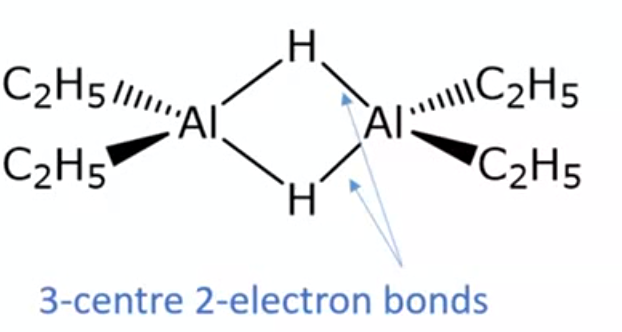
• The Et groups are electron releasing (+I effect) • Which stabilises electron deficient Aluminium
Balance the following equation

