S1) Patient Safety and Quality in the NHS
No description yet. This curated deck is ready for daily study.
Card preview (13)
Why have quality and safety become so important?
• Evidence of patient harm / sub-standard care • Variations in healthcare • Direct and indirect costs to the NHS • Government policies demanding change
Define healthcare quality from six different aspects
• Safe – no needless deaths • Effective – no needless pain/suffering • Patient-centred – focus on patients’ needs & priorities • Timely – no unwanted waiting • Efficient – no waste • Equitable – no one left out
What variations in healthcare exist in the UK?
Patients across England vary in: • The extent to which they receive high quality care • Access to care
What is equity?
Equity: everyone with the same need gets the same care
What is an adverse event?
An adverse event is an injury caused by medical management (rather than the underlying disease) that prolongs the hospitalisation and/or produces a disability
Provide an example of an adverse event
A drug reaction that occurs in a patient prescribed the drug for the first time is an adverse event—but one that may be unavoidable
What is a preventable adverse event?
A preventable adverse event is an adverse event that could be prevented given the current state of medical knowledge
Provide some examples of preventable adverse events
• Failure to rescue • Wrong dose/type of medication given • Retained objects • Operations performed on the wrong part of the body
Why do things go wrong in patient safety and quality?
• Poorly designed systems that do not take account of ‘human factors’ • Culture and behaviour
Most medical practice is complex and uncertain, thus increasing the likelihood of mistakes Provide examples of how the healthcare system compounds this complexity
• Inadequate training • Long hours • Similar ampoules with different contents • Lack of checks
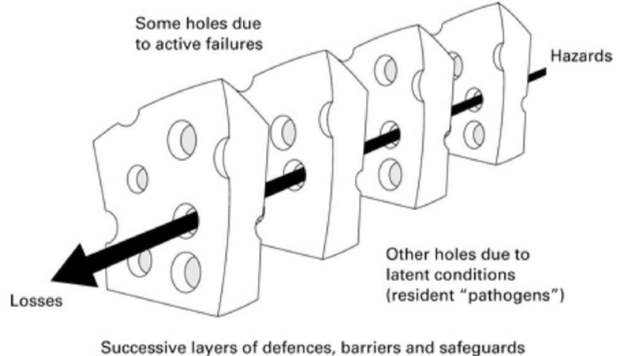
In terms of James Reason’s framework of error, explain the principle of active failures
• Active failures are acts which lead directly to the patient being harmed • They occur at the sharp end of practice i.e. by clinicians closely involved in care • E.g. baby has seizures as a result of being given an overdose of a drug*
In terms of James Reason’s framework of error, explain the principle of latent conditions
• Latent conditions (or failures) are the predisposing conditions • It is any aspect of the context in which care is provided that means the active failures are more likely to occur • E.g. poor training, poor design of syringes, lack of checks*
Illustrate James Reason’s Swiss Cheese Model