Gas & Liquid Properties
暂无描述。系统推荐的高质量记忆内容,适合每天坚持背诵学习。
卡片预览 (24 张)
What is the Ideal Gas Law?
P V = n R T Pressure (atm) * Volume = number moles * gas constant * Temperature (Kelvin) R=.082
What is the Kinetic Molecular Theory?
KE = (1/2)(mass)(velocity)2 • At the same Temp, all gases have the same average KE. • Speed increases with temperature, and decreases with mass. • Heavier gases are going to move slower but will have the same KE at that temperature. • Sidenote: At the same temperature, pressure, and volume, there will also be the same number of molecules. PV=nRT
Direct and Inverse relationships:
Just look at the PV = nRT fomula. Inverse if both in numerator on same side of equal sign.
How do you relate pressure and volume, if everything else is constant? PV = nRT
P1V1 = P2V2
How do you relate volume and temperature, if everything else is contant? PV = nRT
V1/T1=V2/T2
How do you relate Pressure and Temperature if everything else is constant? (PV=nRT)
P1/T1=P2/T2
What is Standard Molar Volume?
• Equal volumes of gases at the same T and P have the same number of molecules. • The volume for 1mol of gas at Standard Temperature (273 K) and Pressure (1.00 atm) is 22.4 Liters.
Convert from Celsius to Kelvin
Add 273 T = oC + 273 = K
Convert from mm Hg to atm
Divide by 760 1 atm=760 mm Hg
What are the equations to calculate density?
d = m/v d = PM/RT

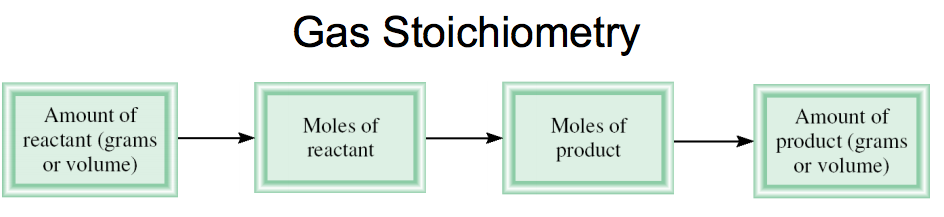
Steps for gas stoichiometry problems
What is diffusion?
Diffusion is the gradual mixing of molecules of different gases. • The rate of diffusion (or of effusion) of a gas is directly proportional to temperature and inversely proportional to its molar mass (technically the square root of it)
What is effusion?
EFFUSION is the movement of molecules through a small hole into an empty container. • Ex: air escaping knotted balloon through pores • The rate of effusion (and diffusion) is directly proportional to Temperature, and inversely proportional to Molar mass.
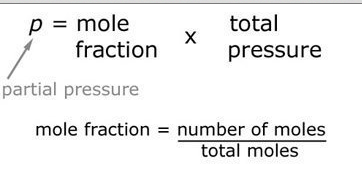
What is Dalton’s Law of Partial Pressures, and how could you calculate the partial pressure of each component?
• Ptotal in gas mixture = PA + PB + … • Partial pressure of component A = the moles of A divided by total moles (aka the mole fraction of A) X Total Pressure
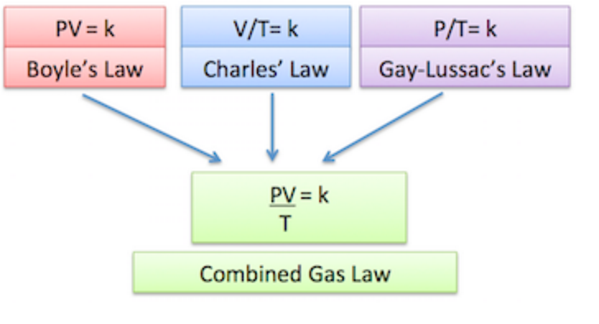
What is the combined gas law?
PV/T is a constant
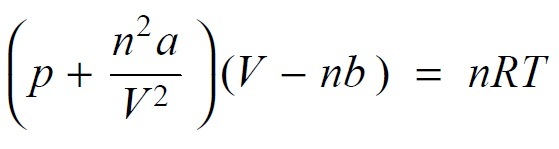
Describe the deviations from the ideal gas law, and the constants in the van der Waals equation
• The real Pressure is smaller than the ideal Pressure as a result of attractive forces between real gas molecules. They don’t go directly where they’re headed so hit wall less frequently. • a is for attraction. Larger a value means stronger attractive forces. ADD to P to get ideal. • The real Volume is larger than the ideal Volume because real molecules do take up some space. • b is for bigness. Larger b value means larger molecular sizes. Subtract from V to get ideal.
What are the 5 types of intermolecular forces, in order of their typical strength?
• Ion-dipole attractions • Hydrogen bonding (type of dipole-dipole attraction) • Other Dipole-dipole attractions • Dipole-induced dipole attractions • Induced dipole-induced dipole attractions. (aka London Dispersion Forces, Van der Waal’s Forces)
What are ion-dipole attractions?
• You have to have ions. The charged end of the ion interacts with a polar molecule (like water). • Look for polar molecule that dissociates and polar solvent (water). • Acids and bases in water will have ion dipole forces. • Similar to ion-ion except you have one ion and a partial ion which is a dipole. • The force of attraction depends on size of the molecule (how close can the nuclei get) and the size of the charge (Coulomb’s law) • The greater the force of attraction, the more exothermic the hydration enthalpy
What are dipole-dipole attractions?
• Two permanently polar molecules will be attracted to each other. (Whether the same or different substances.) • Hydrogen bonding is the strongest type of dipole-dipole. • Both molecules need to have a Hydrogen bond between H directly with FON. So both have to have either H-F H-O or H-N. • You can compare the strength for dipole dipole interactions if MM is similar - strength depends on how electronegative the central atom is.
What is hydrogen bonding?
• Hydrogen bonding is the strongest type of dipole-dipole attraction. • Special because nitrogen, oxygen and fluorine are very electronegative and often accompanied by lone pairs in structure. The hydrogen is attracted to their lone pair. • Both molecules need to have a Hydrogen bond between H and either F,O,N. • Tip: having fon • Look for H-O H-F H-N
What are induced-dipole dipole attractions?
• Occurs if there are polar and nonpolar molecules in a sample. • One of the molecules is permanently polar, and induces a nonpolar molecule to have a temporary dipole. • The larger a molecule is, the more polarizable it is. • If it’s in water, you’re going to see induced dipole
What are Induced dipole-induced dipole attractions? aka London Dispersion Forces aka Van der Waal’s Forces
• Everything will have them. They are the only attractive forces that exist between nonpolar molecules. Polar molecules have them too. • If it so happens that the electrons are all on the other side temporarily, the molecule can induce another temporary dipole moment. • Weak force but higher in molecules with larger molar mass (larger electron cloud, and ↑ polarizability)
What is surface tension?
• Molecules at the surface experience net inwards force of attraction. • Water molecules at the surface are pulled inwards by its neighbors below (hydrogen bonding)
What is wetting?
• The spreading of a liquid across a surface to form a thin film • The IMF between the liquid and surface are about the same strengh as the IMF within the liquid • So the surface must be hydrophillic • If the surface is hydrophobic, it does not have strong IMF forces with water. So the water molecules pull inwards, so only the fewest possible water molecules touch the surface.