Immunology
No description yet. This curated deck is ready for daily study.
Card preview (20)
Untreated immune deficiency leads to…
…death from overwhelming opportunistic infection
Primary Immune deficiency disorders
(Born with it) Bruton’s disease Congenital thymic aplasia (Di George Syndrome) SCID - severe combined immune deficiency
What is Bruton’s disease?
Congenital agammaglobulinaemia Absence of B cells No germinal centres, small tonsils Maternal transfer of IgG protects baby for 6-9 months Treated by gamma-globulin injections • or patient dies from staph, strep + haemophilus influenzae
Congenital Thymic Aplasia (Di George Syndrome)
Absence of T cells, no secondary antibody response Patients cannot control viral infections Fetal thymus transplant required
SCID (severe combined immune deficiency)
T cells do not mature Adenosine deaminase deficiency Agammaglobulinaemia Extreme susceptibility to infection 2 year survival time w/out Bone Marrow transplant
Causes of Secondary immune deficiency
Irradiation Cytotoxic drugs (suppress immune system) Glucocorticoids
Acquired Immune Deficiency Syndrome (AIDS)
HIV infecting + killing CD4 T cell = immune deficiency HIV lives inside T cells
3 lines of defence against infection
Physical barriers (skin, mucus membrane) Innate immune system (consists of phagocytes -phagocytosis) Adaptive immune system (dependent on antigen receptors on lymphocytes; includes acquired)
Clonal selection
ability to distinguish foreign, harmful antigenic threats (infection) from self - dependent on specific antigen receptors ability to then amplify that response by selectively expanding the clone of the crosslinked B cell or T cell + protective manner to protect against infection
Primary + secondary response
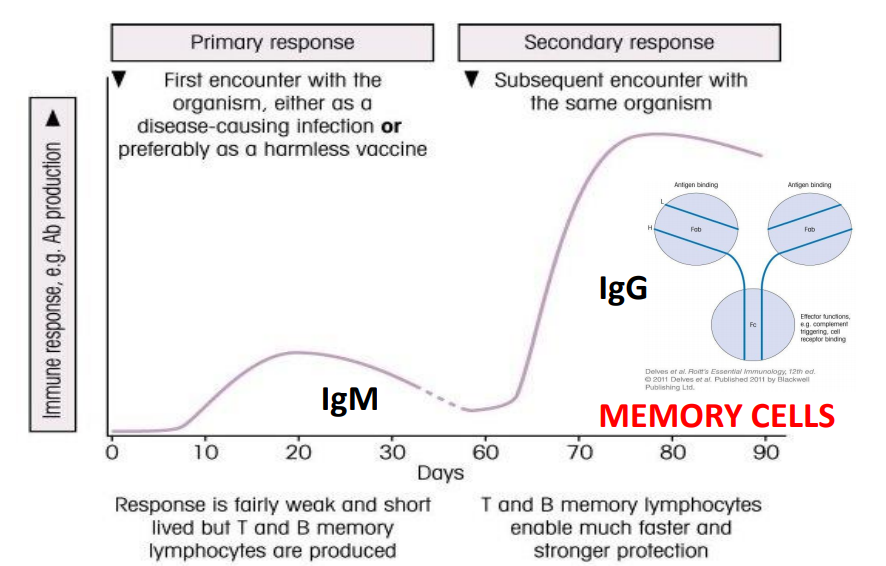
Function of the Spleen
Control blood-borne infection
T lymphocytes
Arise in bone marrow but mature in the thymus gland Start immune responses - have antigen specific T cell receptor (CD3) 2 populations of T cells • T helper • Cytotoxic T lymphocytes CD = cluster of differentiation = surface markers distinguishable by specific antibody reagents
B cells
Differentiate into plasma cells + secrete antibodies Function as a antigen-presenting cells (APCs)
Antigen-presenting cells (APC)
Focus antigen onto the T + B cell antigen receptors causing a more powerful immune response
Antibodies
Classification of antibodies
Immunoglobulin M (IgM) Immunoglobulin G (IgG) Immunoglobulin A (IgA) Immunoglobulin D (IgD) Immunoglobulin E (IgE)
What are antibodies?
Antibodies are also called immunoglobulins They co-purify with the globulin fraction of plasma There are 5 classes Each class has a specific receptor on its surface called Fc receptor. For phagocytosis to occur, antibodies crosslinked to antigen bind to Fc Region on phagocyte.
Where is the receptor for IgE found?
On basophils + mast cells They possess granules containing mediators e.g. histamine Mediators are released after contact with allergen
Chemokines + Cytokines
Act as chemical messengers
MHC + antigen presentation
MHC is also known as Human Leukocyte Antigens (HLA) Function of MHC is to present antigen to T cells to distinguish between self + nonself