Period 3
No description yet. This curated deck is ready for daily study.
Card preview (14)
Na + water
Sodium reacts with cold water. It fizzes around on surface etc. 2 Na (s) + 2 H2O (l) —– 2 NaOH (aq) + H2 (g)
Mg+ water
Magnesium reacts very slowly with cold water to form the hydroxide but reacts more readily with steam to form the oxide Mg (s) + H2O (g) ——MgO (s) + H2 (g)
Trends in the reactions of the elements Na, Mg, Al, Si, P and S with oxygen
The elements all react with oxygen to form oxides. Sodium burns with a yellow flame to produce a white solid Mg, Al, Si, and P burn with a white flame to give white solid smoke S burns with a blue flame to form an acidic choking gas. 4 Na (s) + O2 (g)—– 2 Na2O (s) 2Mg (s) + O2 (g)——-2MgO (s) 4Al + 3O2 (g)——- 2Al2O3 (s) Si + O2 (g)—- SiO2 (s) 4P + 5O2 (g)——- P4O10 (s) S+ O2 (g)——– SO2 (g)
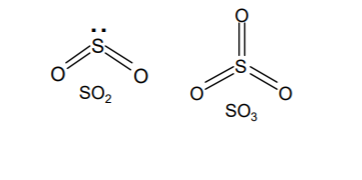
Draw So2 and SO3
Why is Sodium is stored under oil and phosphorus under water
Sodium is stored under oil and phosphorus under water to stop these elements coming into contact and reacting with air
Ionic oxides
The metal oxides (Na2O, MgO, Al2O3 ) are ionic. They have high melting points. They have Ionic giant lattice structures: strong forces of attraction between ions: higher mp. They are ionic because of the large electronegativity difference between metal and O The increased charge on the cation makes the ionic forces stronger (bigger lattice enthalpies of dissociation) going from Na to Al so leading to increased melting points. Al2O3 is ionic but does show some covalent character. This can be explained by the electronegativity difference is less big or alternatively by the small aluminum ion with a high charge being able to get close to the oxide ion and distorting the oxide charge cloud.
Macromolecular oxides
SiO2 is Macromolecular: It has many very strong covalent bonds between atoms. High energy needed to break the many strong covalent bonds – very high mp +bp
Simple molecular oxides:
P4O10 (s), SO2 (g) are simple molecular with weak intermolecular forces between molecules (van der waals + permanent dipoles) so have lower mp’s. They are covalent because of the small electronegativity difference between the non-metal and O atoms. P4O10 is a molecule containing 4P’s and 10 O’s. As it is a bigger molecule and has more electrons than SO2 it will have larger van der waals forces and a higher melting point
Aluminium metal is protected from corrosion in moist air by…
Aluminium metal is protected from corrosion in moist air by a thin layer of aluminium oxide. The high lattice strength of aluminium oxide and its insolubility in water make this layer impermeable to air and water
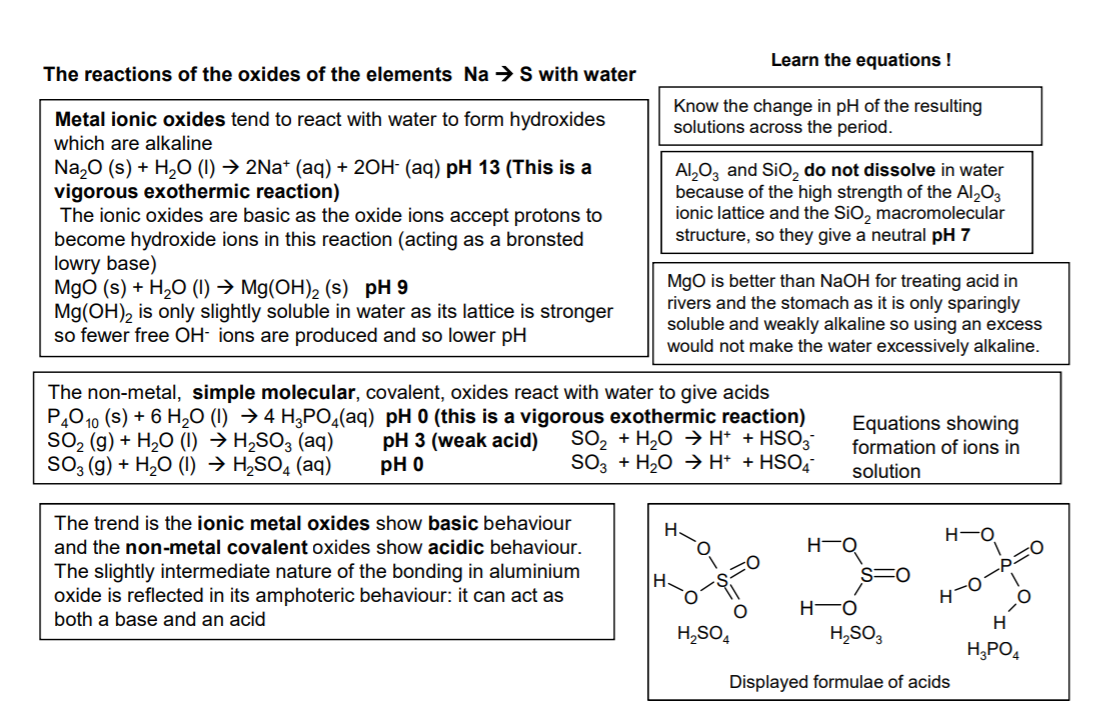
The reactions of the oxides of the elements Na to S with water
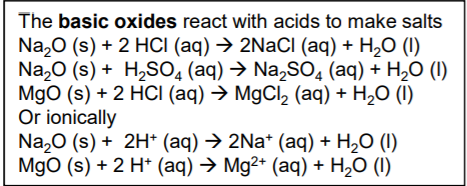
Acid reactions between period 3 oxides and simple acids and bases
Amphoteric Oxides
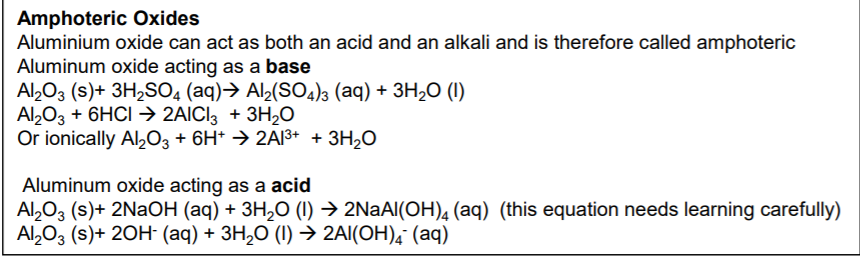
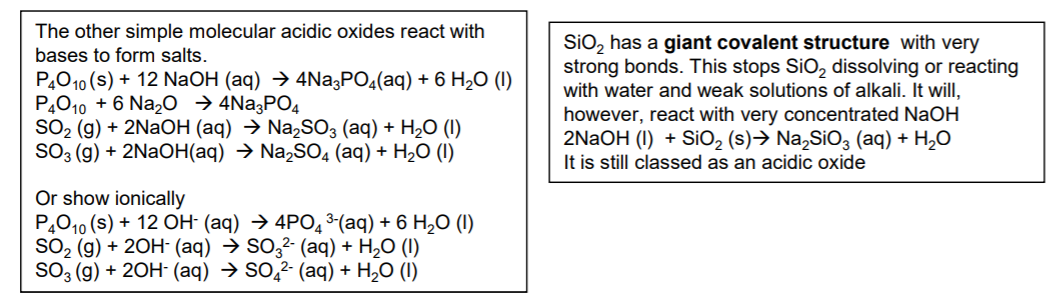
The other simple molecular acidic oxides react with bases to form salts