Chapter 1: Atomic Structure
No description yet. This curated deck is ready for daily study.
Card preview (24)
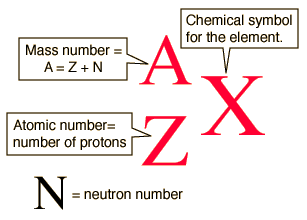
Atomic Number
number of protons found in an atom of an element (Z)
Mass Number
Sum of protons and neutrons in nucleus (A)
What is the convention for nuclear notation?
Isotopes
Same atomic number, different mass number Almost all elements exist as 2+ isotopes, which are usually present in the same proportions in any sample of a naturally occurring element
Unit of Charge
1.6 x 10⁻¹⁹ C
Protons
Found in nucleus of atom, +1e charge, mass of 1 amu
Neutrons
No charge, slightly larger mass than proton, can vary in number among atoms of an element
Electrons
Move through space around nucleus, different energy levels, -1e charge, mass = 1/2000 of proton
Attraction of subatomic particles
Electrostatic attraction > gravitational force
Electron Shell
Electrons in outer shells have higher average energy and travel farther from the nucleus than those in inner shells
Valence Electrons
Electrons farthest from nucleus; have strongest interactions with environment. They determine the reactivity of an atom.
What allows atoms to increase stability?
The sharing or transferring of valence electrons in bonds, which allows elements to fill their highest energy level
How many proton and electrons are present in an atom’s neutral state?
Equal numbers of protons and electrons
Cation
Positively charged atom
Anion
Negatively charged atom
Atomic Mass
Mass number (different for each isotope) Different isotopes have different atomic masses
Atomic Weight
Weighted average of the different isotopes of an element, which have their own atomic mass. Represents both the mass of the “average” atom of that element, in amu, and mass of one mole of the element (in grams)
What is the mass of 1 proton?
About 1 amu
What is the size of 1 amu?
1/12 the mass of a Carbon-12 atom 1.66 x 10⁻²⁴ g
Mole
Avogadro’s number = 6.02 x 10²³
Which electrons have the lowest energy level?
The ones closest to the nucleus
Which is stronger, the electrostatic attraction or gravitational force between subatomic particles?
Electrostatic attraction, since their mass is really small
What was Rutherford’s idea?
Atoms have a small, dense, positively charged nucleus
What did Planck theorize about the emission of energy from atoms?
Energy is emitted as EM radiation from matter comes in discrete bundles called quanta