Week 5
No description yet. This curated deck is ready for daily study.
Card preview (22)
What are the Two most common and important descriptions(summaries) of data?
• Location • Spread (or variation) Tells us how variable the measurements are from individual to individual
What are the measures of location?
Mean Median Mode
What does location inform?
Location (or central tendency) Tells us about the average or typical individual
What does spread tell us?
Spread (or variation) Tells us how variable the measurements are from individual to individual
What are the common measures of spread(variation)?
• Range • Standard deviation • Variance • Coefficient of variation
Is the range a good estimator of the distribution width?
no Small samples tend to give lower estimates of the range than large samples So sample range is a biased estimator of the true range of the population.
What is the standard deviation?
Positive square root of the variance
What is a parameter?
• Is a summary describing the population e.g. means, measures of variation, measures of relationship • The “truth” IF you were able to measure ALL individuals in the population
What is a Statistic?
Is an approximation (estimate) of the truth, subject to error
How do precision and uncertainty relate to each other?
• High precision = low uncertainty • Low precision = high uncertainty
What is standard error?
• Key measure of the precision of an estimate
What is the effect of increased sample size on spread?
Increasing the sample size reduces the spread of the distribution of an estimate, increasing precision
What does the standard error achieve?
quantifies the uncertainty around that estimate Reflects the precision of an estimate
are Estimates with small standard errors more or less precise?
more precise than those with larger standard errors
What is the formula for the Standard error of the mean?
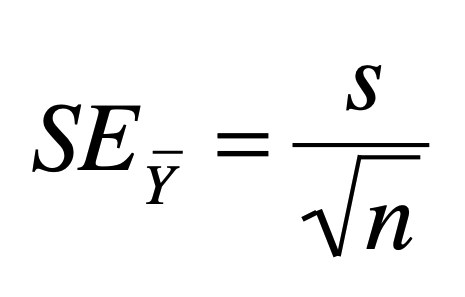
What does standard error imply about replication?
More replication is always better AS LONG AS the replicates are true replicates
What is a Type I error?
– fail to reject a true null hypothesis
What is a null hypothesis?
treatment has no effect on response variable
What is a sample?
• A sample is one measurement taken from a single independent unit. • Independent units do not interact.
What is a subsample?
• Sometimes multiple sub-samples are averaged to make a single sample.
What is a Replicate?
A replicate consists of one complete set of treatments and one control.
define replication?
The process of iteratively observing multiple independent samples.