Data storage and compression
No description yet. This curated deck is ready for daily study.
Card preview (12)
(Exam-style question) Both kibibyte and kilobyte can be used as measures of file size. Compare kibibyte and kilobyte. (2)
Any one from: • Kilobyte is an SI measurement, whereas kibibyte is an International Electrotechnical Commission (IEC) measurement • Kilobyte is equivalent to 1000 bytes, whereas a kibibyte is equivalent to 1024 bytes • Kilobyte is equivalent to 10³ bytes, whereas a kibibyte is equivalent to 2¹⁰ bytes • Kilobyte is a base 10 measurement, whereas a kibibyte is a base 2 measurement
Recall the conversions between binary multiples.
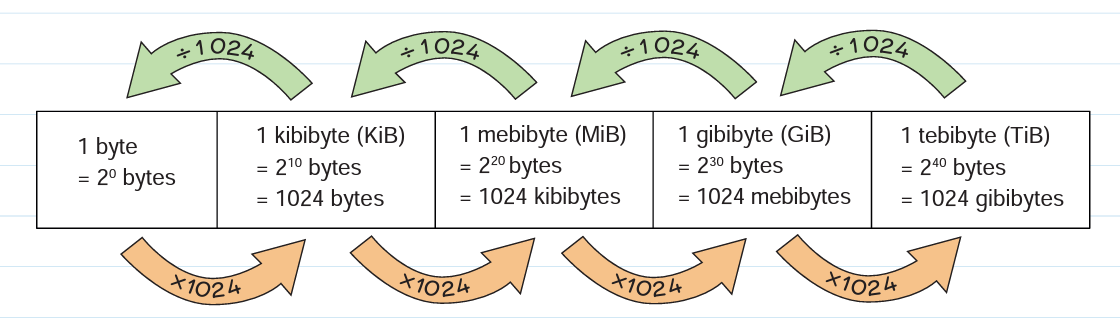
Recall the number of bytes represented by each of the following: kilobyte, megabyte, gigabyte, terabyte
• kilobyte (kB) - 10³ • megabyte (MB) - 10⁶ • gigabyte (GB) - 10⁹ • terabyte (TB) - 10¹²
Give some reasons for why file compression is used.
• Less internet bandwidth is used when files are downloaded/uploaded • Transfer time is faster • Reduced file size / less storage space is needed • Smaller files reduce congestion on the internet
Describe the purpose of lossless compression.
• Reduces file size without deleting any data • When compressed data is uncompressed, it is restored completely to the original file
Describe how lossless compression works.
Algorithms look for areas of redundancy where same data is stored many times, grouping this data into one reference (this is an example of run-length encoding)
Give examples of where lossless compression is used successfully and where it is used less successfully.
Successful uses • Text files • Graphic files with a low colour depth Less successful uses • Audio files • 24-bit colour files
Describe the purpose of lossy compression.
• Reduces file size by deleting some data • Changes made are irreversible and original form cannot be retrieved
Describe how lossy compression works.
• Image files - algorithms analyse image and find areas where there are slight differences, give these area same value and the file is rewritten with less bits • Digital sound recordings - small variations in frequency, tone and volume are removed, human ear cannot detect these small differences
Give examples of where lossy compression is used successfully and where it is used less successfully.
Successful uses • Image files • Digital sound recordings Less successful uses • Text files • Executable software
Give 2 examples of lossy algorithms.
• JPEG • MP3
(Exam-style question)

3c3w2c6w3c