Organic Test 3
No description yet. This curated deck is ready for daily study.
Card preview (24)
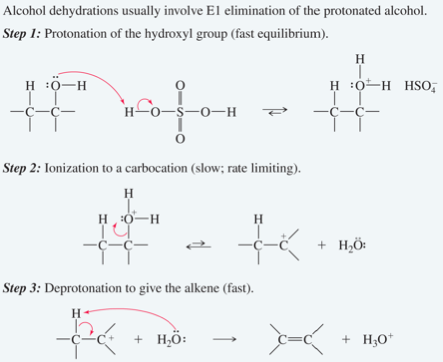
Acid- Catalyzed Dehydration of an Alcohol Mechanism
By the E1 mechanism
What two different reagants can be used if you want to form an anti-diol from an alkene?
• MCPBA then H3O+ • CH3CO3 in water
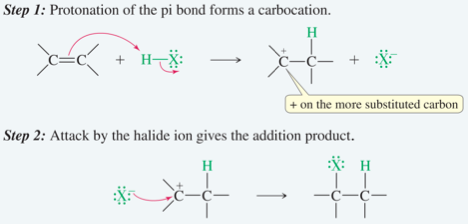
Mechanism for Ionic Addition of HX to an alkene
Stability of Cis/Trans isomers
Trans isomers are generally more stable than the corresponding cis isomers.
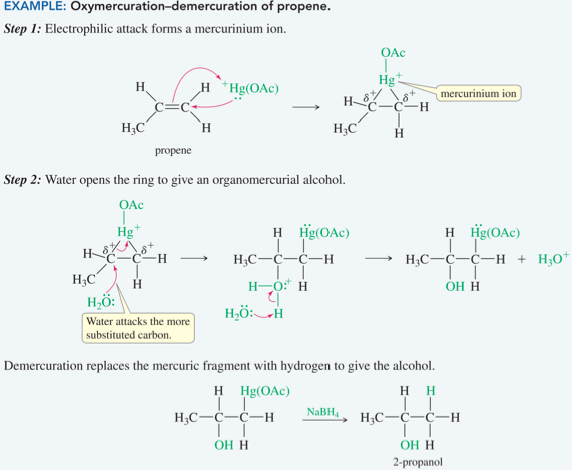
oxymercuration-demercuration mechanism
**Results in a Markovnikov addition of OH and H without rearrangement. Use if you don’t want it to rearrange!
Free-Radical Halogenation of HBr Result with peroxide
Results in an anti-markovnikov addition in the presence of peroxide
Platinum and H2 as reagants together do what ____
reduce alkene to alkane (hydrogenation)
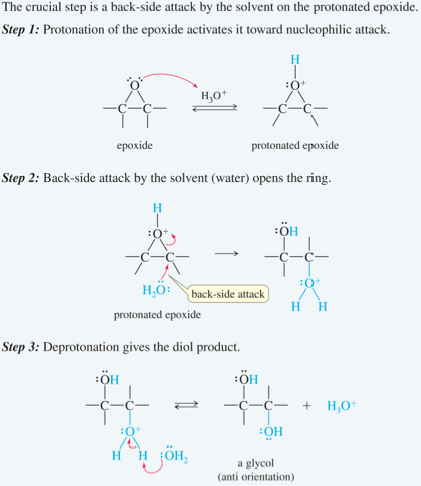
What is the mechanism for an Acid-Catalyzed opening of an Epoxide?
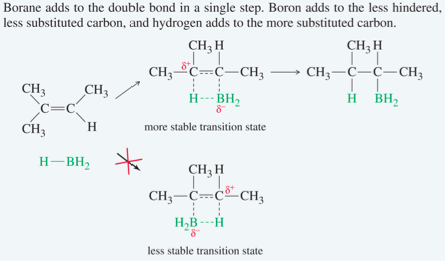
Mechanism for Hydroboration of an alkene
**anti-mark **syn-addition
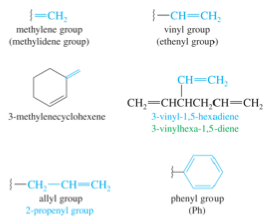
Alkenes as Substituents
alkenyl groups: methylene vinyl allyl phenyl
What two reagants are used for oxidative cleavage of alkenes and what is the difference between them?
• KMnO4 (warm/conc.) harsh, can’t recover aldehydes they are further oxidized into alcohols. • O3 then (CH3)2S can recover aldehydes
Addition of Hydrogen Halides to Alkenes

An E2 elimination takes place on a chair confirmation only if the proton and leaving group are _____
transdiaxial
E-Z nomenclature
If the two first-priority atoms are together (cis) on the same side of the double bond, you have the Z isomer, from the German word zusammen, “together.” If the two first-priority atoms are on opposite (trans) sides of the double bond, you have the E isomer, from the German word entgegen, “opposite.”
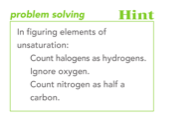
Equation for Elements of Unsaturation
=(1/2)(2C+2-H) C= Carbon H= Hydrogen Double bond= 1 element of unsaturation A ring= 1 element of unsaturation A triple bond= 2 elements of unsaturation
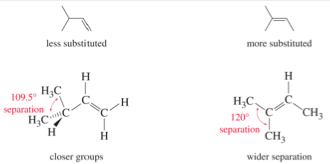
Zaitsev’s rule (stability of double bonds)
More substituted double bonds are usually more stable. The alkyl groups attached to the double bonded carbons stabilize the alkene.
If an alkene can not easily undergo hydration in aqueous acid, what reagant can be used?
• Hg(OAc)2/ H2O • NaBH4 (oxymercuration-demercuration)
Energy Differences in cis-trans isomers
Trans isomers are generally more stable than the corresponding cis isomers. In this case, the alkyl substituents are separated farther in trans isomers than they are in cis isomers.
Mechanism for the formation of Halohydrins (OH and X) from alkenes
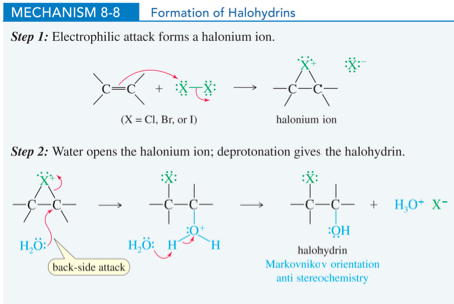
What reagants are necessary to turn a double bond into a dibromocyclopropane?
CHBr3 KOH and H2O **cis/trans isomerism retained
Summary for naming Alkenes
• Select the longest chain or largest ring that contains the largest possible number ofdouble bonds, and name it with the -ene suffix. • Number the chain from the end closest to the double bonds. Number a ring so that the double bond is between carbons 1 and 2. Place the numbers giving the locations of the double bonds in front of the root name (old system) or in front of the suffix -ene, - diene, etc. (new system). • Name substituent groups as in alkanes. The ethenyl group and the propenyl group are usually called the vinyl group and the allyl group, respectively. • Remember E-Z Nomenclature if you can’t use Cis/Trans. (Also, never forget R/ S if necessary) (diene,triene,tetraene,etc)
What is a peroxide?
