C4.5 - Titration 1️⃣✅
No description yet. This curated deck is ready for daily study.
Card preview (20)
What are the 3 indicator solutions used in a titration?
• Litmus • Phenolphthalein • Methyl Orange
What colour does Litmus turn if an acid is present?
Red
What colour does litmus turn if an alkalia is present?
Blue
What colour does phenolphathalein turn if an acid is present?
Colourless
What colour does phenolphathalein turn is an alkalia is present?
Pink
What colour does methyl orange turn if an acid is present?
Red
What colour does methyl orange turn if an alkalia is present?
Yellow
Why do we place the conical flask on a white tile?
To make the colour change easier to see
Why do we swirl the conical flask as you add the acid/alkalia?
To ensure even distribution of acid/ alkali
What is a titre?
The difference between the starting volume and the end volume of acid/alkalia to work out the total volume of alkalia/acid added to the flask in total.
What are th main 5 specialist equipment used in titration?
• Pipette • Conical Flask • Burette • White Tile • Pipette filler
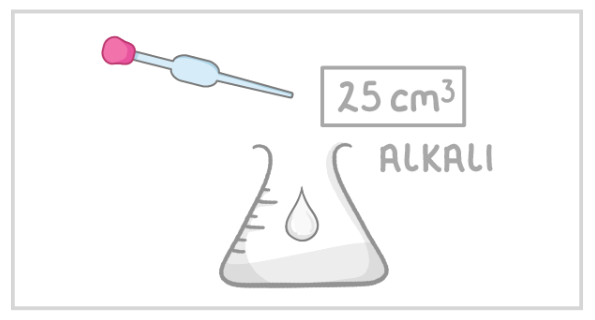
What is the 1st step in titration?
Use your pipette to add 25cm3 of alklakia/acid to a clean conical flask
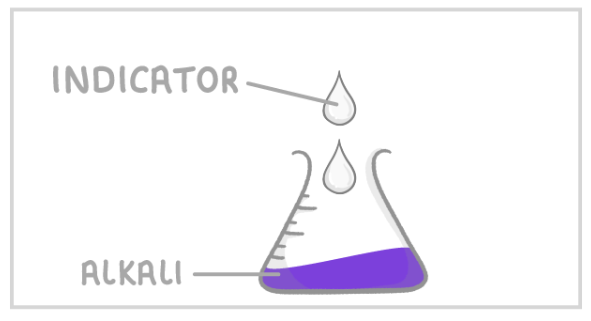
What is the 2nd step in titration?
Add a few drops of indicator and put the conical flask on a white tile
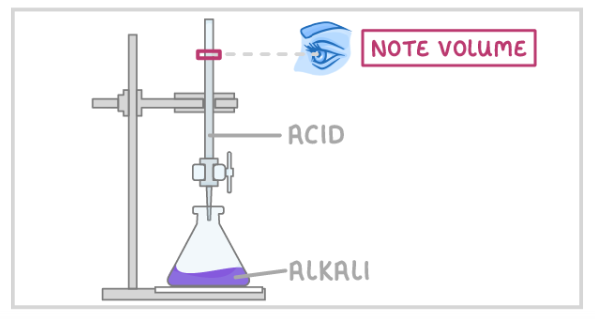
What is the 3d step in titration?
Fill the burette with acid/alkalia and note the starting volume
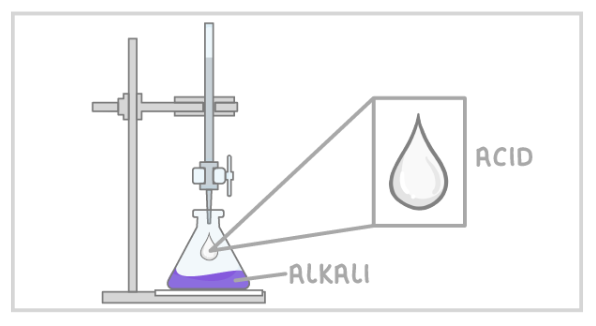
What is the 4th step in titration?
Slowly add the acid/alkalia from the burette to the alkalia/acid in the conical flask, swirling to mix - adjust tap to let out 1 drop at a time , swrirling continuously
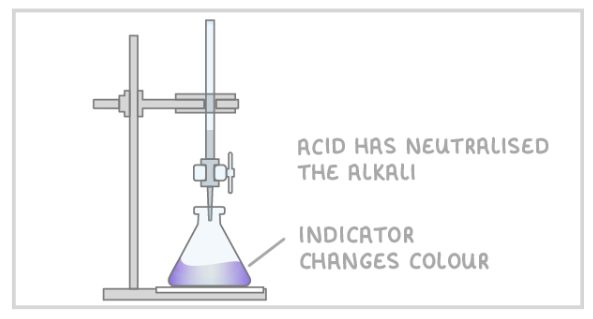
What is the 5th step in titration?
Stop adding acid/alkalia when the end point is reached e.g. when the acid/alkalia is neutralised by the alkalia/acid and the indicator changes colour
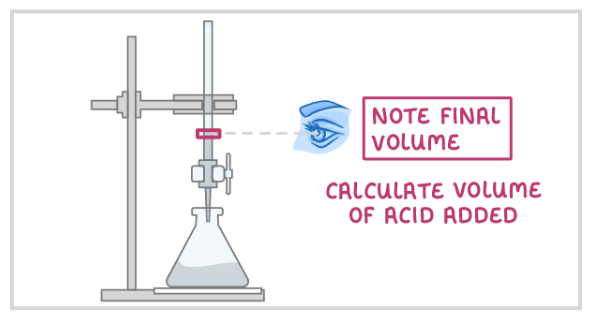
What is the 6th step in titration?
Note the final volume reading and calculate your titire.
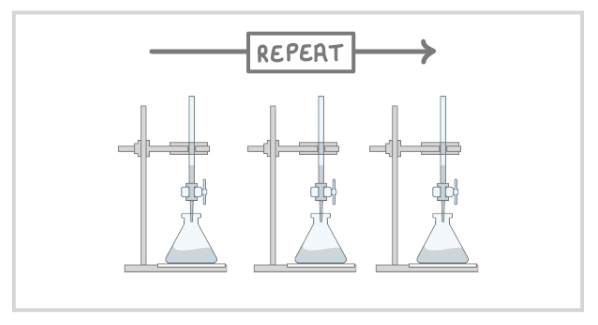
What is the 7th step in titration?
Repeat your titration until your titres/ results are concordant.
What do concordants results mean?
Concordant results are results/ volumes of acids that are within 0.10 cm3 of eachother
What is the 8th step in titration?
Finally use your concordant titres to work out a mean volunme of acid required to neutralise that alkalia/acid