Chapter 4
No description yet. This curated deck is ready for daily study.
Card preview (19)
Exothermic (-H)
Heat is released Weak bonds broken, stronger bonds formed
Endothermic (+H)
Heat is absorbed Strong bonds broken, weaker bonds formed
Reactions favor products with the ________
Reactions favor products with lowest enthalpy
Larger BDE = ?
stronger bond: more energy to break bond
Bond dissociation energy proportional to orbital overlap
better overlap → stronger bonds
heterolytic cleavage

homolytic cleavage
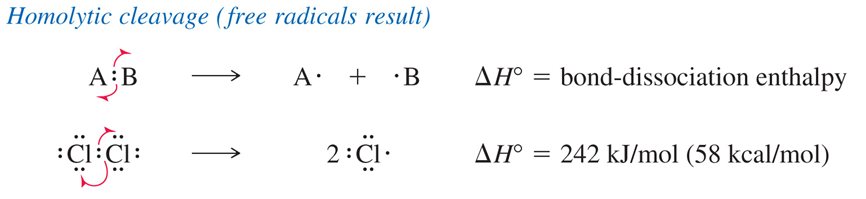
Determine which molecule has higher BDE: Cl2 vs. Br2
Cl2: orbital overlap is greater due to smaller atomic radius of Cl
Determine which molecule has higher BDE: C-O vs. C-S
C-O: bond is more polarized and orbital overlap is greater (atomic radii similar)
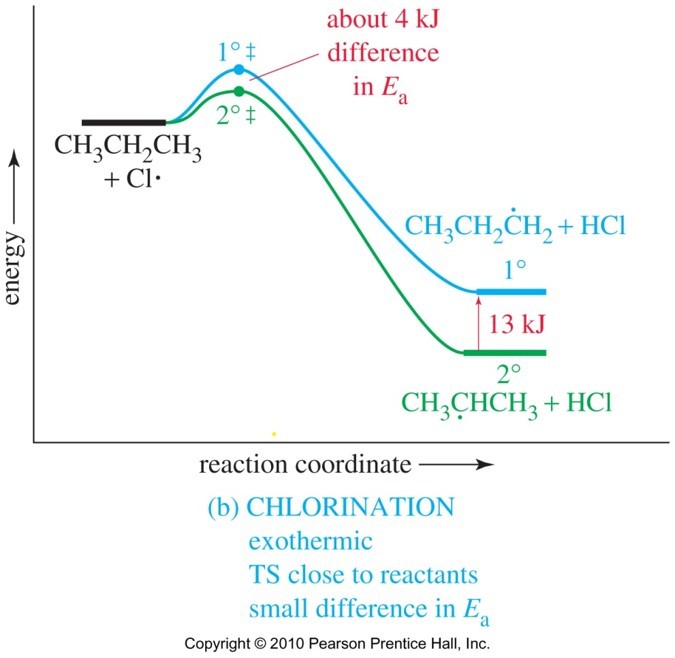
What happens during the transition state
Bond breaking and bond forming occur in transition state. Reorganization to an intermediate or product
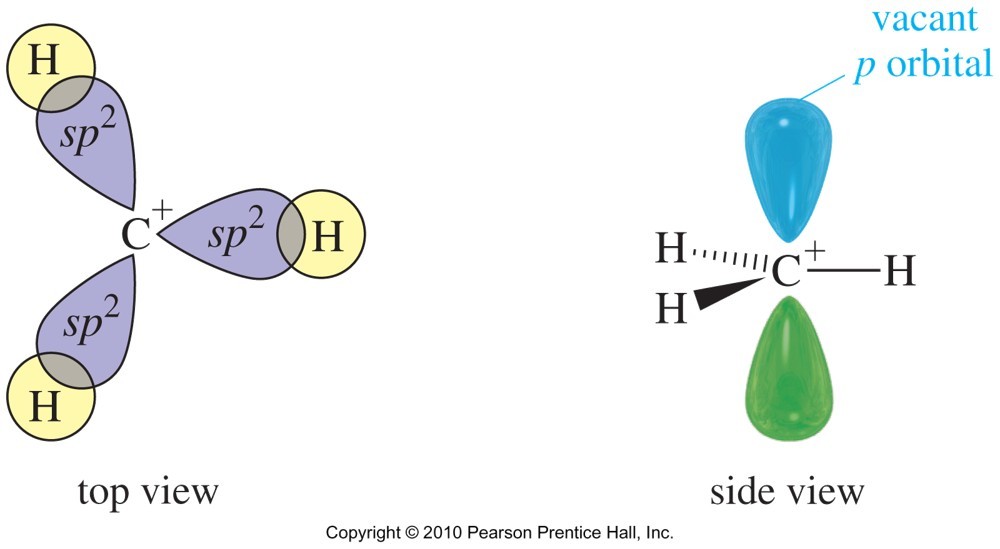
Carbocation Structure
Carbon has 6 electrons, positively charged. Carbon is sp2 hybridized with vacant p orbital.
Carbocation Stability
Stabilized by alkyl substituents in two ways: • Inductive effect: Donation of electron density along the sigma bonds. • Hyperconjugation: Overlap of sigma bonding orbitals with empty p orbital.
Inductive Effect
• Inductive effect: Donation of electron density along the sigma bonds.
Hyperconjugation
Hyperconjugation: Overlap of sigma bonding orbitals with empty p orbital.
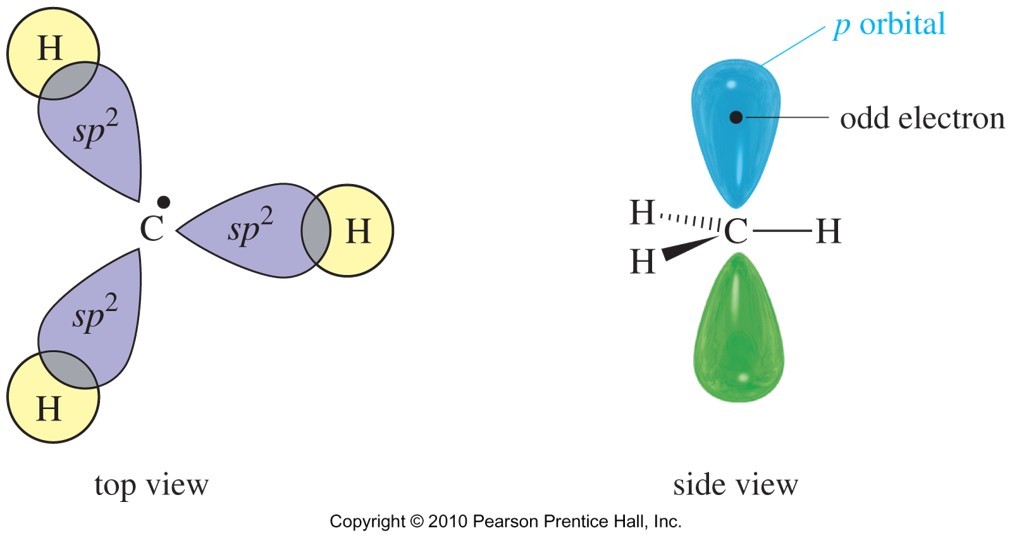
Carbon Free radical
• electron-deficient –Less-sensitive to stabilizing factors (same order of stability though) • Stabilized by alkyl substituents and by resonance
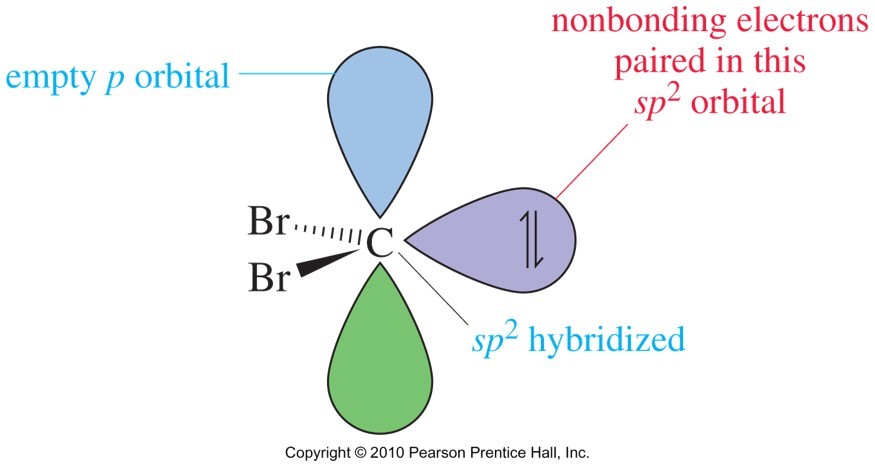
Carbene
• Carbon is neutral • Vacant p orbital, so can be electrophilic • Lone pair of electrons, so can be nucleophilic
Stability of Carbanions
-:CH3 > primary > secondary > tertriary nucleophilic - strong bases
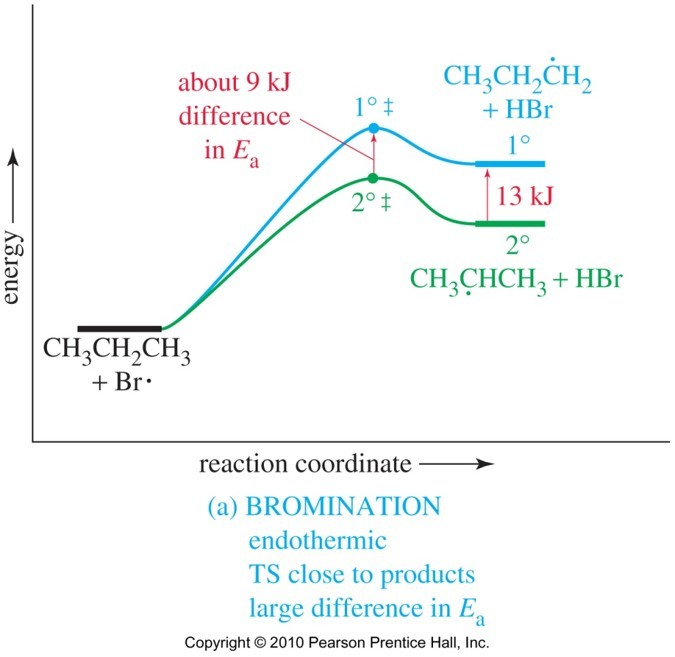
Bromination
Chlorination