1. Atomic Structure
No description yet. This curated deck is ready for daily study.
Card preview (24)
3 factors of the Bohr Model:
• protons + neutrons are found in the centre of the atom called the nucleus • protons + neutrons can also be called nucleons • electrons orbit around the nucleus in shells/energy levels
Name Fundamental Particles of an Atoms, their relatives masses and relative charges

Atomic Number is equal to what
equal to the number of protons
Mass Number is equal to what
equal to the sum of the number of protons and neutrons
What are isotopes
Atoms with the same number of protons but different number of neutrons
Why do isotopes of the same element have the same chemical properties?
They have the same electronic configuration
Isotopes have the same electron configuration so …
They have the same chemical properties
Number of Neutrons =
Mass Number - Atomic Number
Atoms have a neutral charge, why?
Number of protons = Number of electrons
What are cations?
An atoms that has lost electrons so protons>electrons and is now an ion
What are anions?
An atom that has gained electrons so electrons>protons and is now an ion
1st Ionisation Energy:
the amount of energy needed to remove a mole of e- from a mole of atoms, in the gaseous state (units= kJ mol-1
Equation for the 1st ionisation energy (of Potassium, K):
K(g) → K+ (g) + e-
1st 3 Ionisation Energies of Boron:
1: B(g) → B+ (g) + e- 2: B+(g) → B 2+ (g) + e- 3: B 2+(g) → B 3+ (g) + e-
3 factors that influence I.E:
1) Shielding 2) Nuclear Charge (number of protons in the nucleus) 3) Distance from nucleus
Trend in 1st I.Es of elements down a group:
• Shielding increases (- Distance from nucleus increases) • Weaker attraction between nucleus and outermost e- • 1st I.E decreases down group
Why do I.Es 1-3 increase?
Each e- is being removed from a more +ve ion each time. (attraction between the electrons and the protons increase as there are less electrons being attracted by the same number of protons)
Why does the 4th I.E increase drastically?
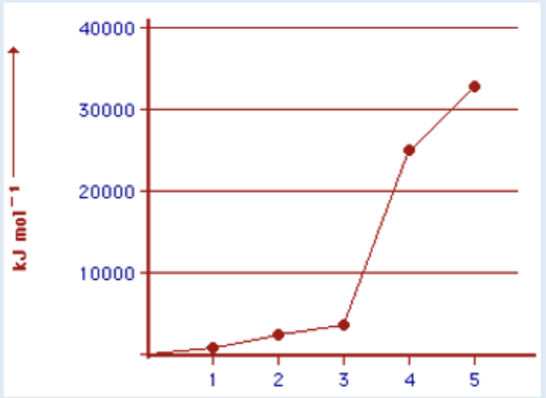
The 4th e- being removed from a shell closer to the nucleus and a more positive ion and so is much more strongly attracted to the nucleus
The following data shows the first seven successive ionisation energies of a period 3 element. State which element it is and explain your reasoning.

(Calculate gap between each e- removed) - Largest increase between 4th + 5th I.Es - 5th e- is on the shell closer to the nucleus - Element must have 4 e- on its outer shell - Period 3, Group 4 = Silicon
Why is Li a bigger atoms than Be?
• Same shielding • Be has more protons • so, stronger attraction to the outer e-
Why is Li a bigger atoms than He?
• Li has an extra shell • Li’s outermost e- is further away from the nucleus • Outer e- is more shielded • Outer e- less strongly attracted to the nucleous
Which element has the highest 1st I.e of all the elements?
He. Because it has same shielding as H but more protons than H.
Trend in 1st I.E across a period: (use example of Period 3 to explain)
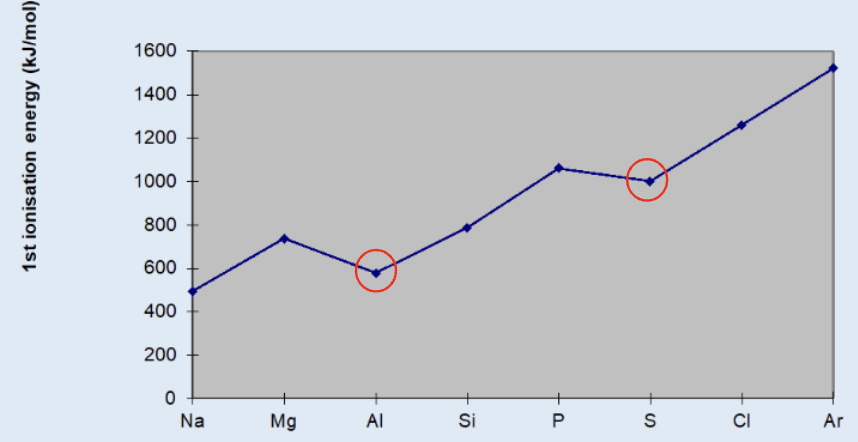
• General increase • Same shielding, grater number of protons, stronger attraction between nucleus and outermost e- • with 2 exceptions Reasons for the exceptions • P subshell lower in energy than than the S subshell → less energy required to remove the e- • 1st e- removed from P = 1p subshell + unpaired. 1st e- removed from S = 1p subshell + paired. P= lower I.E due to e- pair repulsion. Therefore, less energy needed to remove the e- from S.
Why does the atomic radius get smaller across the period?
• same shielding • number of protons increases • greater attraction between nucleus and electrons