M3 - Rates of reaction
No description yet. This curated deck is ready for daily study.
Card preview (24)
What 2 parts make up collision theory?
Particles must collide with sufficient energy They must collide with the correct orientation
How does a homogeneous catalyst interact with the reactants?
Forms an intermediate This intermediate breaks down to give the product and regenerates the catalyst
Which factors can change the rate of a chemical reaction?
Concentration Temperature Use of a catalyst Surface area of solid reactants Pressure (gases only)
Define rate of reaction
The change in concentration of a reactant or a product per unit time OR Rate = Concentration of reactant (or product) / Time
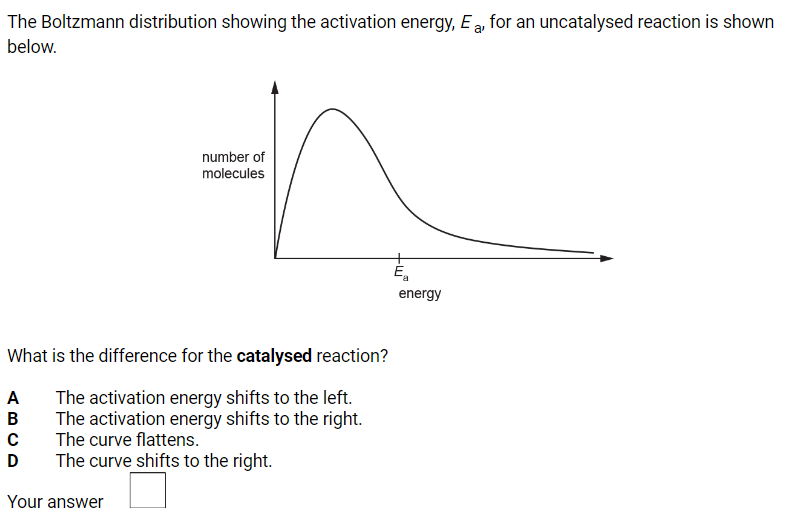
What are the main features of Boltzmann distribution?
No molecules have zero energy Area under the curve is equal to the number of molecules No maximum energy
What is a homogeneous catalyst?
Has the same physical state as the reactants.
What is a heterogeneous catalyst?
Catalysis of a reaction in which the catalyst has a different physical state from the reactants (1)
What is the rule of thumb for reaction rate and increasing temperature?
A 10oC increase in temperature doubles the rate.
What are the two methods of determining reaction rate, when a gas is produced?
Monitoring the volume of gas produced Monitoring the loss of mass of reactants
What does a catalyst do?
A substance that changes the rate of a chemical reaction by providing an alternative pathway with a lower activation energy without undergoing any permanent change itself.
How does a Boltzmann distribution show the effect of a catalyst?
Activation energy with a catalyst is lower than normal activation energy. Therefore a greater proportion of molecules exceed the new lower activation energy.
Explain why increasing concentration/pressure has its effect on reaction rate
Concentration increases More particles per unit volume More frequent collisions More successful collisions Rate increases
What is a heterogeneous catalyst?
Has a different physical state from the reactants.
How does a heterogeneous catalyst interact with the reactants?
Usually solids in contact with gaseous reactants or reactants in solution. Reactants are adsorbed onto the surface, where the reaction takes place. After the reaction, the products leave the surface by desorption.
A
What effect does increasing concentration/pressure have on reaction rate?
Increasing concentration and pressure Reaction rate increases
How does a Boltzmann distribution curve change when temperature is increased?
The peak is lower and shifted to the right A greater proportion of molecules can overcome the activation energy
C
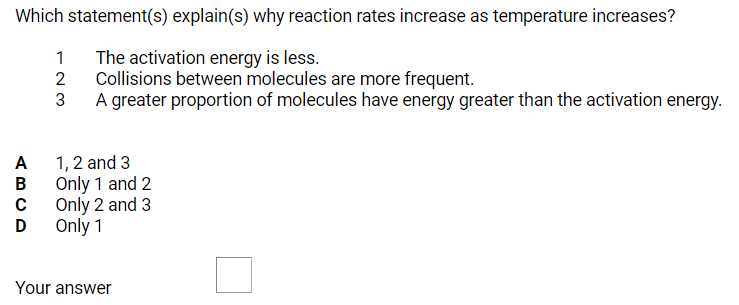
What effect does increasing temperature have on reaction rate?
Reaction rate increases with greater temprature
What are the benefits of using a catalyst?
Lowers activation energy Less electricity used Product made faster and cuts costs and increases profit Less fossil fuels used cuts emissions of carbon dioxide
Explain why increasing temperature has its effect on reaction rate
Particles have more energy Higher speed Collide more frequently More successful collisions Rate increases
What are the units of rate of reaction?
mol dm-3 s-1 or cm3s-1 or g s-1
Give two examples of homogeneous catalysts
Sulphuric acid in the production of esters Chlorine radicals in ozone depletion
What is a homogeneous catalyst?
Catalysis of a reaction in which the catalyst and the reactants are in the same physical state (1)