Lecture 9 : Fluid Compartments and Osmosis
No description yet. This curated deck is ready for daily study.
Card preview (12)
Fluid def
A FLUID is a substance that deforms under shear stress. Important fluids in physiology include those in which water, fats or lipids, are the solvent.
Body water content
Total body water is approx. 42 L for a 70 kg person, and it is proportionally greater than men than in women, and reduces with age.
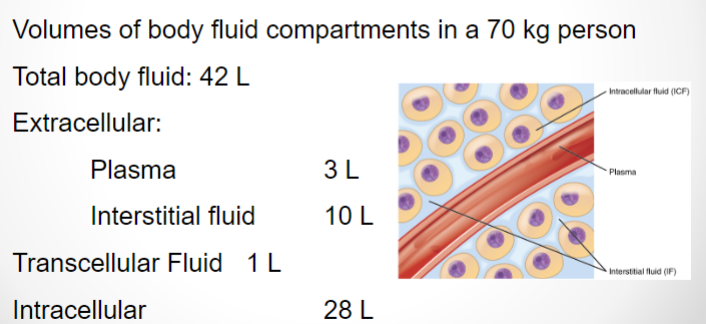
Examples of transcellular compartments
• Peritoneal space (can greatly expand, used therapeutically during peritoneal dialysis) • CSF (protected by blood brain barrier, which are endothelial cells joined by tight junctions) • Pleural cavity • Synovial fluid
Cell Volume Regulation
• Facilitated diffusion • Requires aquaporins • Requires driving force (osmosis, and NOT hydrostatic pressure. Hydrostatic pressure is force per unit area in a fluid) TO regulate volume : • Express aquaporins (affects rate but not equilibrium position) • Change driving force (change concentration of solute) • Osmotic pressure depends on concentration of solutes in cells
How can solute concentration be changed?
• Change concentration of small molecules through metabolic processes • Eg. Amino acids from proteins, betaine from glycine, glucose from glycogen, sorbitol from glucose) • Change influx of ions and small molecules • Volume regulated anion channels (VRACs) • If cells swell, VRACs open to let Cl- and other osmolytes out • Stretch-activated cation channels in response to swelling, eg. Letting Na+ and Ca2+ in to trigger cellular responses, (different types of TRP channels)
Plasma
Plasma is the fluid component of the blood and represents roughly 55% of the blood by volume, rest is occupied by cells. Haematocrit is a measure of the proportion of blood occupied by cells (roughly 45%)
Osmolality vs Osmolarity
Osmolality - number of osmoles per unit MASS of the SOLVENT (Osm.kg^-1) Osmolarity - Number of osmoles per unit VOLUME of the SOLUTION (Osm.l^-1)
Osmotic Pressure
• At the interface between 2 solutions, molecules exchange via diffusion • If concentration of any species is different on either side of the interface, there is a net movement of molecules from one side of the membrane to the other • Osmotic pressure refers to water only • Semi-permeable membrane is the ‘interface’ is the body (the plasma membrane) • The inverse of water potential??
Oncotic Pressure
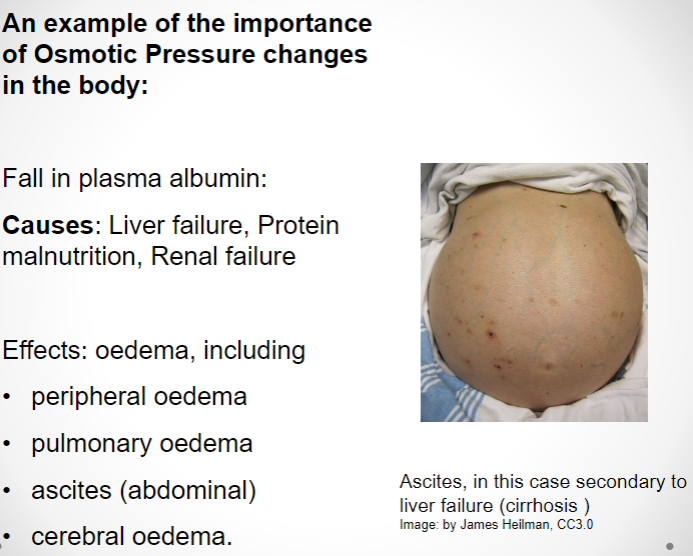
Total osmotic pressure of plasma is VERY HIGH Osmotic pressure estimated by Morse equation : Osmotic pressure = nCRT nC = Osmolality (0.28 osm.kg^-1) R = Ideal gas constant (0.082 L.atm.mol.K^-1) T = Temp (310K) KEY CONCEPT : Osmotic pressure is directly proportional to osmolality
Isosmotic vs Isotonic
Isosmotic - 2 solutions share the same osmolality Isotonic - Applying the solution to RBCs will not cause net fluid movement
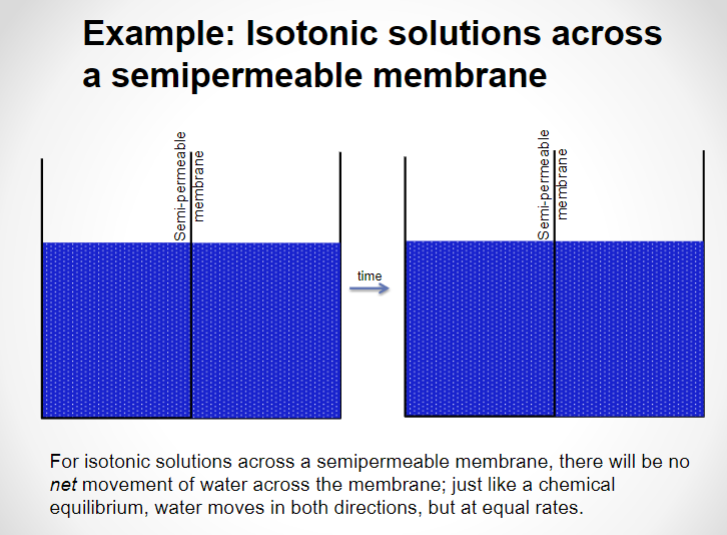
idk
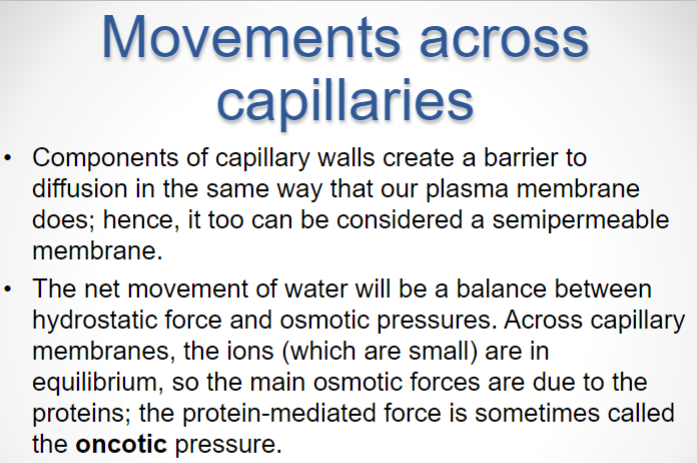
another idk