Week 4 Day 3
No description yet. This curated deck is ready for daily study.
Card preview (15)
CO2 scrubber
CO2 + H2O →H+ + HCO3- system has NaOH H+ + HCO3- +NaOH → H2O + NaHCO3 system has Ca(OH)2 NaHCO3 + Ca(OH)2 → NaOH + CaCO3 + H2O *when CaCO3 is consumed, pH is acidic
How does vaporizer control for temp changes and why?
It has two metal pieces that expand and shring with temp changes, moving a thing that allows varying amounts of O2 through, controlling how much O2 goes by the gas. *increased temp Increases VP which allows the O2 going by the gas to pick up more gas
second gas effect
when a large volume of N2O is taken into bloodstream faster than the other gases, the concentration of the remaining gases increases
microshock to heart
smaller current than 0.1 mA is needed to cause V-fib
ground fault interrupter
shuts off electrical current when it senses it going along the incorrect path *it senses a different current coming in then went out
Isolation power system
• ungrounded electrical service • requires two line to ground faults to affect function of equipment or shock anybody
line isolation monitor
continually checking for leakage current from each phase conductor *this is the third year med student
Nernst Equation
used to calculate cell potential Veq = (61/Z) * log (Kout/Kin) mV
membrane potential
the difference in electric potential between the inside and outside of a cell
depolarization
the interior voltage of a cell becoming less negative
repolarization
the interior of a cell becoming more negative
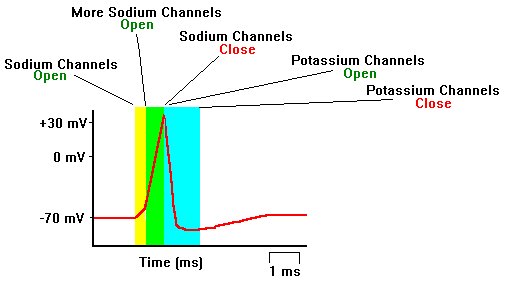
action potential
when the membrane potential of a cell rapidly rises and falls *for an action potential to happen, the membrane potential must depolarize to the critical threshold
SA node
primary pacemaker of the heart
steps in action potential
• Trigger raises membrane potential over threshold • Na+ channels open, Na comes in, membrane potential rises • Na channels close, K channels open • K leaves cells, membrane potential falls, below resting • K channels close, leaving only “leak” channels
contractile myocytes
• resting membrane potential at -90 mV • depolarize only when stimulated, usually by neighboring myosite.