Particulate nature of matter and separation techniques (Pre-IB)
No description yet. This curated deck is ready for daily study.
Card preview (24)
elements
• A pure substance that cannot be broken down into simpler substances by chemical means. • the primary constituents of matter • they take part in chemical reactions in which new substances are made in processes thatmost often involve an energy change • Made of only one type of atom. • Example: Hydrogen (H), Oxygen (O).
What is the smallest unit of an element?
An atom: retains the chemical properties of the element.
compounds
A substance formed when two or more dfferent elements are chemically bonded together in a fixed ratio - gives elements full outer shells of electrons - ex. CO2, H2O - they can be broken into their constituent elements - Compounds have chemical and physical properties that are different from their constituent elements.
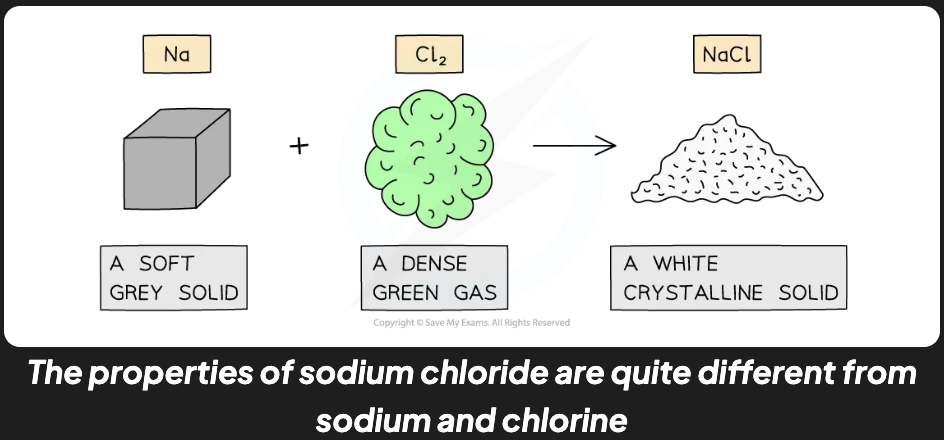
How does a compound differ from an element?
Compound: Made of multiple elements chemically bonded, can be broken down chemically. Element: Made of one type of atom, cannot be broken down chemically.
mixture
A mixture is a material composed of two or more pure substances that are physically combined but not chemically bonded. - they are interspersed with each other, making the components retain the same characteristic properties as their pure form - The components may be elements or compounds, are not in a fixed ratio, and retain their individual properties ex. gases of n2 and o2 in air retain their same characteristics as if they were separate
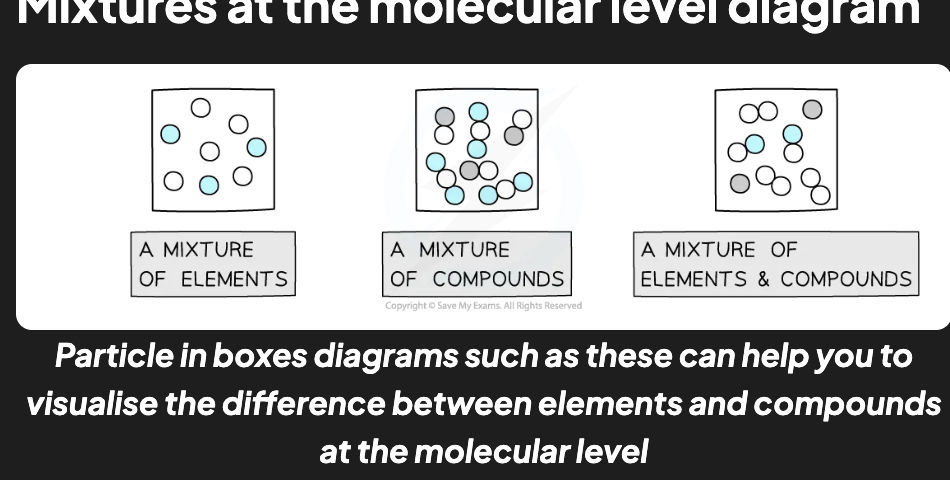
How does a mixture differ from a compound?
Mixture → Two or more substances not chemically bonded, variable composition, retains properties of components, separated by physical methods. Compound → Two or more elements chemically bonded in a fixed ratio, new properties, separated only by chemical methods.
What is a homogeneous mixture?
A mixture with uniform composition and properties throughout. components are in the same phase - to form a this, the inter particle attraction within the diffrent components must be similar in nature to those between the components in the mixture Example: Air (N₂, O₂, CO₂ gases evenly mixed) and bronze (alloy)
What is a heterogeneous mixture?
A mixture with non-uniform composition and visible boundaries between phases. - properties are not the same throuought Example: Oil and water. (water molecules interact by hydrogen bonding and oil molecules by dispersion forces) concrete and orange juice with pulp
Can a single state have multiple phases?
Yes. Two immiscible liquids (e.g., oil and water) form a heterogeneous mixture even though both are liquids.
Why can mixtures be separated by physical methods? what considerations should be taken? (5)
Components are not chemically bonded, so they can be separated based on physical properties like - boiling point - solubility - particle size - magnetism - density
What are common techniques for separating mixtures?
Filtration – separates insoluble solids from liquids. Evaporation – removes a solvent to leave solute behind. Distillation – separates liquids based on boiling points. Fractional distillation – separates liquids with similar boiling points. Chromatography – separates based on solubility and polarity.
What properties are important when choosing a separation method?
• Solubility in water or other solvents. • Melting and boiling points of components. • Whether the mixture is homogeneous or heterogeneous. the components in a mixture can be relatively easy to separate if they have a distinct physical property. the technique chosen depends on this distinct property • all methods rely on some kind of diffrence in properties of substances (usually physical property)
What is solvation?
The process where solvent molecules surround and attract the solute molecules. - separating sand from water - essential for filtration and crystallisation - solvent must be carefully chosen to dissolve only the desired component Example: CuSO₄ combines with water to form CuSO₄·5H₂O.
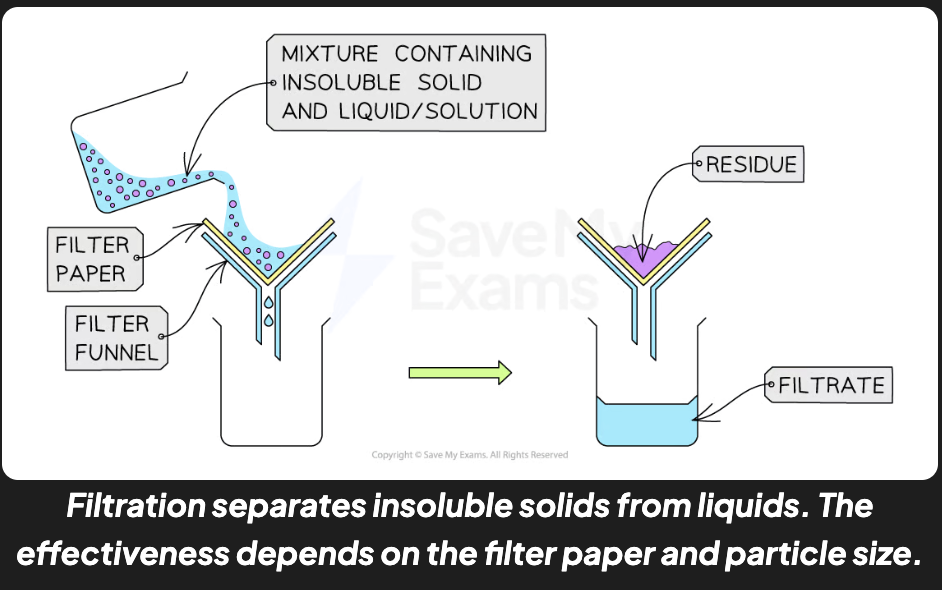
What is filtration and when is it used?
• Filtration separates an insoluble solid from a liquid or gas using a membrane (filter paper) • Place a filter paper in a funnel above a clean beaker • The mixture is poured through a filter; the liquid (filtrate) passes through, and the solid (residue) remains on the filter paper. • water can be removed from salt by evaporation, allowing salt crystals to form ( crystallization) • this works because solid particles are too large to pass through the pores in filter paper • For very small particles, filtration under reduced pressure can be performed using a Büchner flask and vacuum pump. centrifugation is also used, especially when particles are too small or dense for standard filtration
Why use a Büchner flask and vacuum pump for filtration?
To create reduced pressure and speed up filtration, especially for fine particles that clog filter paper under gravity filtration
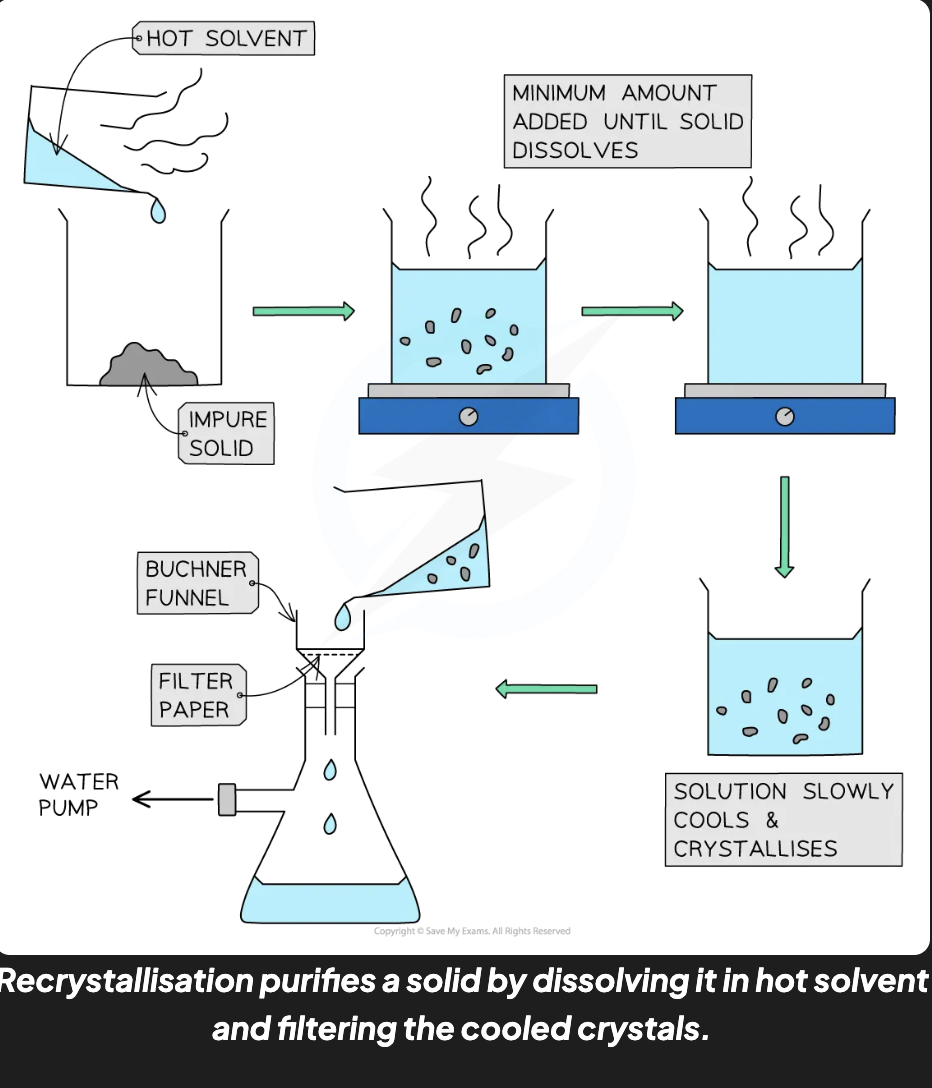
What is evaporation and recrystallization?
Evaporation: Removes the solvent, leaving the solute behind. Recrystallization: used to purify an impure solid by dissolving it in hot solvent and allowing it to crystallise as the solution cools. ex. Removing solid and soluble impurities from a sample - Dissolve impure solid in minimum amount of hot solvent ( to avoid loss of product) - Filter solution to remove insoluble impurities. - Allow solution to cool slowly for crystals to form. - Filter, wash crystals with cold solvent, and dry.
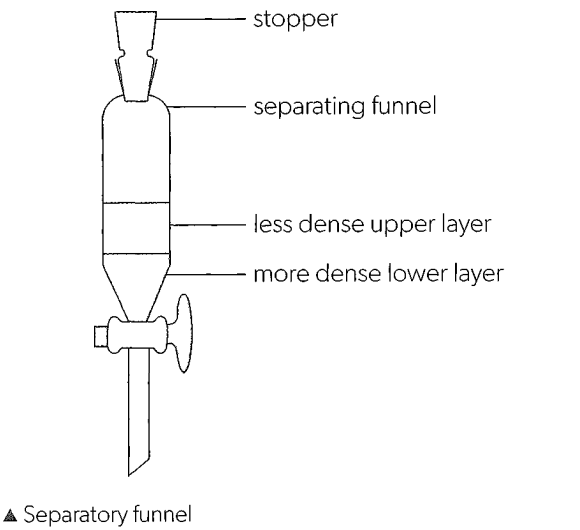
How does a separating funnel work?
A separating funnel is used to separate two immiscible liquids (e.g., oil and water). The mixture is shaken, allowed to settle, and two layers form: Upper layer = less dense liquid. Lower layer = more dense liquid. The lower layer is drained first by opening the tap.
What is distillation and when is it used?
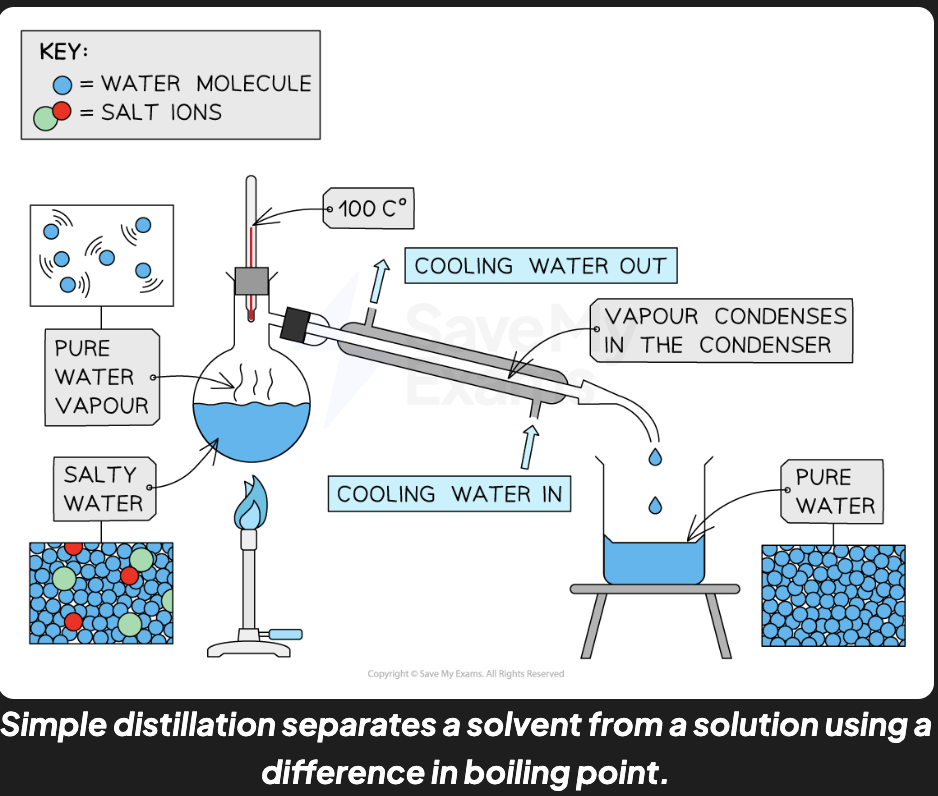
physical separation technique that separates a solvent from a solute or pure liquid from a mixture based on diffrence in boiling points - solvent has a significantly lower boiling point ex. separating water from salt solution, recovering pure solvent from chemical reaction mixture - separates a volatile solvent from a solution. - The solvent boils, the vapor condenses and cools in a condenser (surrounded by cold water), and is collected separately. - pure distillate (liquid) is collected in a clean beaker, other components are left in a flask - Example: Separating water from salt water.
What is reflux and why is it used?
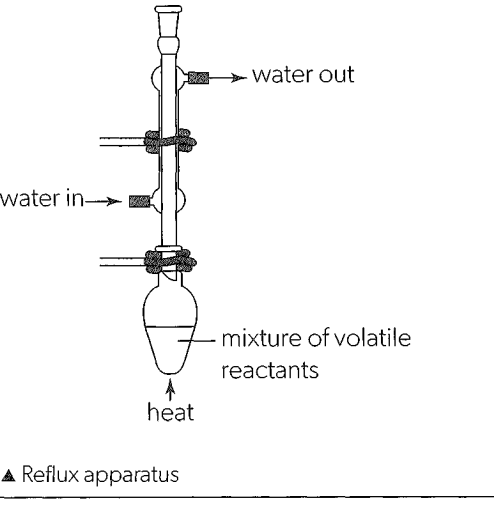
Reflux allows volatile reactants to be heated for long periods without loss of material due to evaporation. Vapors condense and return to the reaction flask. Used in organic synthesis, not for separation.
How is melting point determination used to check purity?
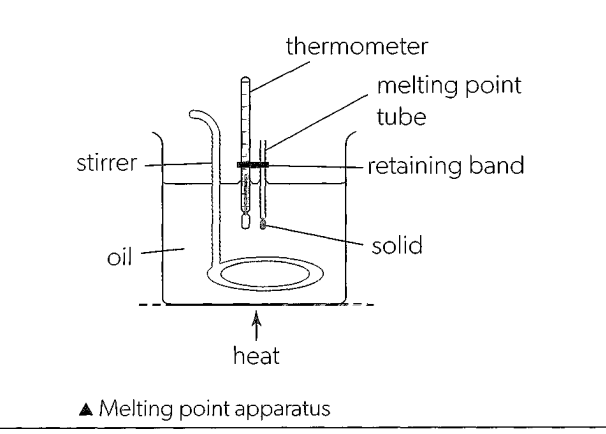
Pure substances have a sharp, fixed melting point matching literature values. Impure substances have: - A lower melting point. - A broader melting range. A small sample is placed in a melting point tube and heated gradually (in oil bath or using melting point apparatus).
What are key physical properties used for separating mixtures?
• Solubility (in water or other solvents). • Boiling point and volatility. • Density (for immiscible liquids). • Particle size (for filtration).
What is chromatography used for?
• To separate mixtures containing small amounts of individual components. • Can identify components qualitatively and quantitatively. • separate dissolved substances in a mixture based on differences in solubility and adsorption to the paper • Can determine the purity of a substance.
What are the two phases in chromatography?
Stationary phase: fixed in place (e.g., paper or solid coating). Mobile phase: moves and carries components (e.g., solvent).
What is adsorption in chromatography?
Adsorption is when molecules stick to the surface of the stationary phase. - It is a surface phenomenon: solute particles are attracted to and temporarily held on the solid phase (e.g., silica or alumina in TLC). Strength of adsorption depends on: - Polarity of the solute and stationary phase. • Intermolecular forces (e.g., hydrogen bonding, van der Waals forces).