Module 4c: Membrane Transport
No description yet. This curated deck is ready for daily study.
Card preview (19)
Must be high enough to produce desired effect, but not too high to cause negative effects.
Drug concentration
The concentration of a drug at its site of action is called ____.
drug efficacy Must get the drug to the receptor it will work on.
What does ADME stand for?
A. Absorption (enters into blood stream) D. Distribution (contact with receptor) M. Metabolism (leave receptor and journey to metab site) E. Excretion (removal)
What are biological membranes made up of?
Phospholipids! :)
The head of the phospholipid is ____?
Polar and hydrophilic. *makes up the extracellular & intracellular walls
The tails of the phospholipids are ____?
Non-polar & Hydrophobic *makes up the inner layer of the PLB
How do we get drugs into the cell?
Via transporters, passive diffusion, channels
Are transporter’s proteins?
YES! *so are channels
What are the types of transport?
Passive & Active
This transport type requires no energy and follows its [ ] gradient.
Passive transport *LMW drugs have an easier time crossing
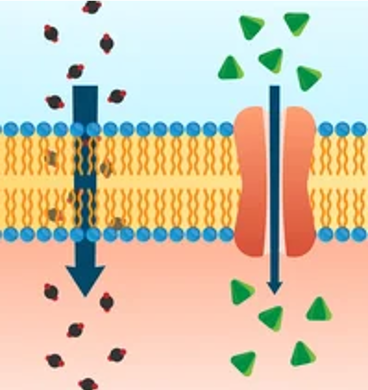
This type of transport requires ATP and involves influx & efflux.
Active transport *requires transport proteins
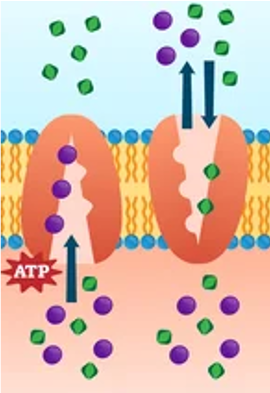
What does it mean when you have hit a transport plateau?
At higher drug concentrations that require Active transport, you have a limited number of transporters that can deliver the drug across the membrane. This can lead to competition with structurally similiar compounds. *Methotrexate (similiar to folic acid); they may compete :O
What two things (about the drug) affect transport & distribution?
• Drug Size • Drug Charge
Is <50 Da considered small for drug size?
YES! * Can be referred to as “Bulk Flow” (passive diffusion) * Easy to move across * works in ionized or unionized 4 carbons = 48 Da
What is the main way drugs move across membranes?
Passive diffusion
What is a Da (Dalton)?
1 gram/mol *used for proteins (very large molecules)
If a drug is ionized, will it be easy to move across the membrane?
No. It will be harder. *It is also dependent on the pH and pKa.
Lipophilic drugs (>50Da) use passive transport but what is also special about these drugs in order for them to move throughout the body?
Need to be balanced lipophilic and hydrophilic.
If a drug is unionized, will it be easier for it to cross the membrane?
Yes. This means it is uncharged.