3. Compliance
No description yet. This curated deck is ready for daily study.
Card preview (11)
Draw a pressure volume curve
Definition
compliance is defined by the change in lung volume per unit change in pressure
What determines
the compliance of the lung itself and the compliance of the chest wall. Lung compliance is determined both by the elastic properties of pulmonary connective tissue and by the surface tension at the fluid–air interface within alveoli Both normal lung compliance and normal chest wall compliance are 150–200 ml cmH2O
Static compliance
Static compliance: a pressure–volume curve is obtained by applying distending pressures to the lung and measuring the increase in lung volume. The measurements are made when there is no gas flow. (The patient expires in measured increments and the intrapleural pressure at each step is estimated via oesophageal pressure.)
Dynamic compliance
: a pressure–volume curve is plotted continuously throughout the respiratory cycle
P–V curves
P–V curves: pressure–volume curves are useful, but they may oversimplify what is happening in the lung. In particular, accurate dynamic compliance curves can be difficult to generate in diseased lungs. The final curve also represents the total rather than the separate lung units, whose individual compliance may be very different. In ARDS about a third of the lung may remain normal. The curve can be used to set PEEP and to control ventilation
Hysteresis:
inspiratory and expiratory pressure–volume curves are not identical, which gives rise to a hysteresis loop. Hysteresis describes the process in which a measurement (or electrical signal) differs according to whether the value is rising or falling. It usually implies absorption of energy, for example due to friction, as in this case. The area of the hysteresis loop represents the energy lost as elastic tissues stretch and then recoil (viscous losses) and as airway resistance is overcome (frictional losses).
Specific compliance:
compliance is related to lung volume, and this potential distortion can be removed by using specific compliance, which is defined as compliance divided by the FRC. This correction for different lung volumes demonstrates, for instance, that the lungs of a healthy neonate have the same specific compliance as those of a healthy adult.
Factors which alter compliance
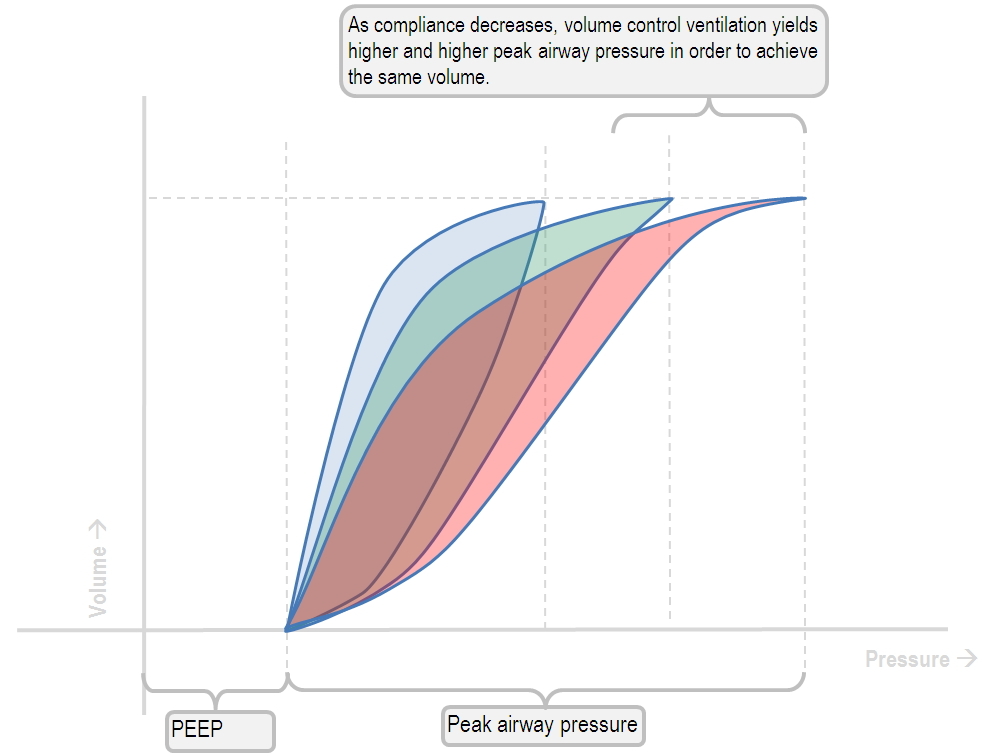
ARDS and pulmonary oedema decrease respiratory compliance by reducing lung compliance. Restrictive conditions such as ankylosing spondylitis or circumferential thoracic burns reduce it by decreasing the compliance of the chest wall. Compliance is also decreased if the FRC is either higher or lower than normal. At high lung volumes, tissues are stretched to near their elastic limit, whereas at low volumes greater pressures are required to recruit alveoli. In acute asthma, therefore, patients are ventilating at a high FRC, at which the compliance is lower and the work of breathing correspondingly greater. Compliance is also affected by posture, being maximal in the standing position. Obesity may reduce compliance both via a reduction in FRC and a decrease in chest wall compliance due to the cuirass of adipose tissue. Age has no influence.
Intermittent positive pressure ventilation (IPPV) and decreased compliance Constant-pressure generators
: these ventilators generate an increase in airway pressure which produces inspiratory flow whose rate depends on the compliance and resistance of the whole system (patient and breathing circuit). The sudden initial mouth–alveoli pressure gradient produces high flow into the lungs, which then decreases exponentially as the lungs fill and the gradient narrows. In lungs with low compliance, the alveolar pressure increases much more rapidly, the pressure differential reduces and inspiratory flow declines.
Constant-flow generators
: these ventilators produce an incremental increase in flow rate to generate a tidal volume that is a product of the flow rate and the inspiratory time. The pressure of the driving source is much greater than that in the airways, and so flow into the lungs is not affected by sudden decreases in pulmonary compliance or increases in airway resistance. The delivery of an unchanged tidal volume in the face of decreased compliance will be associated with a more rapid increase in alveolar pressure and a higher airways pressure.