Impression materials
No description yet. This curated deck is ready for daily study.
Card preview (24)
what is the function of impression materials?
produce an accurate 3D negative replica of the surface and shape of hard/soft oral tissues
what is dental stone? what is it used for?
material used to fill the impression and produce a positive replica (stone cast), recording the position, size, shape and orientation of each tooth used for: * evaluating occlusal/position problems in orthodontic cases * producing restorations (inlays, crowns) * fabricating prosthesis (partial denture framework)
how would you classify impression materials?
• clinical - mucostatic, mucocompressive • properties - elastic, non-elastic
what is the difference between mucostatic and mucocompressive IMs?
• mucostatic - fluid materials that displace the soft tissues slightly (undisplaced mucosa) e.g. ZOE, low viscosity alginates • mucocompressive - viscous materials that record an impression of the mucosa under load (displaced soft tissues) e.g. impression compounds, high viscosity alginates/elastomers
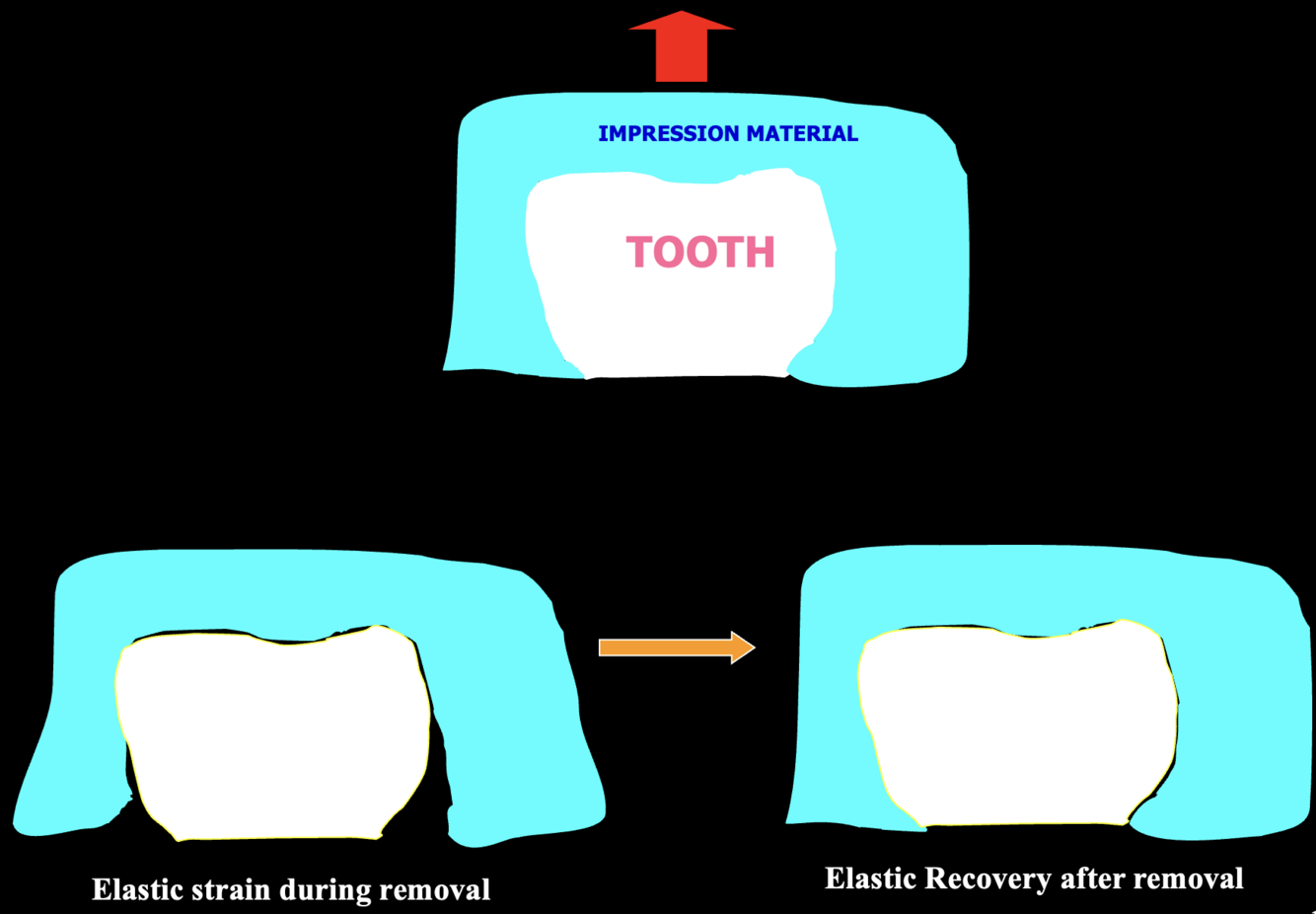
describe what happens when an IM is removed after setting
• IM in its initial paste form flowed around the tooth and made **close contact ** • once hardened and on removal, the IM bulges out due to strain to overcome the bulbous aspect of the tooth • after removal, the IM undergoes elastic recovery and changes shape temporarily
describe the ideal elastic behaviour diagram of an IM
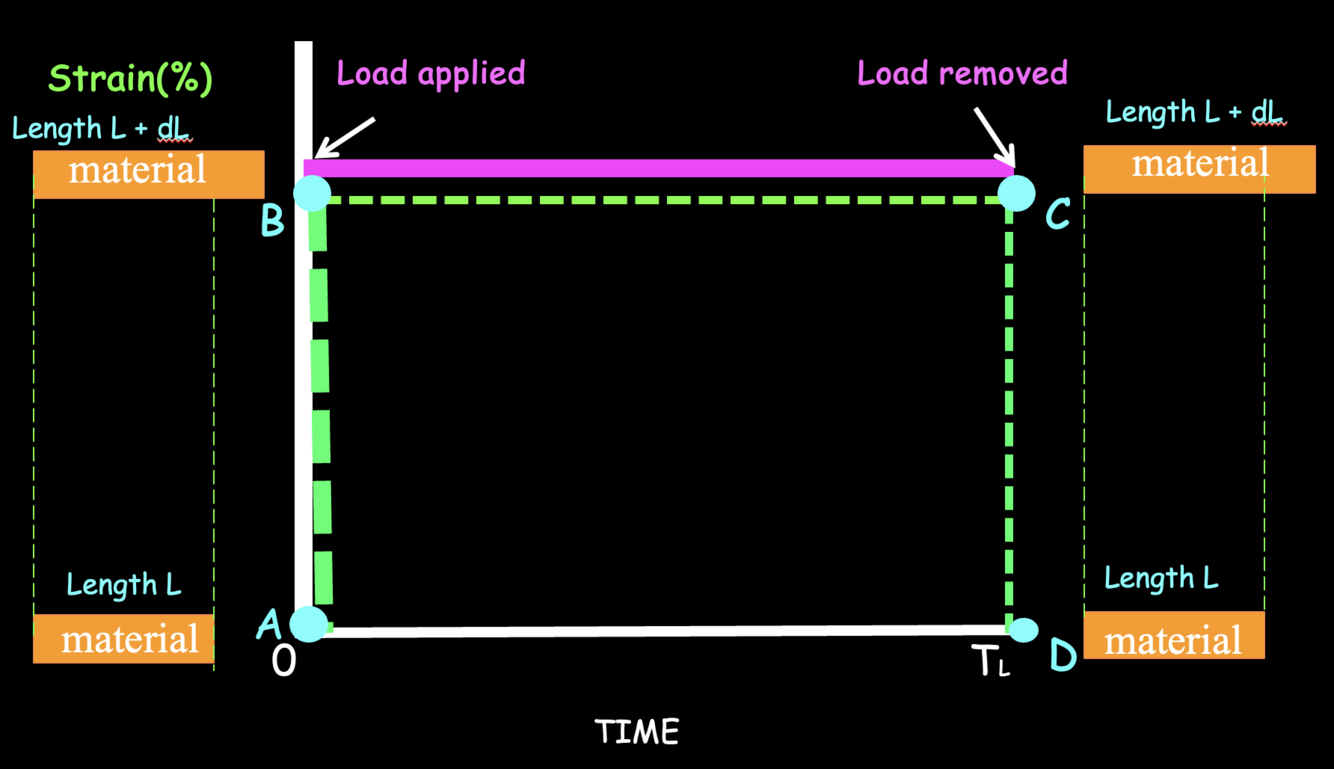
• at time=0, a force is applied to the IM, causing the material to undergo a change in dimensions • IM reaches its maximum strain instantly (B) - length = L+dL • for as long as the load is applied, the strain on the IM remains constant • when the load is released (time TL), the IM instantly recovers to 0% strain and the IM has the same dimensions
describe the actual viscoelastic behaviour of an IM
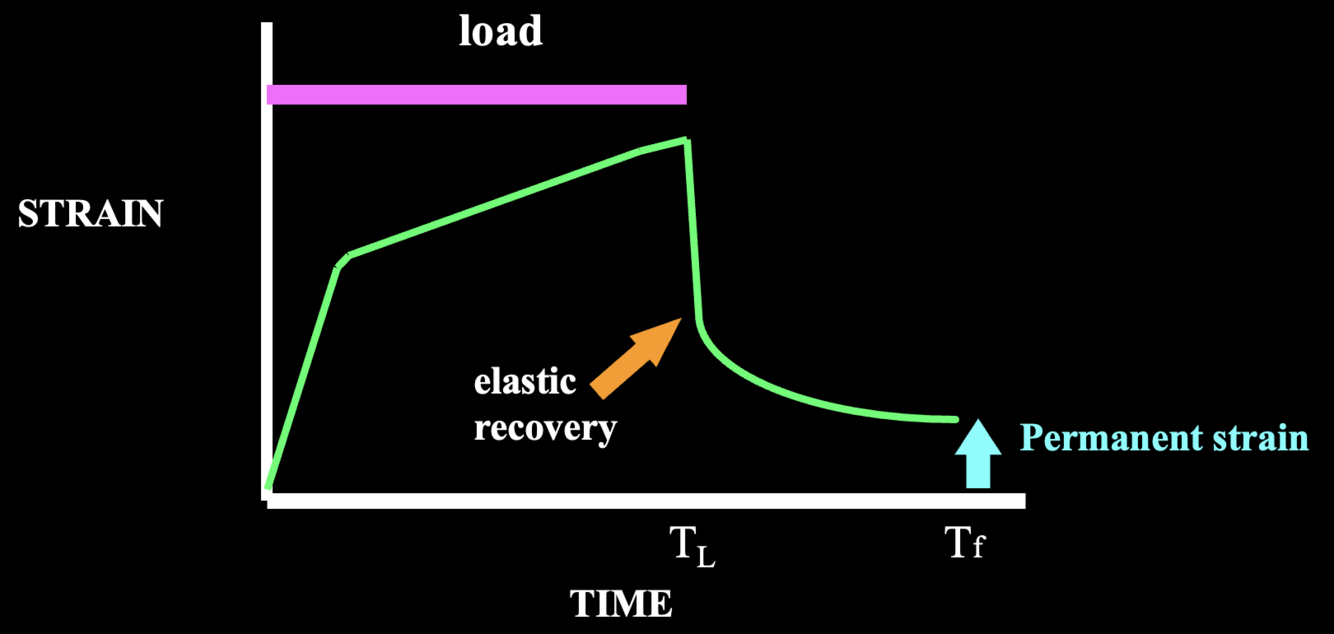
• when a load is applied at time=0, the IM does not reach its maximum strain instantly • there is a rapid increase in strain initially but tapers off so the maximum strain is reached after some time (TL) • when the load is released, the IM gradually returns towards its original dimensions but never reaches full elastic recovery • there is some permanent strain and the IM is not 100% accurate
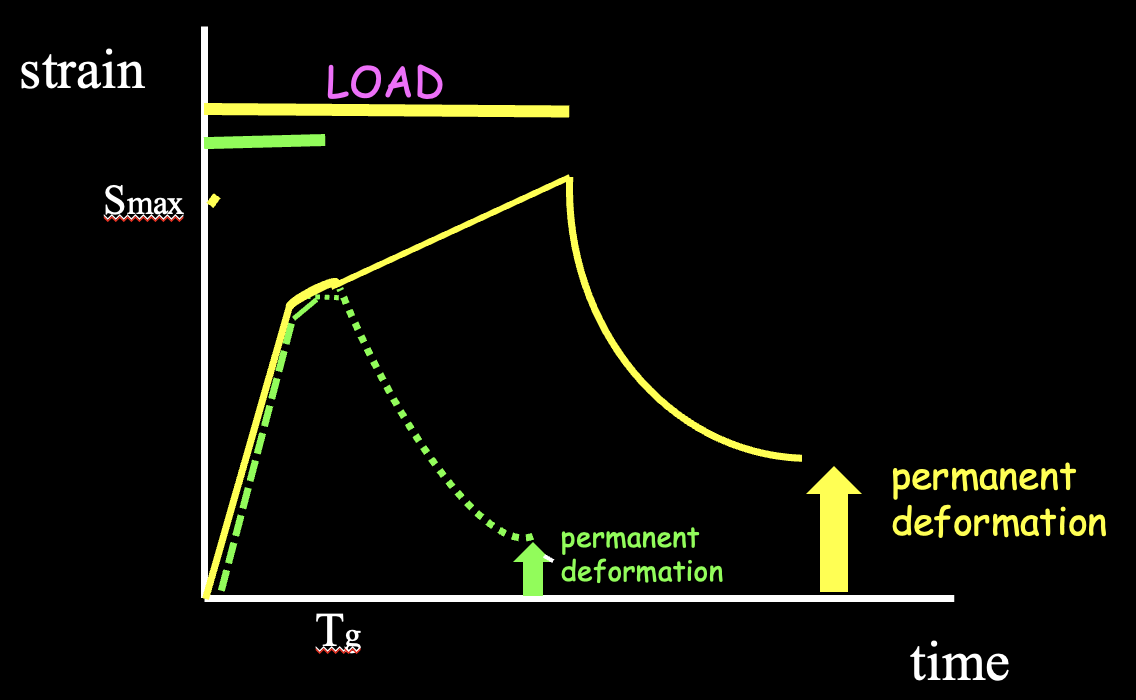
how would the viscoelastic behaviour of an IM change with a load applied over a shorter time?
• the strain of the IM increases the same way over time • when disengaging the impression tray quicker than normal (Tg), the IM has not yet reached maximum strain (Smax) • the IM gradually recovers more of its original shape so there is less permanent strain • technique: short, sharp, pulling force
what is the difference between elastic and non-elastic IMs?
• elastic materials recover its original shape e.g. hydrocolloids, elastomers • non-elastic materials end up deformed (poor fit and fracturing) e.g. impression compound, impression paste
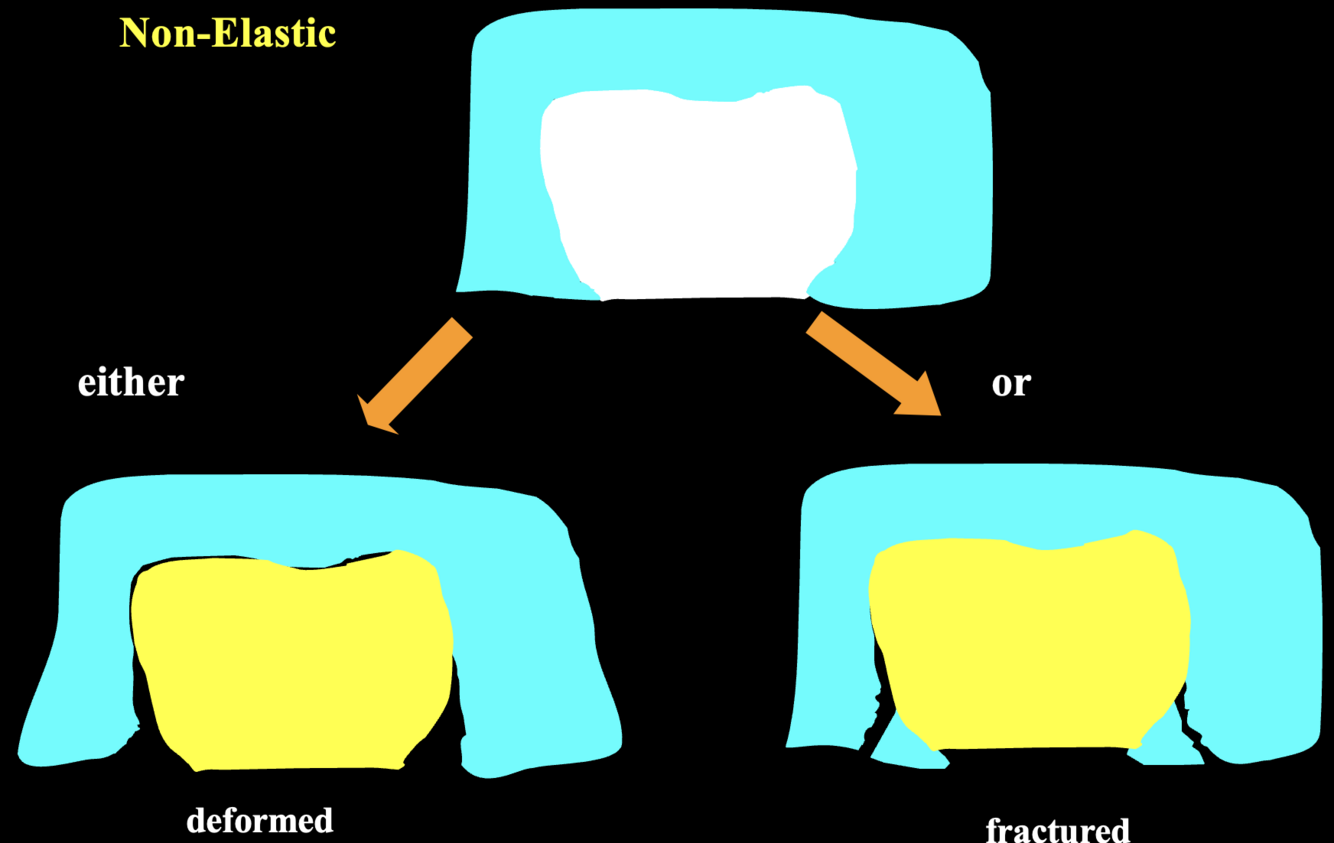
describe the impression taking process
• preparation - mixing, chemical reaction • insertion - tray type? adhesive? • setting - chemical, polymerisation, cooling • removal - short, sharp pull • storage - how long? • cast preparation - gypsum
what are the ideal accuracy properties of IMs?
• flow - surface detail, low enough viscosity? • no dimensional change on setting • complete elastic recovery on removal - no dimensional change • does not change dimensionally over time (storage) • dimensions unaltered during decontamination • compatible with cast material
what properties affect accuracy?
• viscosity - affects level of detail recorded • setting mechanism - can cause dimensional contraction • thermal expansion coeficient - ideally low to cope with mouth to room temp transition • hydrophobic/hydrophilic - tooth may need to be dried/wet for good contact • elasticity • tear strength - withstand tearing when removed especially with undercuts • storage • ease of removal
what are the ideal patient factor properties of IMs?
• non-toxic and non-irritant • acceptable taste and smell • short setting time • removable without damage to oral tissues
what are the ideal operator properties of IMs?
• quick and simple technique • convenient working and setting times • easily decontaminated • inexpensive
what is a colloid?
a two phase system of fine particles (1-200nm) of one phase dispersed in another phase
what is a hydrocolloid?
a two phase system where one phase of fine particles is dispersed in water
what are the two states that hydrocolloids exist in?
• as a SOL - viscous liquid state • as a GEL - jelly-like consistency where fine particles form a framework that encapsulates a liquid
what is the equation of the setting of alginate?
sodium alginate + calcium sulfate -> sodium sulfate + calcium alginate

what component of alginate delays gel formation? how does this happen?
trisodium phosphate * preferably reacts with calcium ions in calcium sulfate to delay gel formation * when all trisodium phosphate has been used, the calcium ions react with sodium alginate

how do you manipulate alginate?
• use correct powder/liquid ratio • use water at 18-24 degrees • use perforated tray and adhesive • insert tray into pts mouth and wait for set • remove impression tray with a sharp pull
how can you reduce permanent distortion and tearing?
• use large bulk of material (5mm) • pull sharply
what are the accuracy properties of alginate?
• flows to record fine detail :) • acceptible setting changes but needs storage ASAP :/ • nearly elastic - always some slight permanent strain :/ • poor tear strength - avoid deep undercuts :( • syneresis (shrinkage) or imbibition (expansion) during storage may occur adn affect dimensional accuracy :( • avoid patient movement during setting - can distort shape and affect internal stresses :(
what are the patient factor properties of alginate?
• non-toxic :) • non-irritant :) • comfortable to patient :) • acceptable taste and smell :) • ideal setting time :)
what are the operator properties of alginate?
• relatively easy to use :) • reasonable setting time :) • storage can be difficult - avoid moisture :( (expands), syneresis (release of water), imbibition (uptake of water)