M4 - Alkenes
No description yet. This curated deck is ready for daily study.
Card preview (24)
Alkenes are which kind of hydrocarbons?
Unsaturated
What is the systematic name of hydrocarbon A?
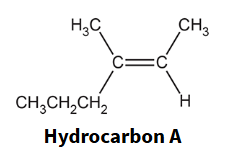
3-methylhex-2-ene
Name compound C: CH3CH2CH=CHCH2CH2OH
Hex-3-en-1-ol
What is the general formula and the suffix used for naming alkenes?
CnH2n -ene
What prefixes are used when there is more than one alkene group, and any other addtions we might need to make to the name?
• Use ‘di-‘, ‘tri-‘, ‘tetra-‘, etc. • Add an ‘a’ after the stem For example, octa-1,4-diene
How do you determine the parent chain when naming organic compounds?
Find the longest C chain that includes the alkene group.
What is the rule for numbering the parent chain in alkene naming?
Give the lowest number possible for the alkene group.
Define the term structural isomers?
Compounds with the same molecular formula but different structural formulae.
Define the term stereoisomers?
Compounds with the same structural formula but with different arrangement of atoms in space. This includes E/Z and cis/trans isomers.
How should alkyl groups be named in the alkene naming process?
Name and number any alkyl groups, listing them in alphabetical order if multiple, for example, 2-ethyl-3-methylheptane.
What prefix is used for naming cyclic alkenes?
‘cyclo-‘ This indicates the presence of a closed ring of carbon atoms.
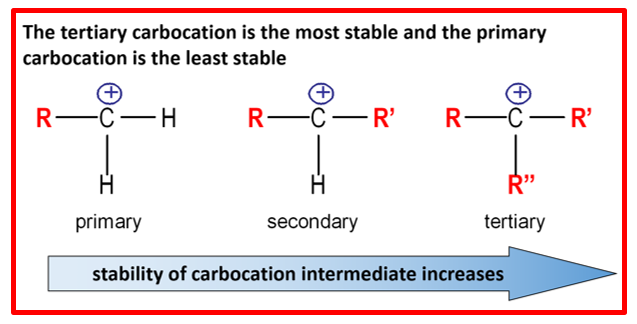
What is the major product formed from the electrophilic addition of HBr to propene?
2-bromopropane It is formed from a secondary carbocation intermediate which is more stable.
What is Markownikoff’s Rule?
This leads to the formation of a more stable carbocation intermediate
What are the five main reactions of alkenes?
• Halogenation e.g. bromination / chlorination • Hydrogenation • Hydration • Addition of a Hydrogen Halide Each reaction has specific reagents and conditions.
What is the chemical test for an alkene functional group?
• Add bromine water • Solution turns from orange to colourless This indicates the presence of a C to C double bond.
What are the problems associated with the disposal of addition polymers?
• Non-biodegradable • Burning produces toxic gases
What are some sustainable ways to process waste polymers?
• Recycled (to make other plastic materials) • Combustion for energy production • Use as an organic • Removal of toxic waste products
How can polymers minimize environmental damage?
• Develop biodegradable polymers • Develop photodegradable polymers
What are the Cahn-Ingold-Prelog (CIP) Priority Rules?
Atoms attached to carbon atoms of the double bond are given priority based on atomic number This helps in determining E/Z isomerism
What is the criteria for a compound to be a Z isomer?
The groups of higher priority are on the same side (zee zame zide) of the double bond.
What is the criteria for a compound to be a E isomer?
The groups of higher priority are on diagonally opposite sides of the double bond.
What criteria must be met for cis/trans isomers?
• Must have a carbon-carbon double bond, has restricted rotation • Each carbon must have two different groups attached • Two groups must be identical (often a H, one on each C of the C=C) This includes common examples like 2-butene
Define the term electrophile
An electron pair acceptor Electrophiles are essential in electrophilic addition reactions.
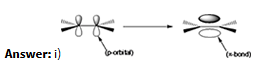
Draw a labelled diagram to show the formation of the π-bond.
• (sideways) overlap of p orbitals ✓ • (labelled) diagram on right showing π-bond ✓