Transition Metals
No description yet. This curated deck is ready for daily study.
Card preview (24)
• What is a coordinate bond
• A coordinate bond is a covalent bond / a shared pair of electrons which have both come from the same atom
• What is a ligand
• A ligand is an ion or molecule with a lone pair of electrons which can form a coordinate bond with a transition metal ion
• What is a bidentate ligand
• A bidentate ligand had two atoms that each donate a lone pair of electrons eg C2O42- and H2NCH2CH2NH2
• What is the coordination number
• The number of coordinate bonds a transition metal ion forms
• What is a complex ion
• A central atom or ion surrounded by ligands
• Draw [Ni(H2NCH2CH2NH2)3]2+
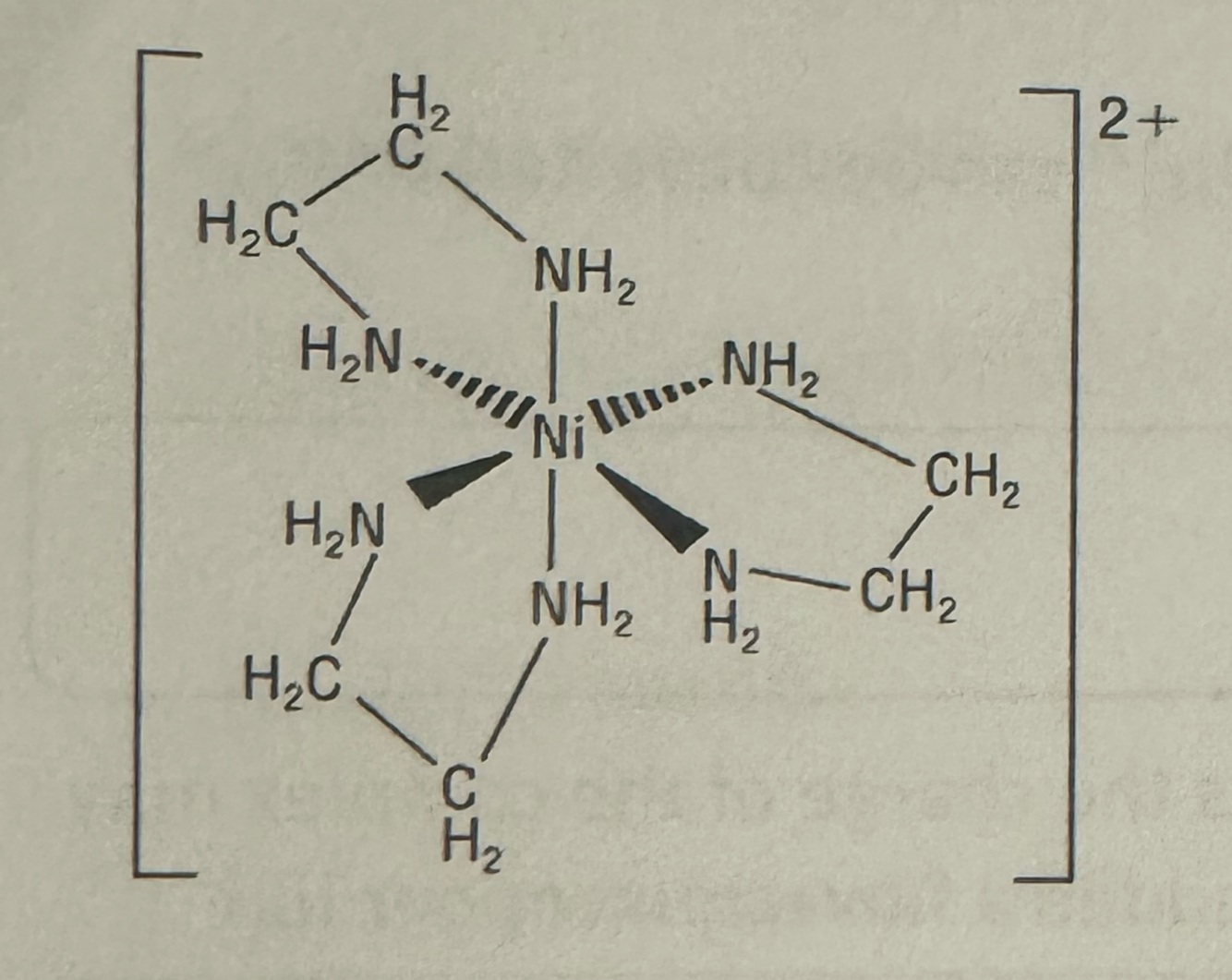
• What is the shape, coordination number and oxidation state of Ni in [Ni(H2NCH2CH2NH2)3]2+
• Shape: octahedral • Coordination number: 6 • Ni oxidation state: +2
• What can all transition metal ions form with ligands?
• All transition metal ions can form coordinate bonds with ligands
• What are the different types of ligands?
• Monodentate ligands - each ligand forms 1 coordinate bond • Bidentate ligands - each ligand forms 2 coordinate bonds • Multidentate ligands - each ligand forms 2 or more coordinate bonds
• What are the 4 monodentate ligands?
• H2O: • Cl:- • :NH3 • -:CN
• Whata are the 2 bidentate ligands?
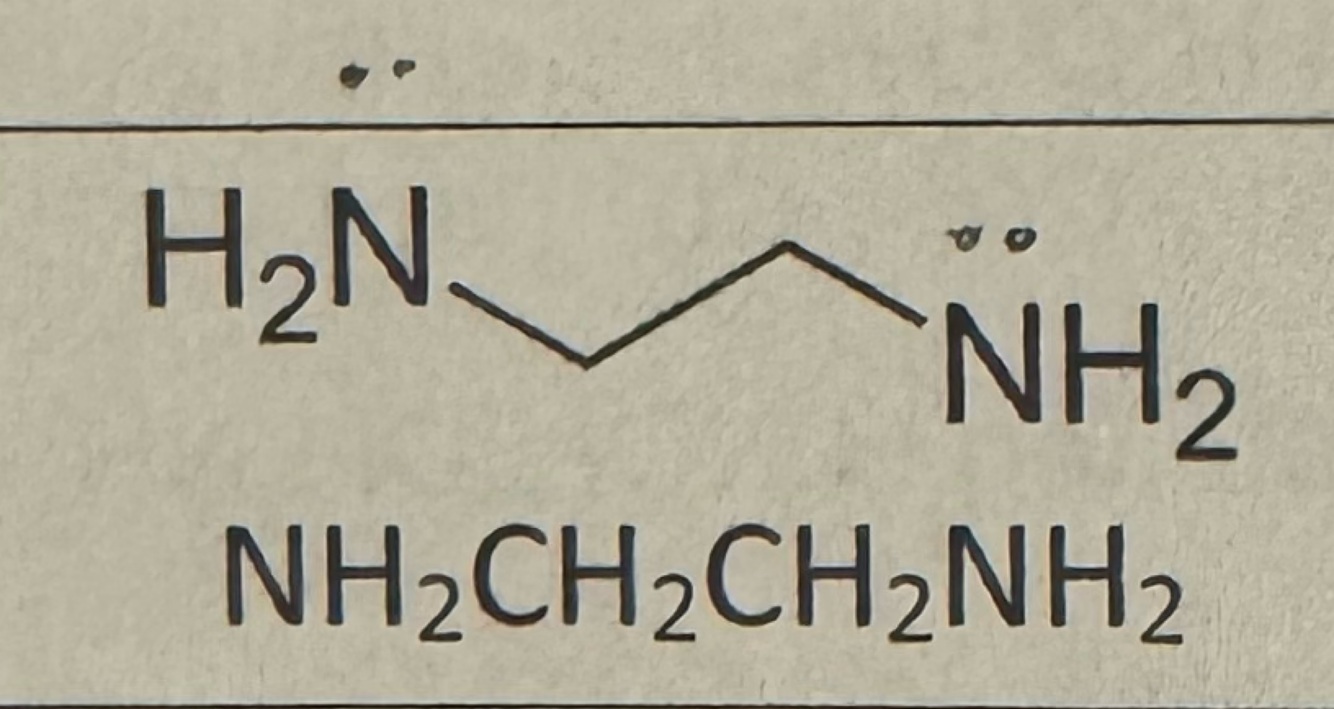
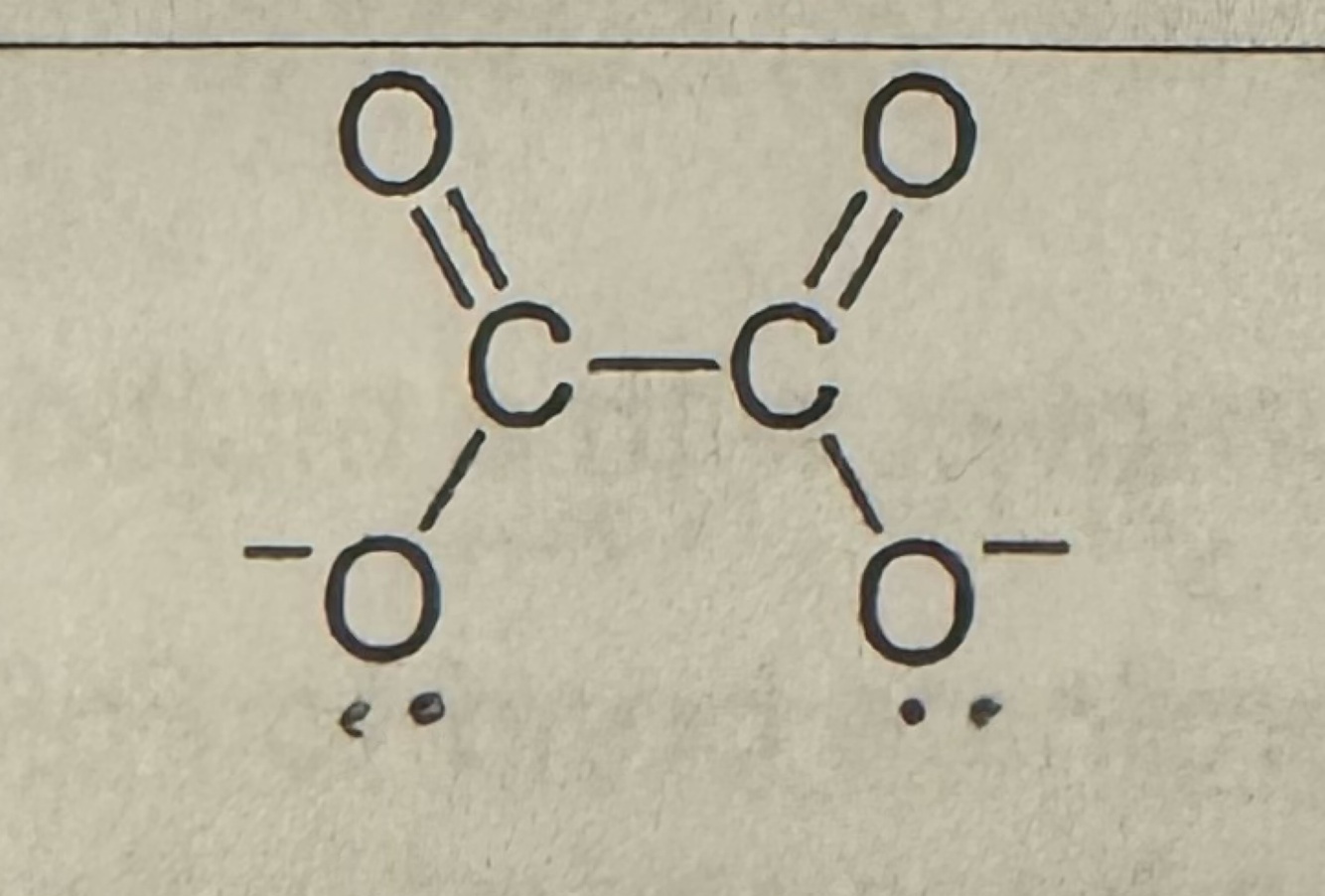
• Ethane-1,2-diamine (NH2CH2CH2NH2) - coordinate bonds form from the lone pairs on the two N atoms • Ethanedioate ion (C2O42-) - this is the ion formed from ethanedioic acid, bonds form from the two O- atoms
• Draw ethane-1,2-diamine
• What are the four common shapes which transition metal complexes form?
• Octahedral • Tetrahedral • Square planar • Linear
• Draw the ethanedioate ion
• When do hexa aqua ions form?
• Hexa aqua ions form whenever a transition metal salt is dissolved in water • NH3 is a similar size to H2O and so ammonia complexes are usually octahedral too as 6 ligands can fit around a metal ion
• What is the shape and coordination number of the [CuCl4]2- ion and what is the oxidation state of Cu
• Shape: tetrahedral • Coordination number: 4 • Cu oxidation state: +2
• Why is [CuCl4]2- tetrahedral and not octahedral?
• Because chloride ions are relatively large, only 4 can fit around transition metal ions, meaning they cannot be octahedral
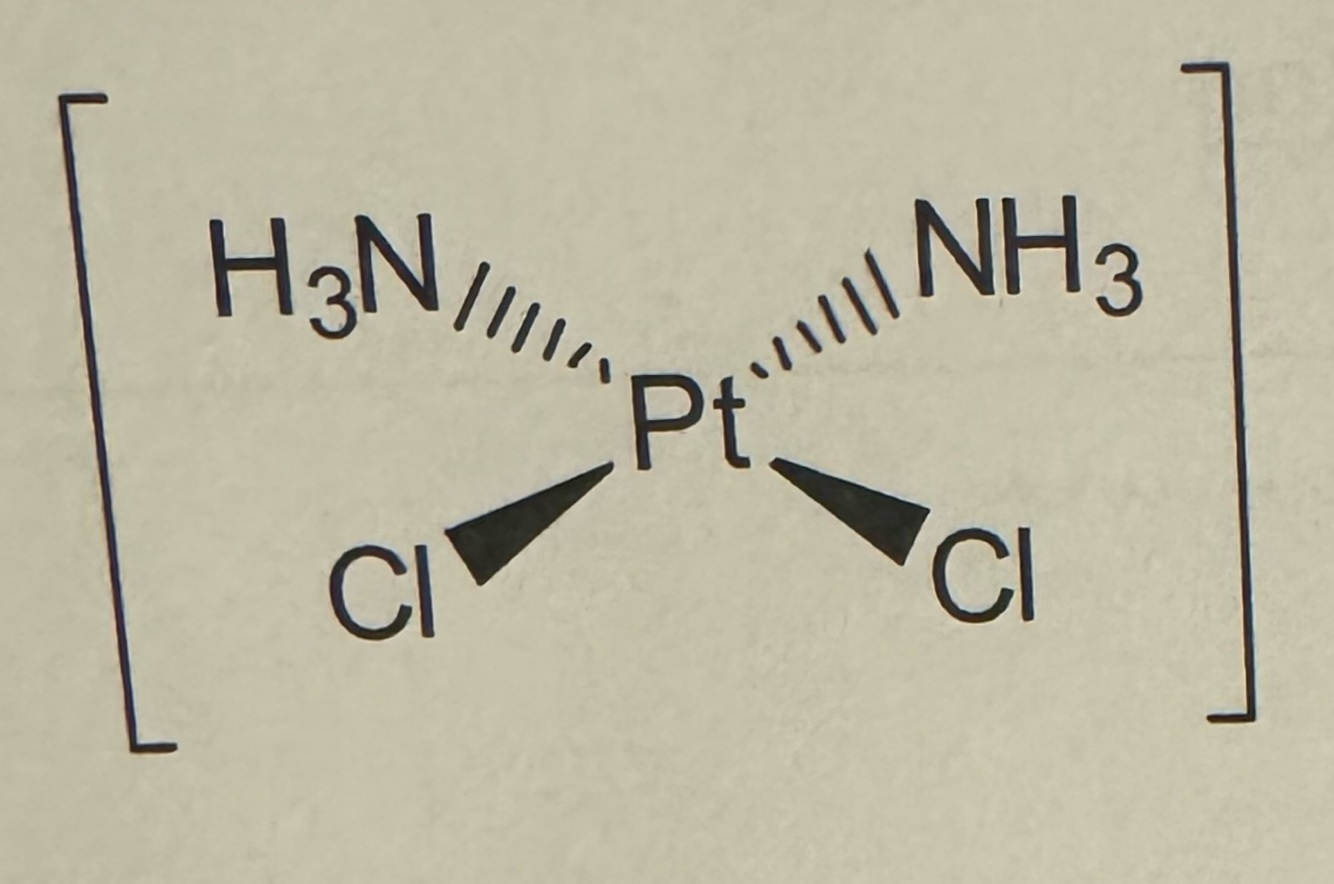
• What is the shape and coordination number of [Pt(NH3)2(Cl)2] and what is the oxidation state of Pt?
• Shape: square planar • Coordination number: 4 • Pt oxidation state: +2
• Draw [Pt(NH3)2(Cl)2]
• What is the shape and coordination number of [Ag(NH3)2]+ and what is the oxidation state of Ag?
• Shape: linear • Coordination number: 2 • Ag oxidation state: +1
• Draw [Ag(NH3)2]+
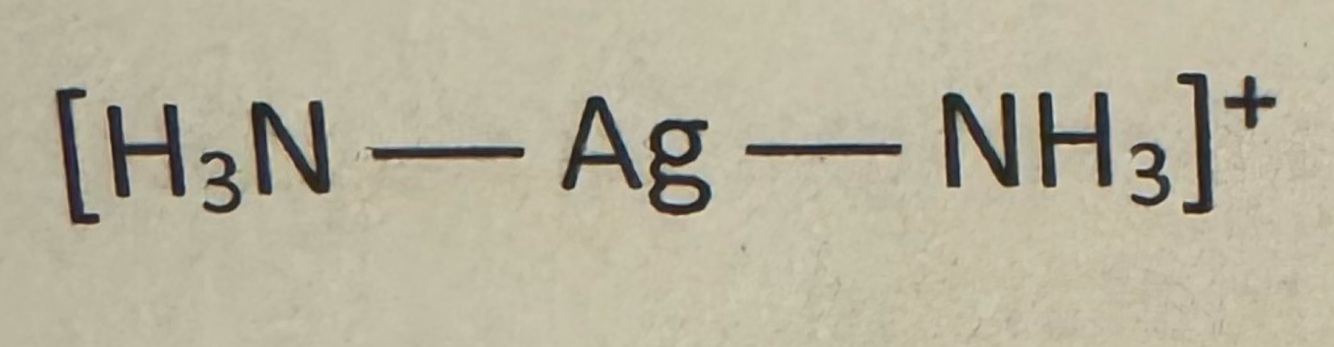
• What is the equation for the formation of [Ag(NH3)2]+ from the dissolving or AgCl/AgBr in ammonia?
• AgCl (s) + 2NH3 (aq) -> [Ag(NH3)2]+ (aq) + Cl- (aq)
• How many coordinate bonds can EDTA4- form
• EDTA4- can form six coordinate bonds; two coordinate bonds form from the N atoms and four coordinate bonds form from the O- atoms
• Why do chloro complexes tend to be tetrahedral?
• Chloro complexes tend to be tetrahedral as the chloride ligand is too big to fit any more than 4Cl- ligands around the metal ion