1.2 The Periodic Table
No description yet. This curated deck is ready for daily study.
Card preview (23)
How are elements arranged in the periodic table?
Order of atomic number So elements with similar properties are in columns
What are colums of elements known as in the periodic table?
Groups
What do elements in the same group have in common?
Same number of electrons in their outer shell Similar chemical properties
What is the law of octaves?
In Newlands periodic table, elements were ordered by weight Similar properties occured every 8th element - stopped after calcium
How did Mendeleev order his periodic table?
Atomic mass Did change order based on atomic weight (takes account of isotopes) Trends, so he left gaps when elements did not react similarly, therefore predicting elements
How is the modern periodic table ordered?
Atomic number Elements were then placed in groups
What are group 1 elements called?
Alkali metals
What do all group 1 elements have in common?
Single electron in their outer shell
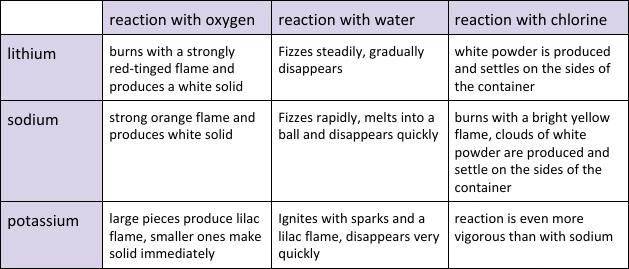
How do group 1 elements react with water?
Vigorously to create an alkaline solution and hydrogen
How do group 1 metals react with oxygen?
All react to create an oxide
How do group 1 elements react with chlorine?
All react forming a white precipitate
What happens to reactivity of group 1 elements as you go down the group?
Reactivity increases This is because the electron in the outermost shell becomes further from the positive nucleus, so there is less attraction to the nucleus As there is less attraction, it can be easily pulled away
LEARN THIS TABLE
What are group 0 elements called?
Noble gases
How many electrons do noble gases have in their outer shell?
All have 8 except helium that has 2 All of their shells are completely full
Why are group 0 elements not very reactive?
They have a full outer shell, so they have a stable arrangement of electrons
What happens to the boiling point of group 0 elements as you go down the table?
Increases due to increasing atomic mass
What are group 7 elements called?
The Halogens
How many electrons do group 7 elements have in their outer shell?
7
Why do group 7 elements exist as pairs e.g. Cl2
They share electrons to have a complete set of pairs
What happens as you go down group 7?
Increased: - Molecular mass - Melting point - Boiling point
Why does reactivity decrease as you go down group 7?
Halogens react by gaining an electron As you go down the group there are more electrons further from the nucleus, so there is less attraction to the positive nucleus So negatively charged electrons are less drawn to the positively charged nucleus as it is further away
If elements decrease in reactivity, what does this mean for displacement?
Elements higher up in the group will displace elements that are lower down So chlorine will displace bromine e.g. Chlorine + Potassium bromide -> Potassium chloride + Bromine