A6 Kinetics II
No description yet. This curated deck is ready for daily study.
Card preview (24)
Define Rate of Reaction
Change in quantaties of reactants or products over time
What does it mean if the reaction is 0th order with respect to a reactant
Changing the concentration will have no effect on rate
What does it mean if the reaction is 1st order with respect to a reactant
Concentration is proportional to rate
What does it mean if the reaction is 2nd order with respect to a reactant
Concentration is proportional to rate (^2)
When given a table to determine the reaction order with respect to a reactant, what must always be included in the explaination of each reactant
• From experiment X to Y • How the concentration of each reactant changes • How the rate changes • The reaction will be 0th/1st/2nd order with respect to the reactant
What will always be included in the rate equation
Rate = k [reagents that are 1st or 2nd order]
How are 0th order reactants included in rate equations
They are not
How are 1st order reactants included in rate equations
To the power of 1 (by itself)
How are 2nd order reactants included in rate equations
Squared
Define Overall Order
Overall effect of the concentrations of all reactants on the rate of reaction
How to determine the overall order of a reaction
The sum of the orders of the reactants
How can the rate constant, K , be determined from a rate equation
Re-arrange so that K = rate / [reactants]
What will the unit for rate always be
dm -3 mol s-1
What will the unit for K always contain
s-1
How should answers in kinetics calculations always be written
dm then mol then s
What does the red line represent on this concentration-time graph
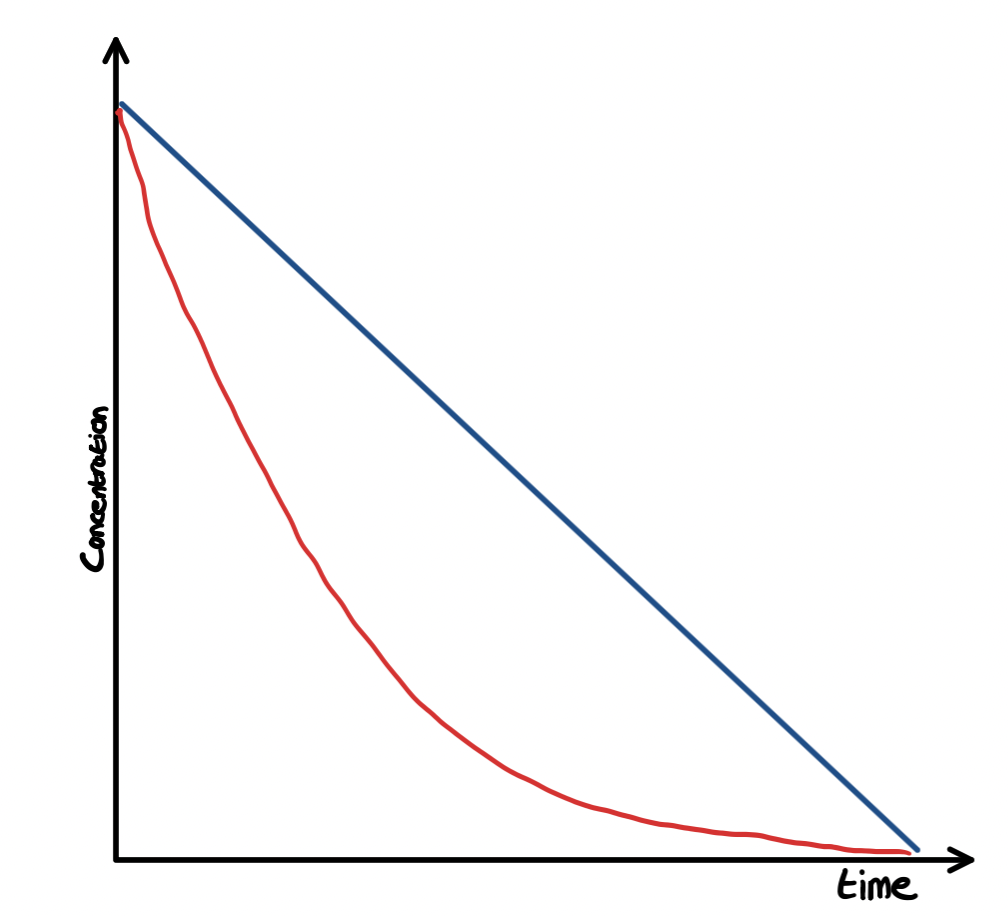
A reactant that is first order
What does the blue line represent on this concentration-time graph
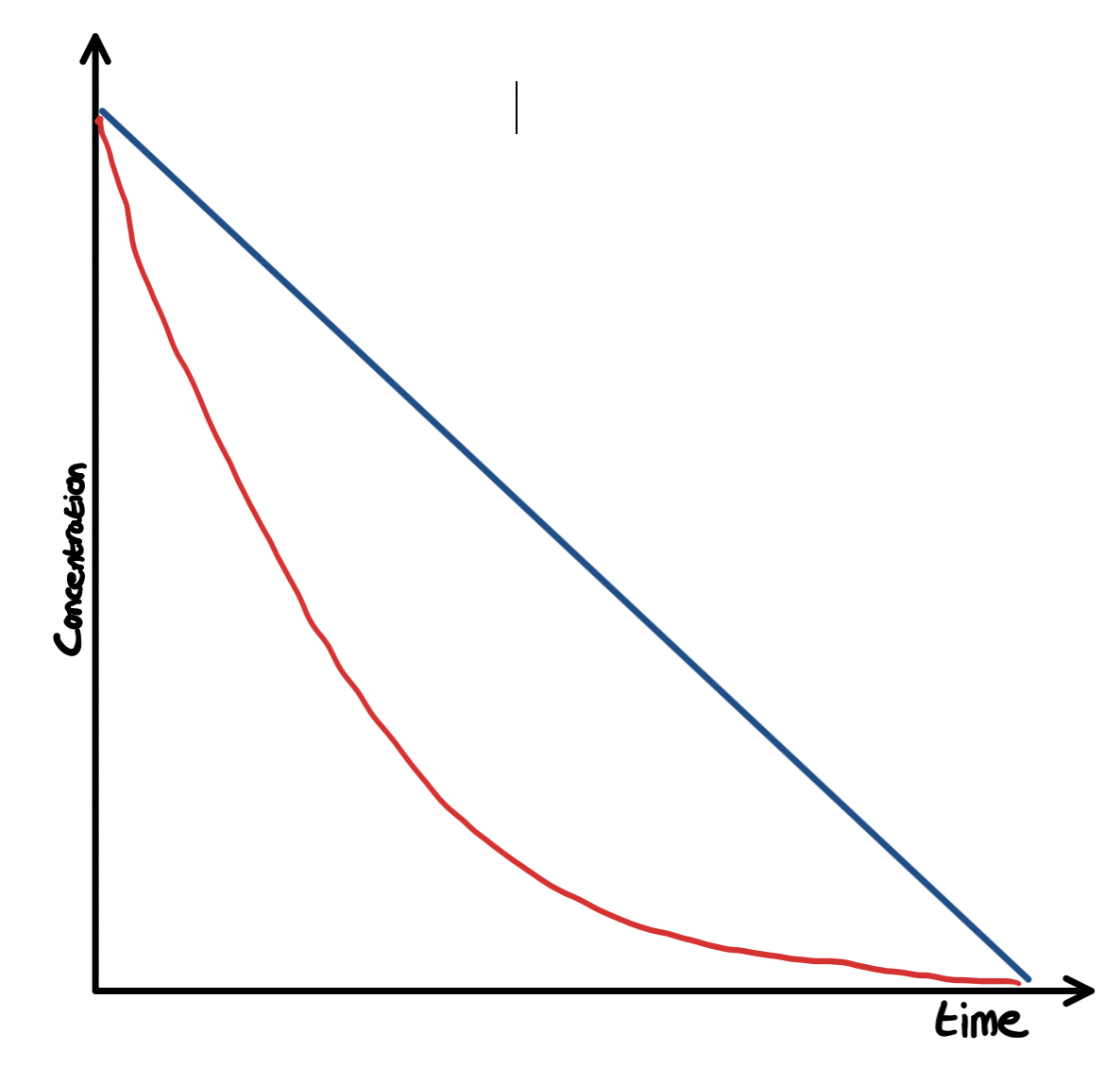
A reactant that is 0tt order
Describe the line on a concentration-time graph, that is 1st order
Line where consecutive half-lives are constant
Describe the line on a concentration-time graph, that is 0th order
Straight line, with a constant negative gradient
Define half-lives
Time taken for the concentration of a reactant to half
On a concentration-time graph, what does it mean if a reactant has constant consecutive half-lives
The reaction is 1st order with respect to the reactant
When can the value of K be determined from a concentration-time
When the reaction is first order with respect to the reactant
What is the formula for K when calculating with a 1st order concentration-time graph
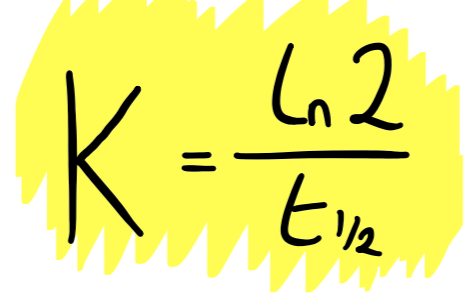
What is an alternative to using the following formula to determine K on a 1st order concentration time graph
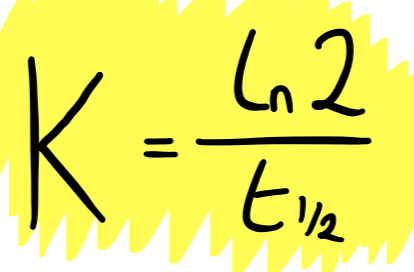
Drawing a tangent to the line at t=0s, and determining the gradient