Chapter 2
No description yet. This curated deck is ready for daily study.
Card preview (12)
Why Hybridization?
• Electron density in hybrid orbitals has a more defined direction - This provides for better orbital overlap in bonding • better overlap = stronger bonds = shorter bonds • bond strength is related to % s-character
Molecular Distortions
• VSEPR predicts bond angles for ideal geometries where all substituents are identical - non-identical groups distort the ideal angles - lone pairs more repulsive than bonding pairs - double bonds more repulsive than single bonds - electronegative atoms can be “compressed” - steric repulsions arise from group’s volume
Consitutional Isomers
• Constitutional isomers have the same chemical formula, but the atoms are connected in a different order. - Constitutional isomers have different properties. - The number of isomers increases rapidly as the number of carbon atoms increases.
Stereoisomers
• Stereoisomers are compounds with the atoms bonded in the same order, but their atoms have different orientations in space. • Cis and trans are examples of geometric stereoisomers and they occur when there is a double bond in the compound.
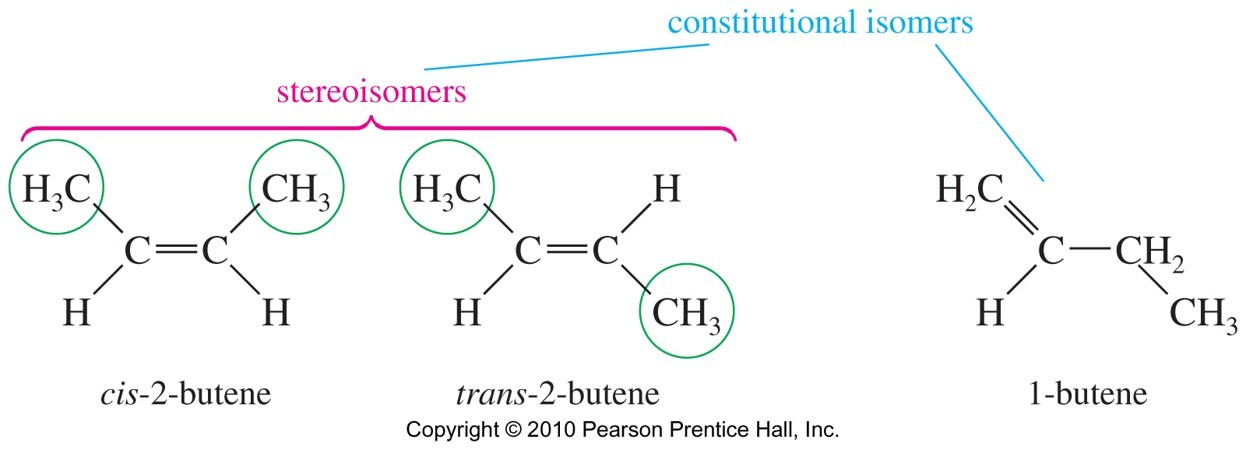
cis
same side
trans
on different sides
Effect of branching on boiling point
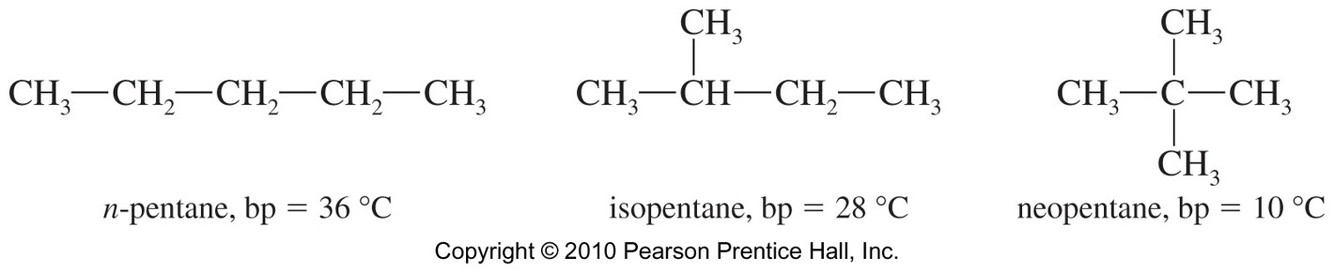
• The long-chain isomer (n-pentane) has the greatest surface area and the highest boiling point. • As the amount of chain branching increases, the molecule becomes more spherical and its surface area decreases. • The most highly branched isomer (neopentane) has the smallest surface area and the lowest boiling point.
Hydrogen Bonding
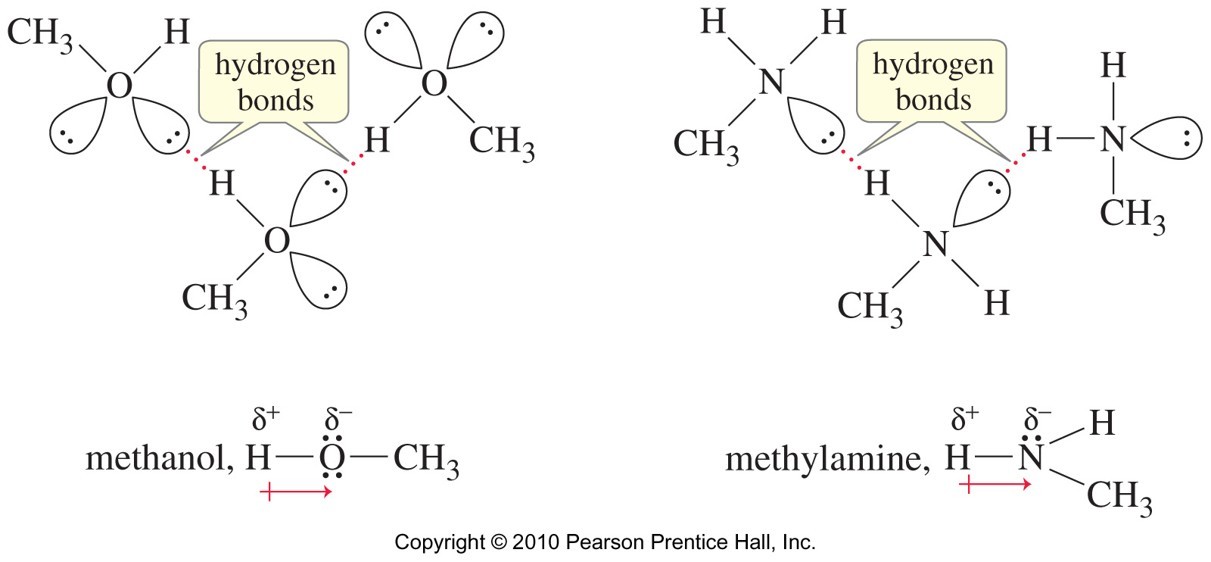
• Strong dipole–dipole attraction. • Organic molecules must have NH or OH to be able to hydrogen bond with molecules of the same type. • The hydrogen from one molecule is strongly attracted to a lone pair of electrons on the oxygen of another molecule. • O—H more polar than N—H, so alcohols have stronger hydrogen bonding.
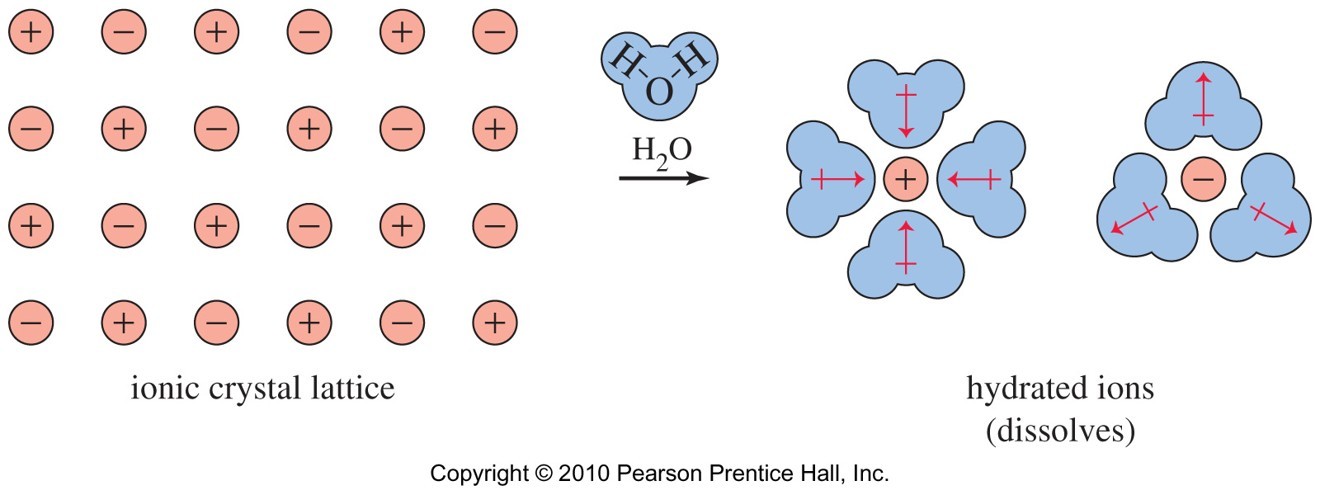
Polar Solute in a Polar Solvent
Dissolves - Hydration releases energy; entropy increases.
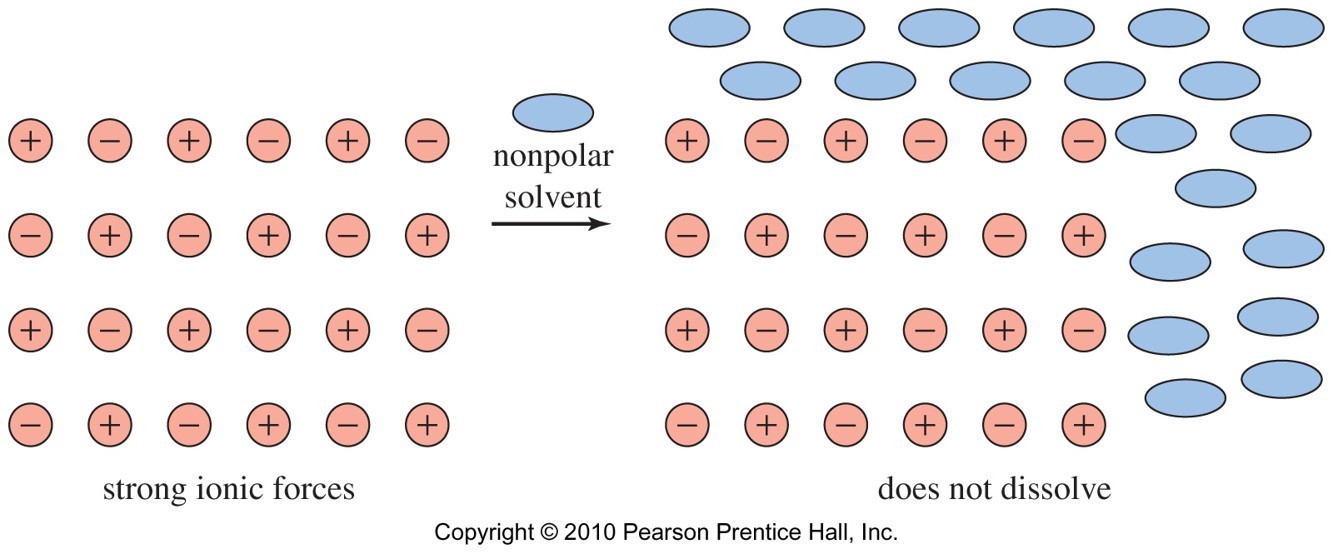
Polar Solute in Nonpolar Solvent
The solvent cannot break apart the intermolecular interaction of the solute, so the solid will not dissolve in the solvent.
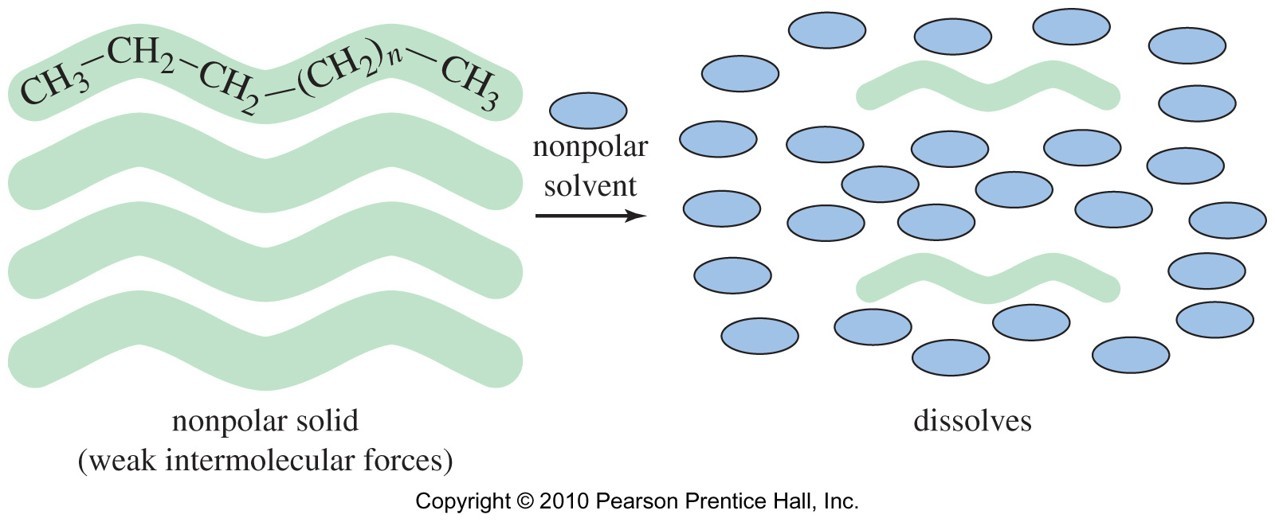
Nonpolar Solute with Nonpolar Solvent
The weak intermolecular attractions of a nonpolar substance are overcome by the weak attractions for a nonpolar solvent. The nonpolar substance dissolves.
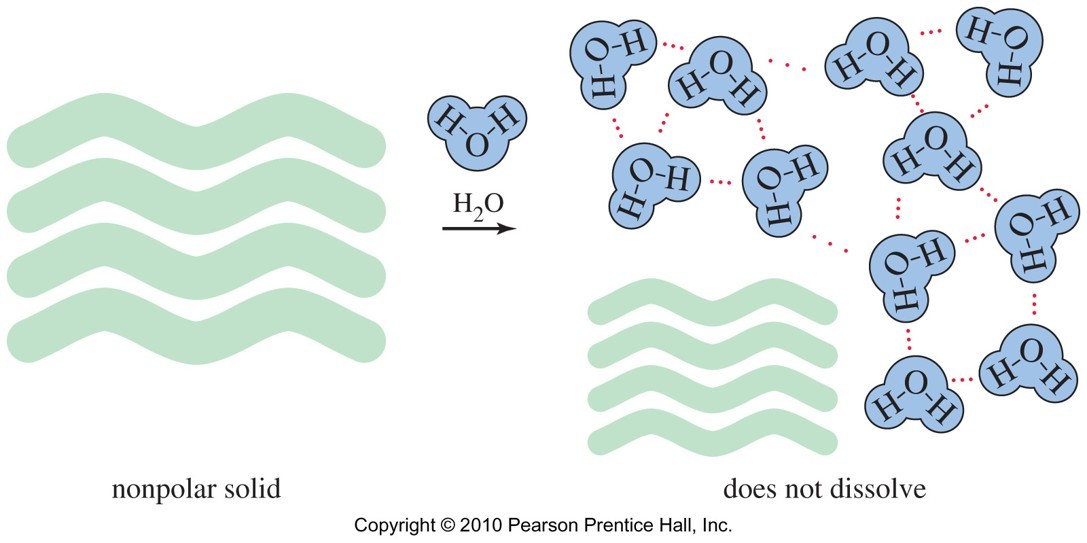
Nonpolar Solute with Polar Solvent
If a nonpolar molecule were to dissolve in water, it would break up the hydrogen bonds between the water molecules. Therefore, nonpolar substances do not dissolve in water.