LO 4.4 - Liming requirement
No description yet. This curated deck is ready for daily study.
Card preview (11)
Question How does Lime relate to pH? Lime
• Soils that naturally contain limestone materials in their particles tend to be neutral or alkaline. Soils that do not contain limestone materials tend to be acid. Over time, soils have a tendency to become more acid. Lime
Question How do you raise the pH of soil? Lime
• Soil is corrected by the addition of lime, usually in the form of ground limestone or magnesium limestone. Lime
Question What element in Lime is responsible for raising the pH level? Lime
• Calcium is the element in limestone that raises pH (skeletons of marine animals). Lime
Question How does Calcium raise the pH level? Lime
• By displacing hydrogen ions that are held on the soil particles. As the concentration of hydrogen ions is reduced, the pH goes up and the soil becomes more alkaline (or less acid). Lime
Question What is he most commonly used grade of lime? Lime
• The most commonly used grade of lime is ground limestone. The particle sizes range from dust up to 3.5 mm in diameter. Lime
Question How long does it take Limestone to be fully utilised after applying to the soil? Lime
• Ground limestone needs to dissolve in the soil before it can be fully utilised – up to 2 years. The smaller particles are more readily available and act more quickly. Lime
Question What is Granulated Lime? Lime
• Granulated lime is ground much more finely and then formed into granules. • It acts more quickly than ground lime, and the particles are less likely to blow away. • Granulated lime is more expensive than ground limestone. Lime
Question What is Over liming? Lime
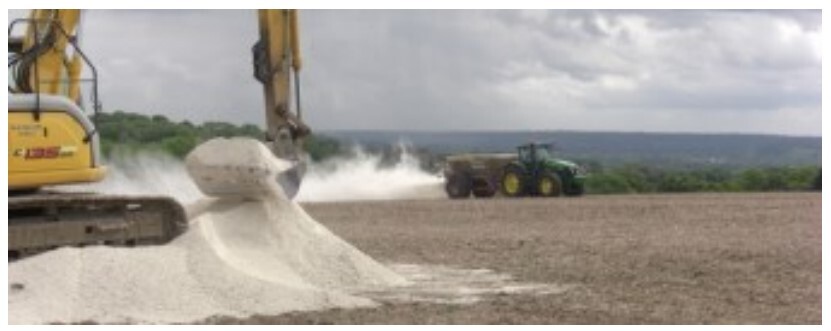
Over liming can occur if: * Too much lime per hectare is applied. * It is spread unevenly. Lime
Question What problems are caused by Over liming? Lime
Over-liming can lead to boron, iron and manganese deficiency. Lime
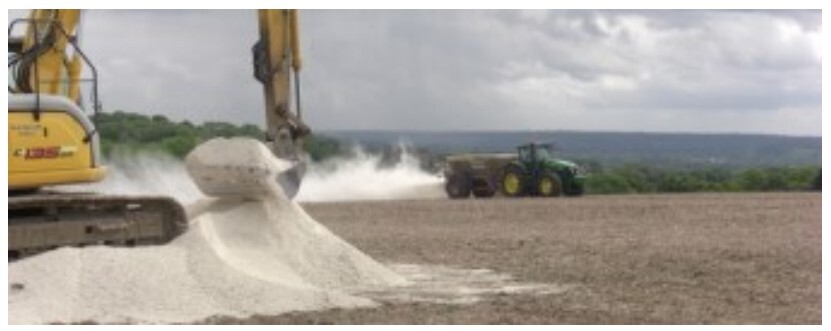
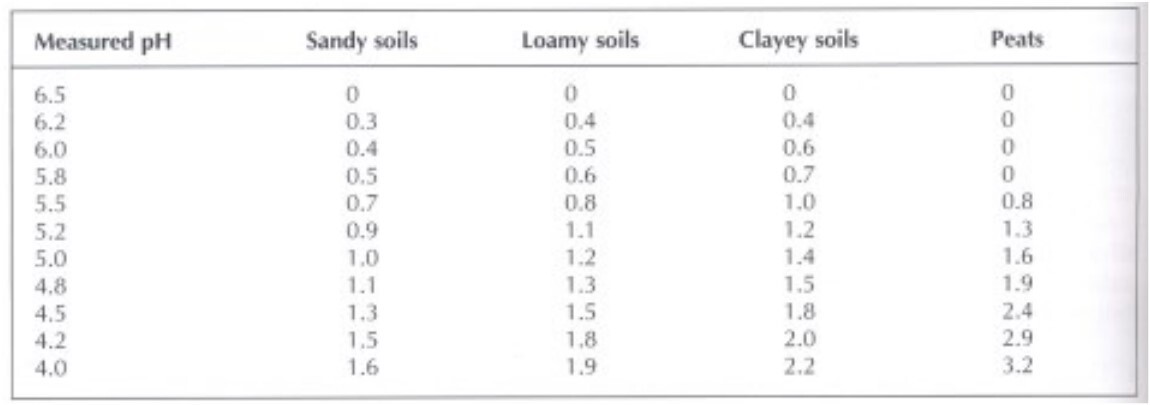
Question How much lime should be added? • Extensive field tests in England and Wales provide guidance on the amount of lime required to achieve a specified increase in pH Lime
The amounts of lime to add (kg m2) to bring the soil to the optimum pH (6.5 for most soils but 6 for peat) for the growth of most vegetables and flowers. The pH shown on the left is the measured pH of the soil before the addition of lime (from MAFF publications). Lime
Question Why do soils become more acidic over time? 5 reasons Lime
• Leaching can remove calcium, potassium, magnesium and sodium which are alkaline thus lowering the pH of soil. • Crops and livestock also remove basic cations from the soil. • Adding acidic fertilisers such as sulphate of ammonia make the soil more acid. • Decomposition of OM releases carbon dioxide. This dissolves to form carbonic acid. • Rainwater contains acids such as carbonic acid, nitric acid and sulphuric acid (the pH of rain is 5.5). Lime