3.6- Organic analysis
No description yet. This curated deck is ready for daily study.
Card preview (24)
What do we use mass spectrometry for?
1) To find the abundance and mass of each isotope in an element, allowing us to determine its relative atomic mass. 2) To find the relative molecular mass of substances made of molecules.
How does ToF mass spectrometry work?
1) +ive ions are accelerated by an electric field. 2) All ions have a constant KE. 3) If all ions have the same KE, then the smallest ions move fastest. 4) The lightest ions arrive at the detector first. 5) The current in the detector is proportional to the ion abundance.
How do you find the Ar from a mass spectrum?
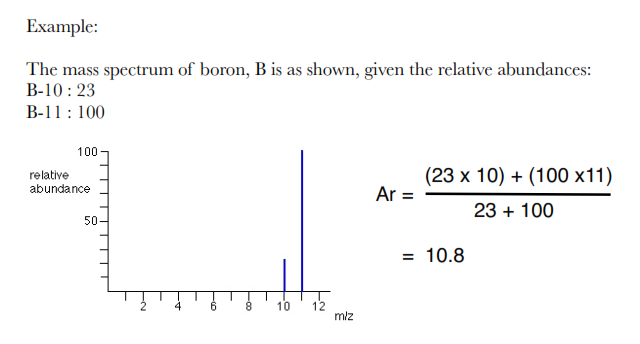
What do you do when the relative abundances in mass spectrum aren’t in %?
Add up the relative abundances and use them as the denominator instead of 100.
What are the two types of mass spectroscopy?
Electron impact Electrospray
How does ionisation happen in electron impact mass spectroscopy?
1) The sample needs to be gaseous. 2) An electron is knocked off each particle by the high-energy electrons to form 1+ ions. 3) The high-energy electrons are released from an electron gun (hot wire filament). 4) Positive ions are accelerated by a negative electric plate.
What is the equation for electron impact ionisation?
X(g) + e- → X+(g) + 2e-
What is electron impact mass spectroscopy used for?
Elements Small molecules
How does ionisation happen in electron impact mass spectroscopy?
1) The sample is added in a volatile solvent. 2) Particles gain a proton as they leave the hypodermic needle attached to positive terminal of high-voltage power supply. 3) The particles are sprayed from the needle as a fine mist. 4) The +ive ions are accelerated by a negative electric plate.
What is the equation for electrospray ionisation?
X(g) + H+ → XH+(g)
What is electrospray mass spectroscopy used for?
Big molecules.
What does a mass spectrum show about a substance made of molecules?
The molecular ion. A mixture of fragment ions. (The fragmentation pattern).
What do we use the ‘molecular ion’ found after doing a mass spectroscopy on the molecule?
To find the relative molecular mass.
What do we use the ‘fragmentation pattern’ to deduce after doing a mass spectroscopy on the molecule?
The structural formula of the molecule.
What peak on a mass spectra can be used to find the Mr of a compound?
The last one (furthest to the right).
How is the ‘molecular ion’ formed?
By the loss of a single electron from an organic unknown.
What is the Mr of this?
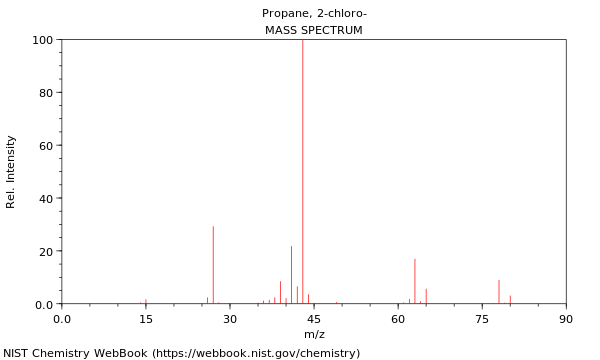
78 or 80
Why is there two possible Mr’s for this compound?
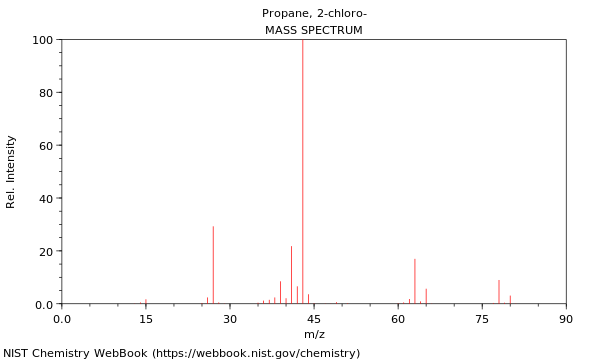
Because there are two isotopes of chlorine.
Why is the 78 peak taller than the 80 peak on this mass spectra?
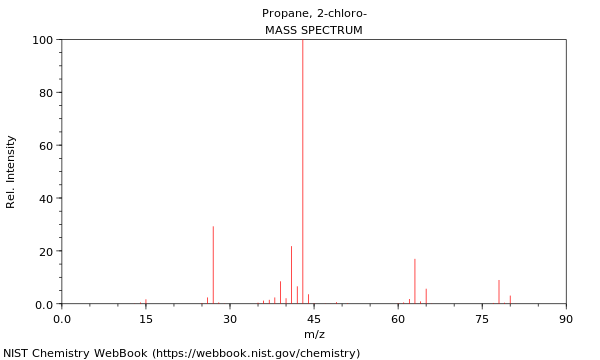
35Cl is 75% abundant and 37Cl is 25% abundant. This means the peak at 78 is 3x the peak at 80.
What are the chemical formulas of the 2-chloropropane ions we can deduce from this mass spectra?
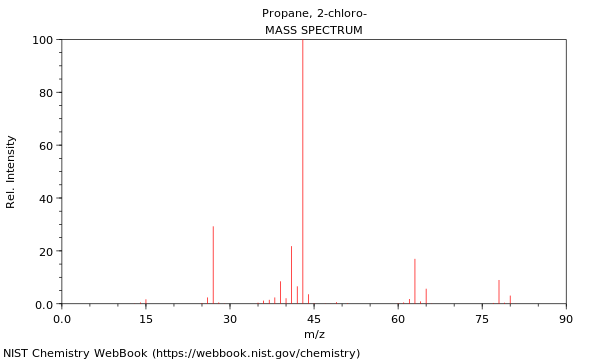
1) C₃H₇35Cl+ 2) C₃H₇37Cl+
What are the chemical formulas of the 2-bromopropane ions we can deduce from this mass spectra?
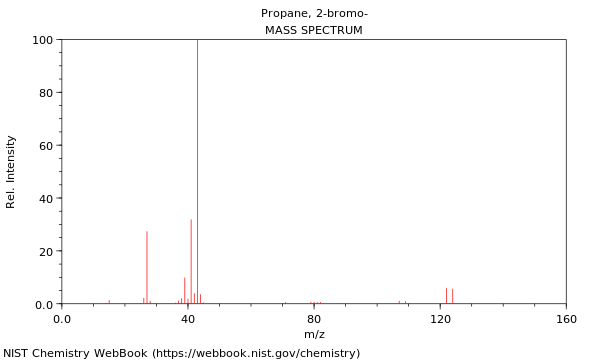
1) C₃H₇79Cl+ 2) C₃H₇81Cl+
Why is there two equal height peaks at the end of this mass spectra for 2-bromopropane?
There is an equal abundance of both 79Br and 81Br.
What does high resolution mass spectroscopy allow us to do?
Distinguish between fragments that have the same whole number masses.
Do we round our answer when calculating high resolution Mr of a compound?
NO- leave all the decimal places. This allows us to differentiate.