Atomic structure
No description yet. This curated deck is ready for daily study.
Card preview (24)
Details of the three Sub-atomic (fundamental) Particles

Isotopes
Isotopes are atoms with the same number of protons, but different numbers of neutrons Isotopes have similar chemical properties because they have the same electronic structure. They may have slightly varying physical properties because they have different masse
mass spectrometer
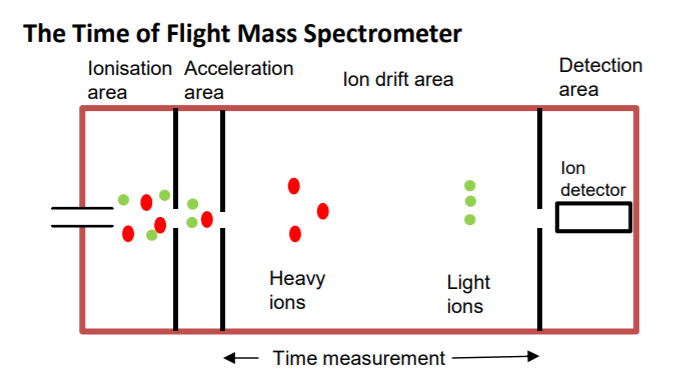
The mass spectrometer can be used to determine all the isotopes present in a sample of an element and to, therefore, identify elements It needs to be under a vacuum otherwise air particles would ionise and register on the detector
Draw TOF
Ionization
Electron impact • A vaporized sample is injected at low-pressure • An electron gun fires high energy electrons at the sample • This knocks out an outer electron • Forming positive ions with different charges E.g. Ti (g) Ti+ (g)+ e – Electron impact is used for elements and substances with low formula mass. Electron impact can cause larger organic molecules to fragment Electro Spray Ionisation • The sample is dissolved in a volatile, polar solvent • injected through a fine needle giving a fine mist or aerosol • the tip of the needle has high voltage • at the tip of the needle the sample molecule, M, gains a proton, H+, from the solvent forming MH+ • M(g) + H+—- MH+ (g) • The solvent evaporates away while the MH+ ions move towards a negative plate Electro Spray Ionisation is used preferably for larger organic molecules. The ‘softer’ conditions of this technique mean fragmentation does not occur
Acceleration
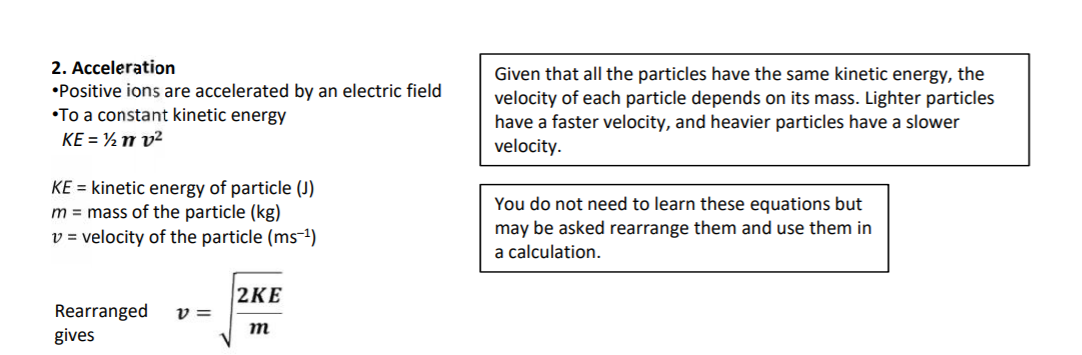
Flight Tube
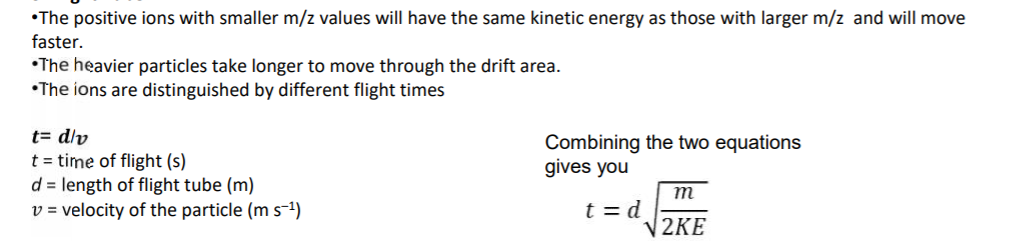
Detection
The ions reach the detector and generate a small current, which is fed to a computer for analysis. The current is produced by electrons transferring from the detector to the positive ions. The size of the current is proportional to the abundance of the species For each isotope, the mass spectrometer can measure an m/z (mass/charge ratio) and an abundance Sometimes two electrons may be removed from a particle forming a 2+ ion. 24Mg2+ with a 2+ charge would have an m/z of 12
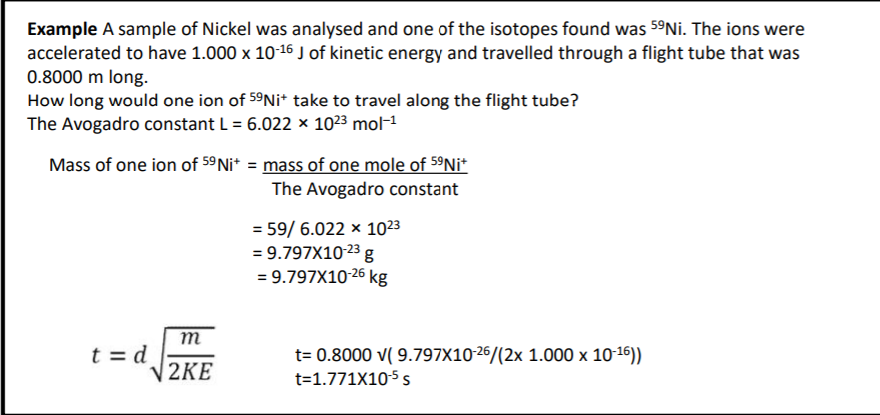
Example A sample of Nickel was analyzed and one of the isotopes found was 59Ni. The ions were accelerated to have 1.000 x 10⁻¹⁶ J of kinetic energy and traveled through a flight tube that was 0.8000 m long. How long would one ion of 59Ni+ take to travel along the flight tube? The Avogadro constant L = 6.022 × 10²³ mol–1 t=d times odmocnina m over 2 KE
Calculating Relative Atomic Mass

Example: Calculate the relative atomic mass of Tellurium from the following abundance data: 124-Te relative abundance 2; 126-Te relative abundance 4; 128-Te relative abundance 7; 130-Te relative abundance 6
= 127.8
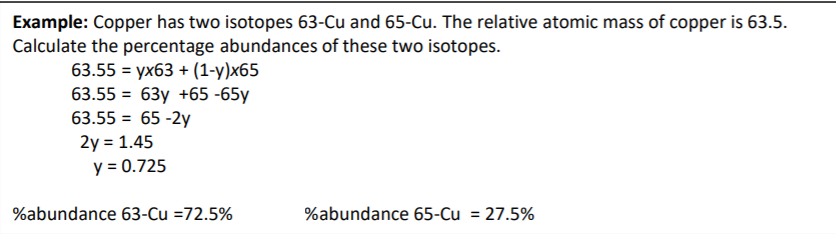
Example: Copper has two isotopes 63-Cu and 65-Cu. The relative atomic mass of copper is 63.5. Calculate the percentage abundances of these two isotopes
Measuring the Mr of a molecule
If a molecule is put through a mass spectrometer with an Electron impact ionization stage it will often break up and give a series of peaks caused by the fragments The peak with the largest m/z, however, will be due to the complete molecule and will be equal to the relative molecular mass, Mr, of the molecule. This peak is called the parent ion or molecular ion If a molecule is put through a mass spectrometer with Electro Spray Ionisation then fragmentation will not occur. There will be one peak that will equal the mass of the MH+ ion. It will, therefore, be necessary to subtract 1 to get the Mr of the molecule. So if a peak at 521.1 is for MH+, the relative molecular mass of the molecule is 520.1.
s sublevels are
spherical
p sublevels are
dumbbells
Cr electron configuration + Cr3+
Cr 1s2 2s2 2p6 3s2 3p6 4s1 3d5 Cr 3+ [Ar] 4s0 3d3
Cu electron configuration + Cu2+
Cu 2+ [Ar] 4s0 3d9
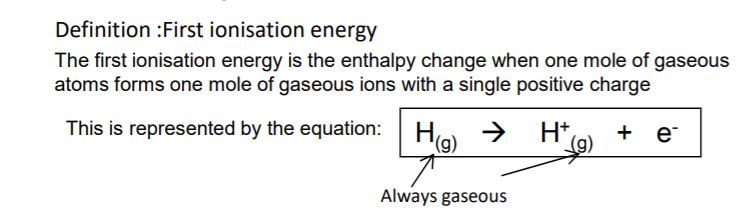
Definition :First ionisation energy
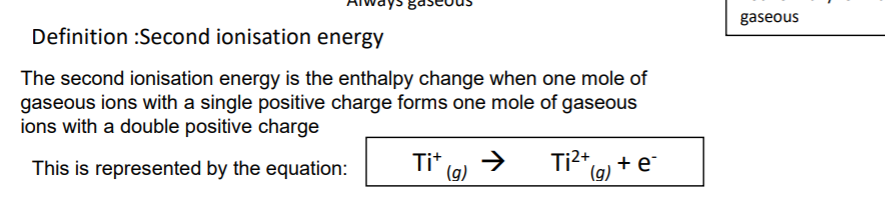
Definition :Second ionisation energy
Factors that affect Ionisation energy There are three main factors
1. The attraction of the nucleus (The more protons in the nucleus the greater the attraction) 2. The distance of the electrons from the nucleus (The bigger the atom the further the outer electrons are from the nucleus and the weaker the attraction to the nucleus) 3. Shielding of the attraction of the nucleus (An electron in an outer shell is repelled by electrons in complete inner shells, weakening the attraction of the nucleus)
Why are successive ionization energies always larger?
The second ionization energy of an element is always bigger than the first ionization energy. When the first electron is removed a positive ion is formed. The ion increases the attraction on the remaining electrons and so the energy required to remove the next electron is larger.
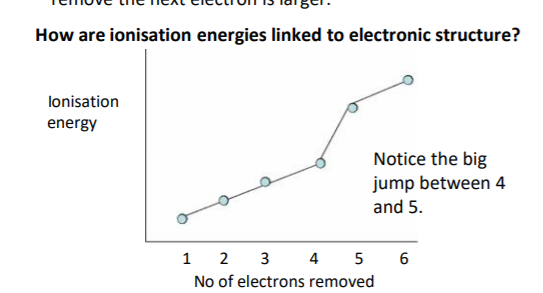
Explanation The fifth electron is in an inner shell closer to the nucleus and therefore attracted much more strongly by the nucleus than the fourth electron. It also does not have any shielding by inner complete shells of electron
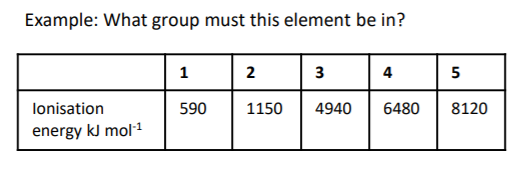
Here there is a big jump between the 2nd and 3rd ionisations energies which means that this element must be in group 2 of the periodic table as the 3rd electron is removed from an electron shell closer to the nucleus with less shielding and so has a larger ionisation energy
Why has Helium the largest first ionization energy?
Its first electron is in the first shell closest to the nucleus and has no shielding effects from inner shells. He has a bigger first ionisation energy than H as it has one more proton