Chapter 9A - Qualitative Tests for functional groups
No description yet. This curated deck is ready for daily study.
Card preview (11)
How can we test for C=C bonds?
• unsaturated = very reactive • presence can be determined qualitatively using oxidising agents • bromine water test • potassium permanganate test
Bromine Water test - Br₂(aq)
• bromine water (mixture between Br₂ and H₂O) has characteristic orange colour • orange colour lost when combined w/ unsaturated compound • colourless product • retain characteristic orange colour if saturated (UV light needed)
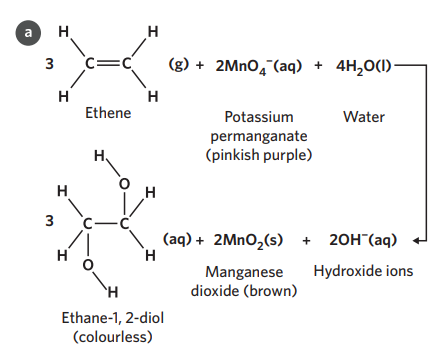
Potassium Permanganate Test
• Baeyer’s test • KMnO₄ (aq) has characteristic purple colour • purple colour lost when alkaline KMnO₄(aq) is combined w/ unsaturated compound • colourless product + brown MnO₂ precipitate • retain purple colour w/ saturated compounds
How can we test for hydroxyl functional groups?
• very electronegative oxygen • hydroxyl groups are reactive • Acidified Potassium Dichromate Test • Lucas Test • Tollen’s test
Acidified Potassium Dichromate Test
• determines presence of primary/secondary alcohol • Orange Cr⁶⁺(aq) ions are reduced to form green Cr³⁺(aq) • Primary alcohol oxidised to an aldehyde • Secondary alcohol oxidised to a ketone • acidified K₂Cr₂O₇ oxidises aldehydes to carboxylic acids but not ketones • acidified potassium permanganate also used

Lucas Test
• determines presence of primary, secondary & tertiary alcohol • cloudy mixture produced when lucas reagent (mixture of concentrated HCl & ZnCl₂) is added to an alcohol

Tollen’s test
• determines presence of an aldehyde (product of partial oxidation of a primary alcohol) • does not test for a ketone (product of partial oxidation of a secondary alcohol) • silver (Ag) is produced

How can we test for a carboxyl group?
• weak acids that react w/ basic substances • acid-base indicator tests • esterification test • reaction with metal carbonate/metal bicarbonate
Acid-base Indicator Test
• COOH partially ionises in water to produce hydronium ions • universal indicator/litmus paper identify presence of acidic COOH CH3COOH (aq) + H2O (l) ⇌ H3O+ (aq) + CH3COO- (aq)
Esterification Test
• COOH + primary OH in presence of concentrated sulfuric acid • an ester w/ sweet aromatic smell is produced
Reaction with metal carbonate/metal bicarbonate
• COOH reacts w/ weak bases to produce CO₂ (bubbles) Reaction types: Acid + metal carbonate → ionic salt + water + carbon dioxide Acid + metal hydrogen carbonate → ionic salt + water + carbon dioxide 2CH3COOH (aq) + Na2CO3 (s) → 2CH3COONa (aq) + H2O (l) + CO2 (g)