Required Practicals
No description yet. This curated deck is ready for daily study.
Card preview (21)
• RP1: Make up a volumetric solution and carry out a simple acid-base titration • STEPS FOR MAKING A SOLUTION
• Weigh the sample bottle containing the required mass of solid on a 2dp balance • Transfer to beaker • Reweigh empty sample bottle • Record the difference in mass • Add 100cm3 of distilled water to the beaker. Use a glass rod to stir to help dissolve the solid • Sometimes the substance may not dissolve well in cold water so the beaker and its contents could be heated gently until all the solid had dissolved • Pour solution into a 250cm3 graduated flask via a funnel • Rinse beaker and funnel and add washings from the beaker and glass rod to the volumetric flask • Make up to the mark with distilled water using a dropping pipette for last few drops. Ensure meniscus rests on calibration line • Invert flask several times to ensure uniform solution
RP1: Make up a volumetric solution and carry out a simple acid-base titration • Describe how to prepare 250cm3 of an aqueous standard solution of ethanedioic acid containing an accurately measured mass of the acid
• Accurately weigh out a dry sample of ethanedioic acid using a high precision (minimum 2dp) balance • Transfer to a beaker and reweigh weighing boat to determine mass transferred • Dissolve acid in a small volume of distilled water, stirring with a glass rod • Transfer to a VOLUMETRIC flask and rinse all equipment transferring rinsings too • Add deionised water up to calibration line using dropping pipette at end • Ensure meniscus rests on calibration line • Stopper bottle and invert 10 times to homogenise solution
RP7: In the iodine clock reaction, I reacts with hydrogen peroxide to form I2. This reacts with HSO: and forms further iodide ions, until the supply of HSO, is exhausted. At this stage, 12 forms a blue complex with starch. You are given solution A, containing iodide ions, solution B containing hydrogen peroxide, and a starch solution. Describe how you would design a series of experiments to determine the order of reaction with respect to the iodide ions.
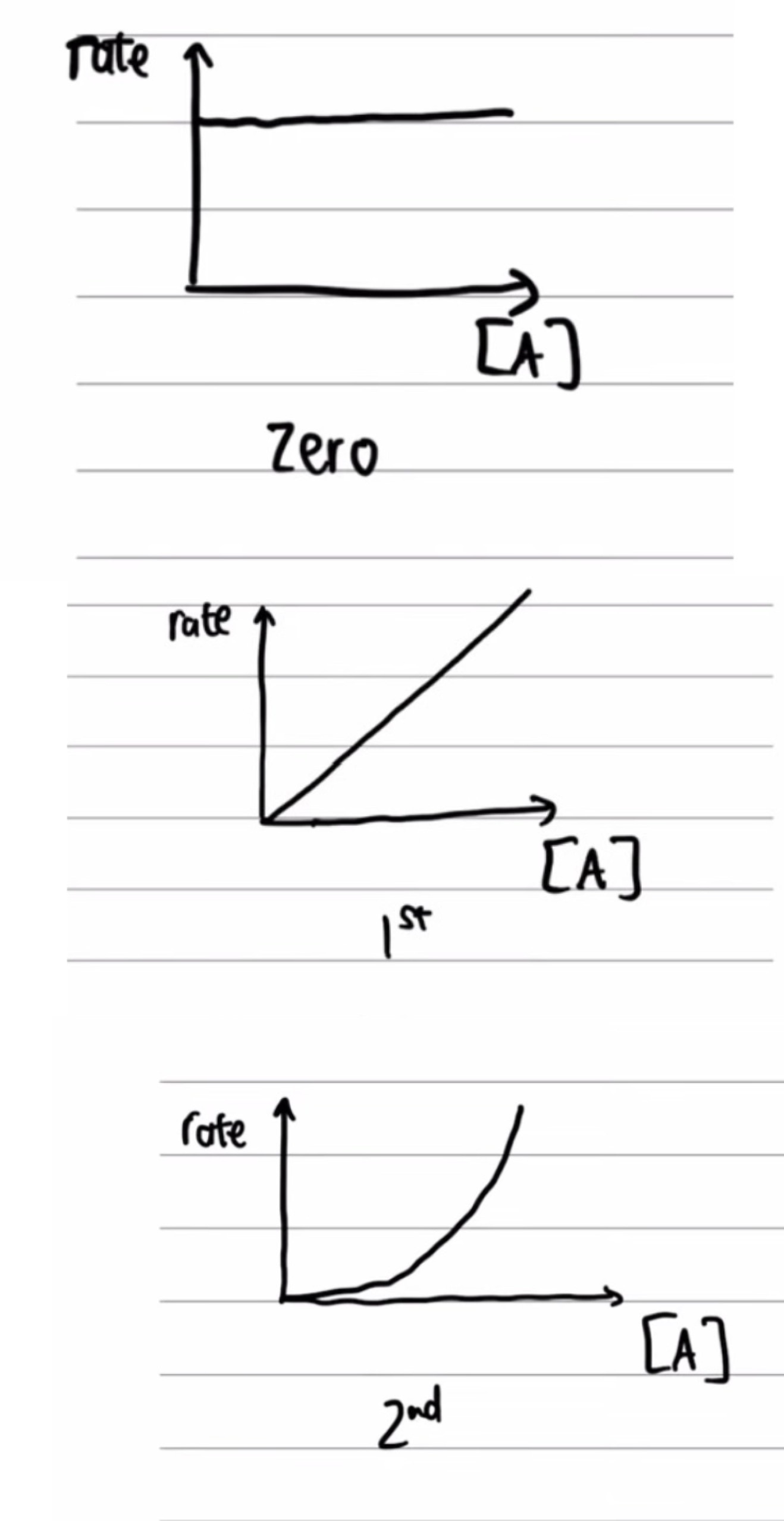
• Perform a series of experiments in which only the concentration of solution A varies. • All volumes remain the same. • [B] + [starch] stay the same • Temperature controlled using a water bath • Add 5cm3 of solution B and 1cm3 of starch to the beaker • Simultaneously add 5cm3 of solution A and start timer • Record time taken for blue colour to appear • Dilute solution A so concentration is half the original • Repeat experiment and record time taken • Use 1/time taken for blue to appear as surrogate rate • If rate x2 when [A] x 2, reaction is first order with respect to A • If rate does not change when [A] x 2, reaction is 0 order with respect to A • if rate x4 when [A] x 2, reaction is second order with respect to A
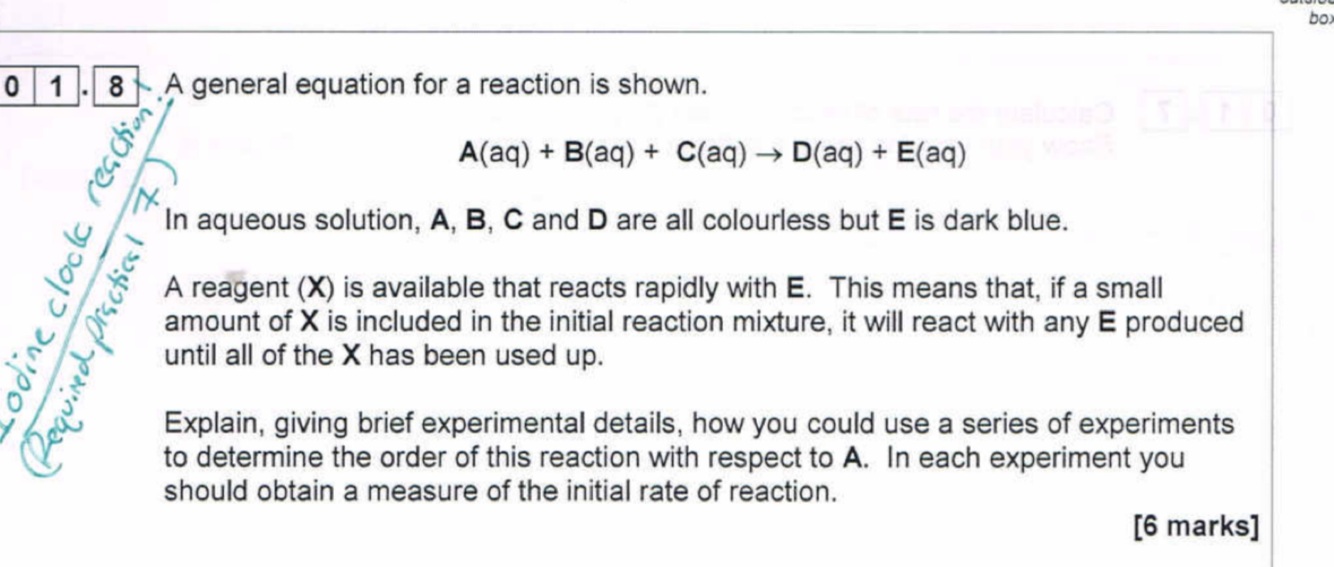
• In each experiment, use a known volume and concentration of B, C and X • Place B, C and X in a conical flask • Add a known volume and concentration of A to the flask and start the timer • Stop the timer when the blue colour is seen • Rate is proportional to 1/t • Repeat the experiment using same volume and concentrations of B, C and X • Keep temperature the same using a water bath • Change the concentration of A (keeping the total volume the same) • Do this for 4/5 concentrations of A • Plot a graph of 1/t against [A]
RP1: Why should you not heat or put hot solutions in the graduated/volumetric flask?
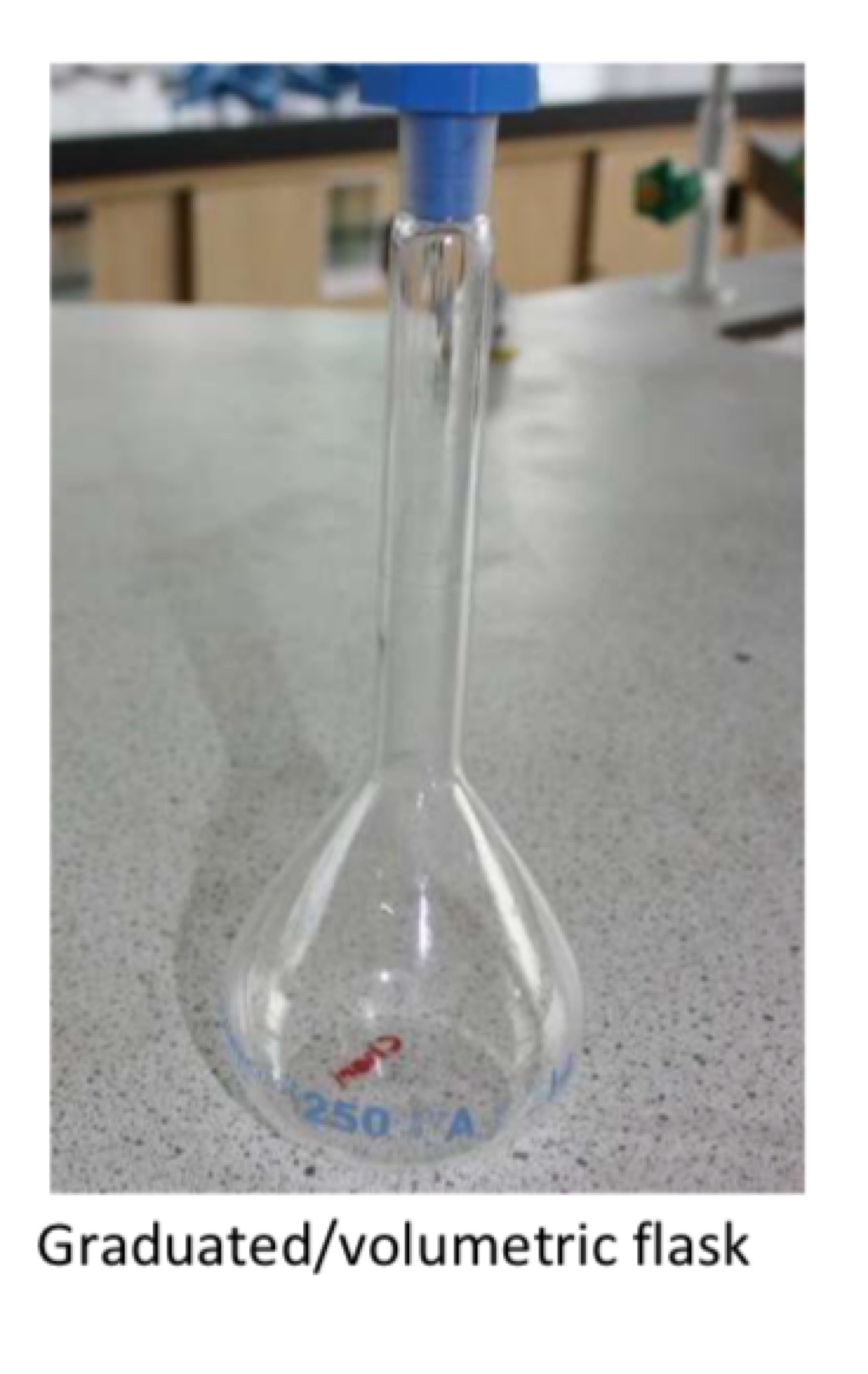
• Do not heat or put hot solutions in the volumetric flask because the heat would cause the flask to expand and the volume would then be incorrect
RP1: How to measure mass accurately?
• Measure mass on 2 or 3 dp balance of a weighing bottle with the required quantity of solid in it • Empty mass into reaction vessel / flask • Reweigh the now empty weighing bottle • Subtract the mass of the empty weighing bottle from the first reading to give exact mass actually added
RP1: How to dilute a solution?
• Pipette 25.0cm3 of original solution into a 250cm3 volumetric flask • Make up to the mark with distilled water using a dropping pipette for last few drops • Invert flask several times to ensure uniform solution
RP1: Why use a volumetric pipette when diluting a solution?
• Using a volumetric pipette is more accurate than a measuring cylinder because it has a smaller uncertainty • Use a dropping pipette to add the final drops until the bottom of the meniscus reaches the mark, ensuring accurate volume without overshooting
RP1: Why are titrations done?
• Titrations are done often to find out the concentration of one substance by reacting it with another substance of known concentration
RP1: In titrations, why is a conical flask used in preference to a beaker?
• A conical flask is used in preference to a beaker because it is easier to swirl the mixture in a conical flask without spilling the contents
RP1: What is the method for using a pipette during titration?
• Rinse pipette with substance to go in it (often alkali) • Pipette 25cm3 of solution A into conical flask • The volumetric pipette will have a mark on its neck to show the level to fill to • The bottom of the meniscus should sit on this line • Touch surface of solution with pipette to ensure correct amount is added • A small amount of solution will be left in the pipette at this stage • The calibration of the pipette will take into account this effect. It should not be forced out
RP1: Why should the burette be rinsed out with the substance that will be put in it?
• The burette should be rinsed out with the substance that will be put in it • If it is not rinsed out the acid or alkali added may be diluted by residual water in the burette or may react with substances left from a previous titration • This would lead to the concentration of the substance being lowered and a larger titre being delivered
RP1: Why should you not leave the funnel in the burette?
• Don’t leave the funnel in the burette because small drops of liquid may fall from the funnel during the titration leading to a false burette reading (would give a lower titre volume)
RP1: Why should you make sure the jet space in the burette is filled with the solution and air bubbles are removed?
• Make sure the jet space in the burette is filled with the solution and air bubbles are removed • If the jet space in the burette is not filled properly prior to commencing the titration it will lead to errors if it then fills during the titration, leading to a larger than expected titre reading
RP1: Why should burette readings be recorded to 2 decimal places?
• Burette readings should be recorded to 2 decimal places • If the meniscus is on a line, record .00 • If between lines, record .05 • As 0.05cm3 is the smallest measurable volume (one drop)
RP5:
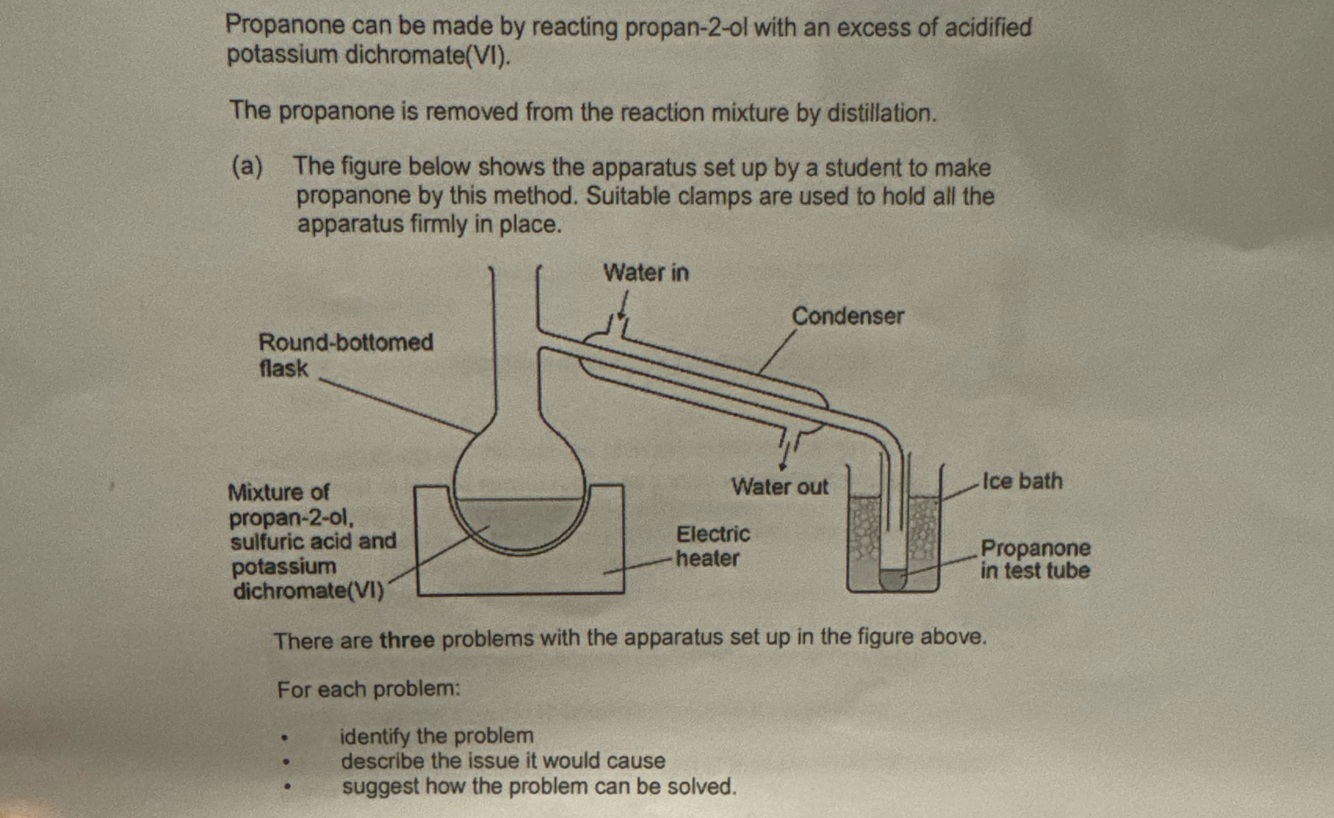
• Anti - bumping granules: • No anti-bumping granules / add anti bumping granules • To prevent the formation of large bubbles • Open system with no thermometer • System should be closed above flask to prevent gases escaping • Should be closed with bung + thermometer • To allow collection of propanone only / to prevent distillation of other components / to stay in suitable temperature range • The water direction in the condenser is wrong • Waters flows in wrong direction through condenser so change water direction • Condenser not cool enough / not full of water • Product may not condense
• Suggest why a pH probe is washed with distilled water between each of the calibration measurements (when measuring pH of DIFFERENT solutions)
• Different solutions must not contaminate each other • To wash off any residual solution which could interfere with the reading
• In a titration, why is it suitable to measure out the liquid being used to titrate in a burette?
• Because a burette can deliver variables volumes
• Suggest briefly a practical procedure that a student could use to obtain data from which the curve in the graph could be plotted (1) • The student was provided with three samples of different indicators, suggest how the practical procedure could be refined by the student to add the most suitable indicator
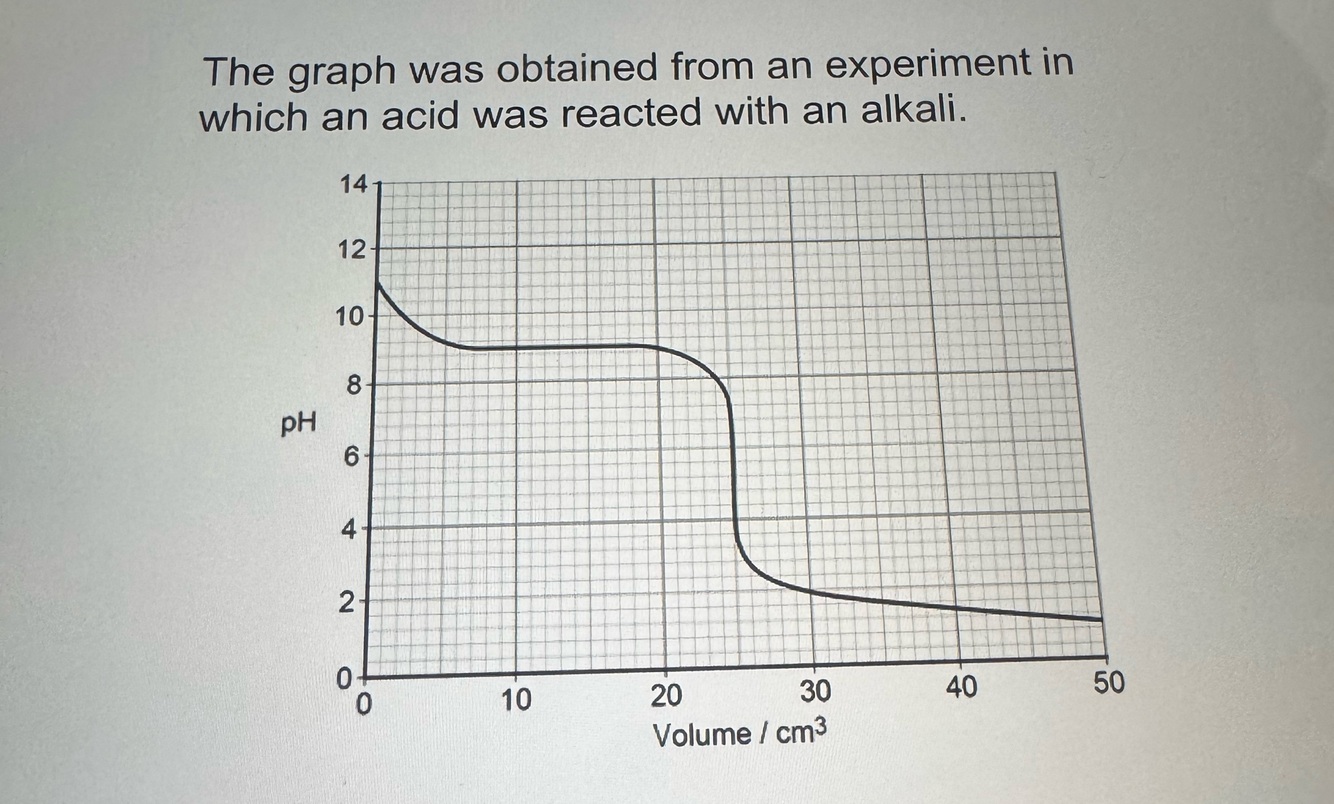
• Placed a fixed volume of alkali in a flask or beaker • Add acid in small portions from a burette • Stir and use a pH meter to record the pH after each addition of acid • Repeat the experiment with each indicator • Select the indicator that changes colour rapidly when the pH changes from about 7 to 4
• Suggest briefly a practical procedure that a student could use to obtain data from which the curve in the graph could be plotted (1) • The student was provided with three samples of different indicators, suggest how the practical procedure could be refined by the student to add the most suitable indicator
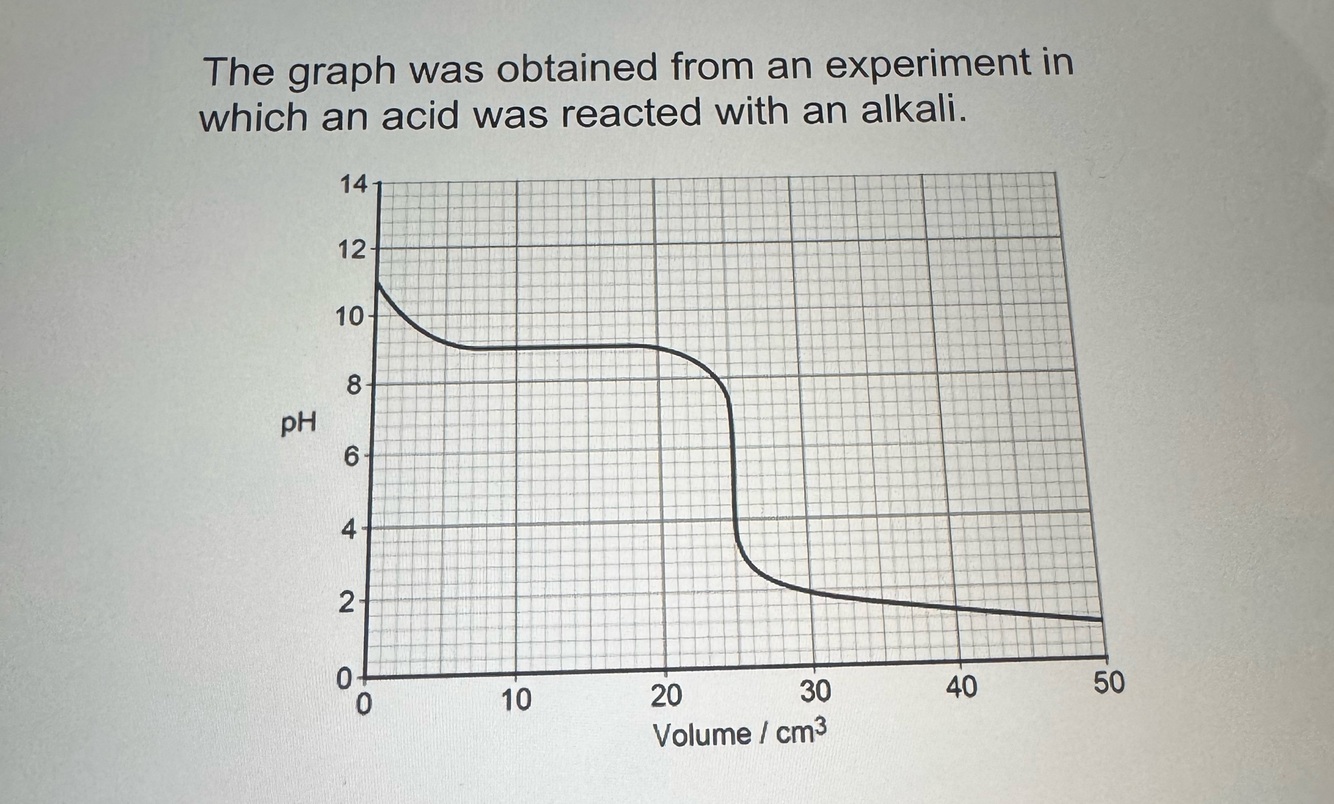
• Placed a fixed volume of alkali in a flask or beaker • Add acid in small portions from a burette • Stir and use a pH meter to record the pH after each addition of acid • Repeat the experiment with each indicator • Select the indicator that changes colour rapidly when the pH changes from about 7 to 4
• Suggest one possible risk to a person who uses a hand-warmer containing sodium hydroxide and hydrochloric acid.
• Container splitting and releasing irritant / corrosive chemicals