Equilibrium
No description yet. This curated deck is ready for daily study.
Card preview (18)
dynamic equilibrium
The term dynamic means both forward and backward reactions are occurring simultaneously
Two features of Dynamic Equilibrium
• Forward and backward reactions are occurring at equal rates. • The concentrations of reactants and products stays constant
Le Chatelier’s Principle
Le Chatelier’s principle states that if an external condition is changed the equilibrium will shift to oppose the change (and try to reverse it).
Effect of Temperature on equilibrium
If the temperature has increased the equilibrium will shift to oppose this and move in the endothermic direction to try to reduce the temperature by absorbing heat If the temperature has decreased the equilibrium will shift to oppose this and move in the exothermic direction to try to increase the temperature by giving out heat.
What effect would increasing temperature have on the yield of ammonia? N2 + 3H2—— 2NH3 exothermic
If temperature is increased the equilibrium will shift to oppose this and move in the endothermic, backwards direction to try to decrease temperature. The position of equilibrium will shift towards the left, giving a lower yield of ammonia
Effect of Pressure on equilibrium
Increasing pressure will cause the equilibrium to shift towards the side with fewer moles of gas to oppose the change and thereby reduce the pressure Decreasing pressure will cause the equilibrium to shift towards the side with more moles of gas to oppose the change and thereby increase the pressure If the number of moles of gas is the same on both sides of the equation then changing pressure will have no effect on the position of equilibrium H2 + Cl2 ⇌ 2HCl Increasing pressure may give a higher yield of product and will produce a faster rate. Industrially high pressures are expensive to produce ( high electrical energy costs for pumping the gases to make a high pressure) and the equipment is expensive (to contain the high pressures
What effect would increasing pressure have on the yield of methanol? CO (g) + 2H2(g) ⇌ CH3OH (g)
If pressure is increased the equilibrium will shift to oppose this and move towards the side with fewer moles of gas to try to reduce the pressure . The position of equilibrium will shift towards the right because there are 3 moles of gas on the left but only 1 mole of gas on the right, giving a higher yield of methanol.
Effect of Concentration on Equilibrium I2 + 2OH- ——— I - + IO- + H2O Brown to colorless
Increasing the concentration of OH- ions causes the equilibrium to shift to oppose this and move in the forward direction to remove and decrease the concentration of OH- ions The position of equilibrium will shift towards the right, giving a higher yield of I- and IO-. ( The color would change from brown to colorless) Adding H+ ions reacts with the OH- ions and reduces their concentration so the equilibrium shifts back to the left giving brown color
Effect of Catalysts on Equilibrium
A catalyst has no effect on the position of equilibrium, but it will speed up the rate at which the equilibrium is achieved. It does not effect the position of equilibrium because it speeds up the rates of the forward and backward reactions by the same amount.
Haber process eqm importance
N2 + 3H2 ⇌ 2NH3 H = -ve exo T= 450oC, P= 200 – 1000 atm, catalyst = iron Low temp gives good yield but slow rate: compromise temp used High pressure gives good yield and high rate: too high a pressure would lead to too high energy costs for pumps to produce the pressure
Contact process eq+ eqm importance
Stage 1 S (s) + O2 (g) —— SO2 (g) Stage 2 SO2 (g) +½O2 (g) ⇌ SO3 (g) T= 450oC, P= 1 or 2 atm, catalyst = V2O5 Low temp gives good yield but slow rate: compromise moderate temp used High pressure only gives slightly better yield and high rate: too high a pressure would lead to too high energy costs for pumps to produce the pressure
Production of methanol from CO eqm importance
CO (g) + 2H2(g) ⇌ CH3OH (g) Exothermic T= 400oC, P= 50 atm, catalyst = chromium and zinc oxides Low temp gives good yield but slow rate: compromise temp used High pressure gives good yield and high rate: too high a pressure would lead to too high energy costs for pumps to produce the pressure
Hydration of ethene to produce ethanol
CH2 =CH2 (g) + H2O (g) ⇌ CH3CH2OH(l) exo T= 300oC, P= 70 atm, catalyst = conc H3PO4 Low temp gives good yield but slow rate: compromise temp used High pressure gives good yield and high rate: too high a pressure would lead to too high energy costs for pumps to produce the pressure High pressure also leads to unwanted polymerisation of ethene to poly(ethene)
carbon neutral
The term carbon neutral refers to “an activity that has no net annual carbon (greenhouse gas) emissions to the atmosphere”
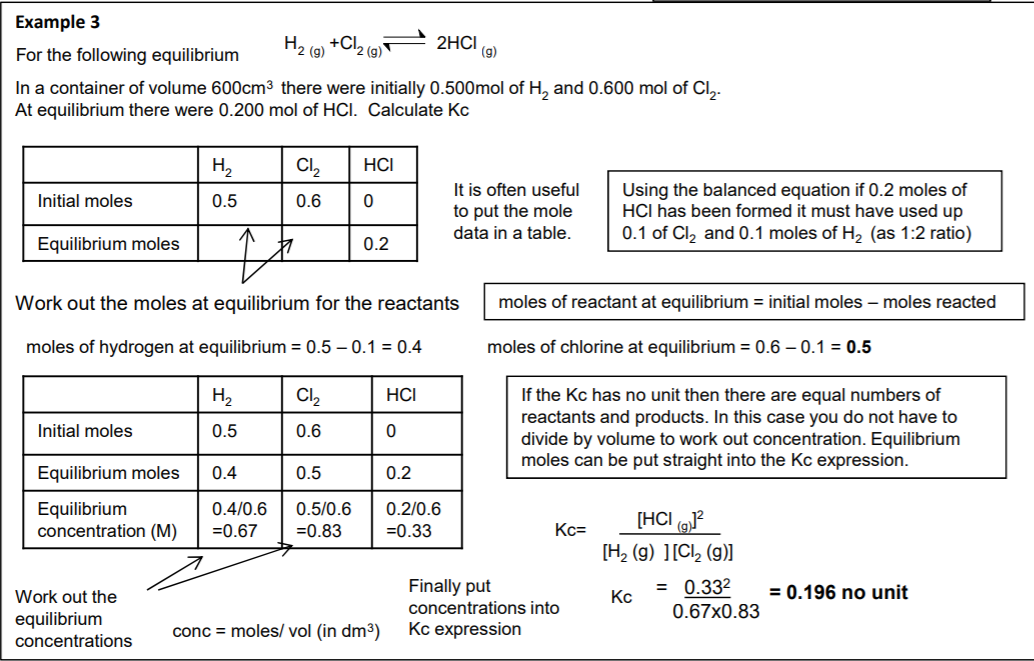
Example 3 H2 (g) +Cl2 (g)——— 2HCl (g) In a container of volume 600cm3 there were initially 0.500mol of H2 and 0.600 mol of Cl2 . At equilibrium there were 0.200 mol of HCl. Calculate Kc
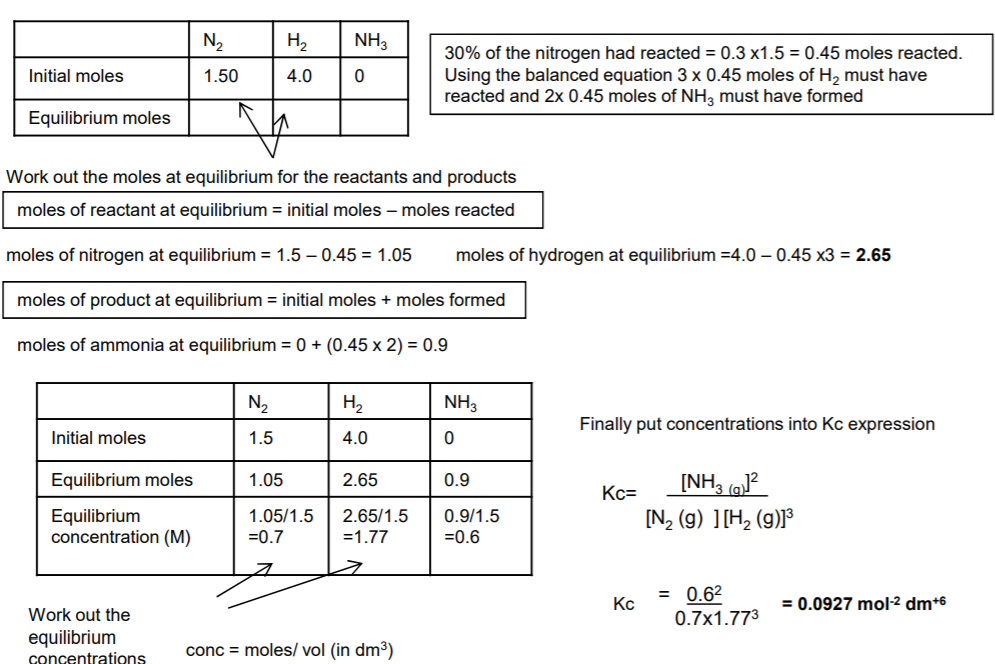
N2 (g) + 3H2 (g )—- 2 NH3 (g) Initially there were 1.50 moles of N2 and 4.00 mole of H2, in a 1.50 dm3 container. At equilibrium 30% of the Nitrogen had reacted. Calculate Kc
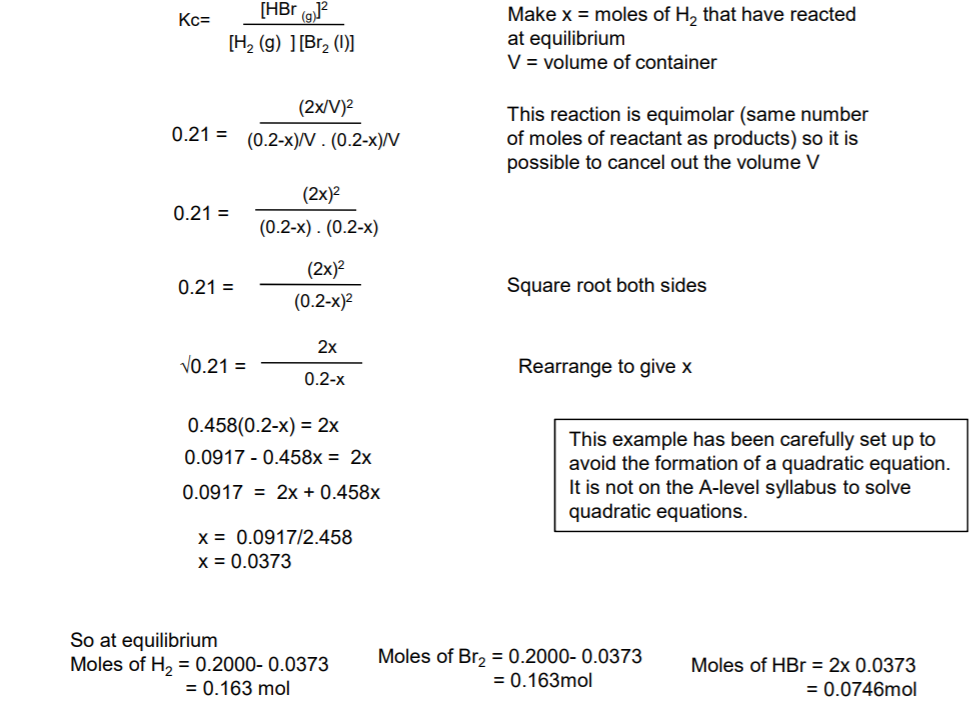
H2 (g) + Br2 (l) ——2HBr (g) 0.200 mol of H2 and 0.200 mol of Br2 are mixed and allowed to reach equilibrium. If Kc = 0.210 calculate the equilibrium amounts, in mol, of each substance.